
On this page
- Diagnosis summary
- Safety and classification scope
- Definition (Reference)
- Typical Presentation (Informative)
- Field Identification Cues (Normative)
- Classification Mapping (to VIS-DA) (Normative)
- Indicative Depth / Relief (Informative)
- Differentiation & False Positives (Informative)
- Evidence Package (Documentation Requirements) (Normative)
- Reporting Language (Template)
- Related glossary terms
- Related DSS
- Source and version
DAMAGE SPECIFICATION STANDARD / METHOD-AGNOSTIC
DSS-P.01.05 — Edge Kink / Localized Warp
Processing / Manufacturing feature - reference; generally not “damage”
Diagnosis summary
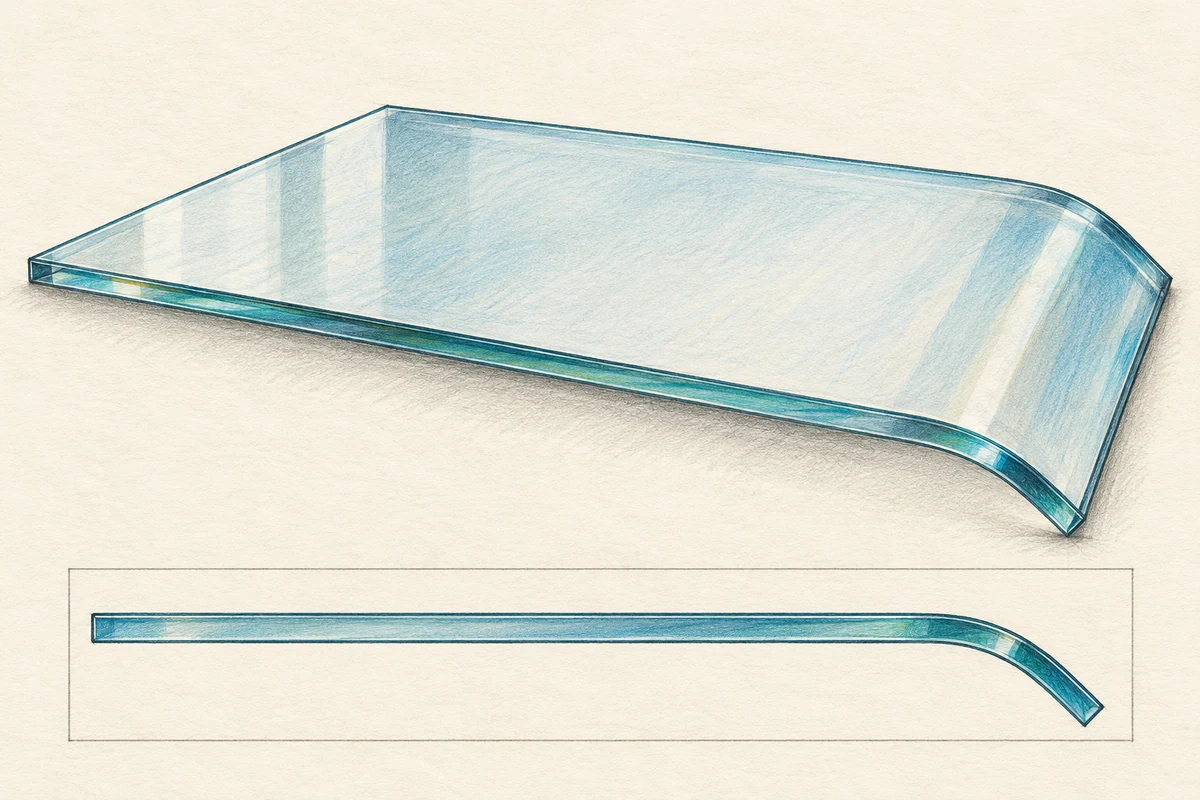
A localized departure from flatness concentrated near an edge or corner of a lite—commonly a small “kink” or short-wavelength warp attributable to manufacturing/handling processes (e.g., heat-treat cooling, conveyor/edge support, post-process handling). It alters straight-line reflections/transmission near the edge zone but does not present as a discrete surface-relief defect at the exposed surface.
Definition (Reference)
ReferenceA localized departure from flatness concentrated near an edge or corner of a lite-commonly a small “kink” or short-wavelength warp attributable to manufacturing/handling processes (e.g., heat-treat cooling, conveyor/edge support, post-process handling). It alters straight-line reflections/transmission near the edge zone but does not present as a discrete surface-relief defect at the exposed surface. VIS geometry is used to observe only; factory flatness/shape acceptance is governed by product standards/project specs, not by VIS post-restoration acceptance.
Typical Presentation (Informative)
Informative- Local edge zone where mullion/horizon reflections kink or bend over a short run; effect diminishes a few inches into the lite.
- No visible transition edge of a worked area; pattern is shape-related, not a ring or halo.
- Non-responsive to Non-Invasive Reveal; persists after clean/dry. Evaluate at VIS normal + oblique sweep and 12/36/72 in distances.
Field Identification Cues (Normative)
NormativeSurface-catch class (MSRT):
- SC-0 (none). Make one light, non-marring pass; no tactile interruption should be felt because this is shape, not local relief. Do not repeat/abrade.
Morphology:
- Localized flatness/shape deviation near edge; no chip flanks, pits, or modeled micro-texture. Classification remains observation-based; do not confuse with edge chipping (see M.03).
Viewing/lighting:
- Use VIS raking light and oblique sweep (~60°-120°) to read the optical bend; document at 12/36/72 in per VIS.
Classification Mapping (to VIS-DA) (Normative)
Normative- Not field damage. When SC-0 and morphology indicate a shape feature (no local relief), record “Processing Feature - Not Surface Damage (outside CAT-1...CAT-4)”.
- If apparent distortion is determined to be inside an IGU cavity or otherwise inaccessible, document fixed parallax and record CAT-5 (out of in-place scope by location/condition).
Indicative Depth / Relief (Informative)
InformativeN/A as a local surface-relief metric. Edge kink/localized warp is a shape/flatness issue; no micrometre relief is detected at the exposed surface via MSRT (SC-0).
Differentiation & False Positives (Informative)
Informative- vs. Bow/Warp (P.01.02): Bow/warp is global curvature across the pane; edge kink is localized near the perimeter. Both are SC-0 and non-relief.
- vs. Roller Wave (P.01.01): Roller wave is periodic and often extends across the lite; edge kink is a short, non-periodic local bend. Both are factory shape features.
- vs. Edge micro-chipping / clamshell (M.03): Edge damage shows fracture morphology and, when accessible, may show clear catch; edge kink shows no catch and no fracture cues.
- vs. Frame/setting block distortion: Bent mullions or improper setting can mimic edge warp. Compare across adjacent lites and capture reference straight-edge in photos at VIS geometry.
Evidence Package (Documentation Requirements) (Normative)
Normative- Photo set (VIS): 12 / 36 / 72 in, normal + oblique; include a straight reference (string line/mullion/edge rule) skimming the affected perimeter to show local bend; note raking used Y/N.
- MSRT: Record SC-0 (none); one pass only; non-marring.
- Forms: Pane ID; surface numbering (#1-#4; laminate-internal), product family, coating on worked surface? (Y/N/Unknown), reveal status, lighting notes/time.
- Acceptance split: VIS governs post-restoration acceptance; factory tolerance/product specs govern flatness/shape at manufacture. Do not conflate.
Reporting Language (Template)
Template- P.01.05 Edge Kink / Localized Warp (Processing Feature) - Local perimeter flatness deviation observed at VIS geometry; MSRT = SC-0 (no surface relief). No transition edge or fracture morphology. Recorded as manufacturing/shape feature; not categorized as surface damage under VIS-DA. If fixed parallax confirms cavity location, record CAT-5 and refer per project protocol
Related glossary terms
- Setting blockGRK-208
- Raking lightGRK-129
- Edge damageGRK-031
Source and version
GlassRenu Damage Specification Sheets (DSS), DSS-P.01.05. Source revision and extraction date are recorded in the deployment manifest.
Open the complete published DSS with table of contents (PDF)
Normative and informative labels are preserved from the source. The downloadable one-sheet is a condensed classification aid; this web page retains the complete source-based specification content.