
On this page
- Diagnosis summary
- Safety and classification scope
- Classification & Scope (Normative)
- Typical Presentation (Informative)
- Field Identification Cues (Normative)
- Surface-catch class (MSRT)
- Visual signature
- Viewing / lighting
- Location / access
- Mechanism cue (context)
- Severity & CAT Mapping (Normative)
- Differentiation & Mis-ID Pitfalls (Informative)
- Evidence Package *(Documentation Requirements) (Normative)
- Reporting Language (Template)
- Related glossary terms
- Related DSS
- Source and version
DAMAGE SPECIFICATION STANDARD / METHOD-AGNOSTIC
DSS-R.03.01 — Suction Cup Rings (residue / pressure mark)
Residue/film / pressure artifact - lifting cup contact; circular/oval rings, center pucks, tri-lobe clusters; typically SC-0, SC-1 if aged film or slight micro-texture
Diagnosis summary
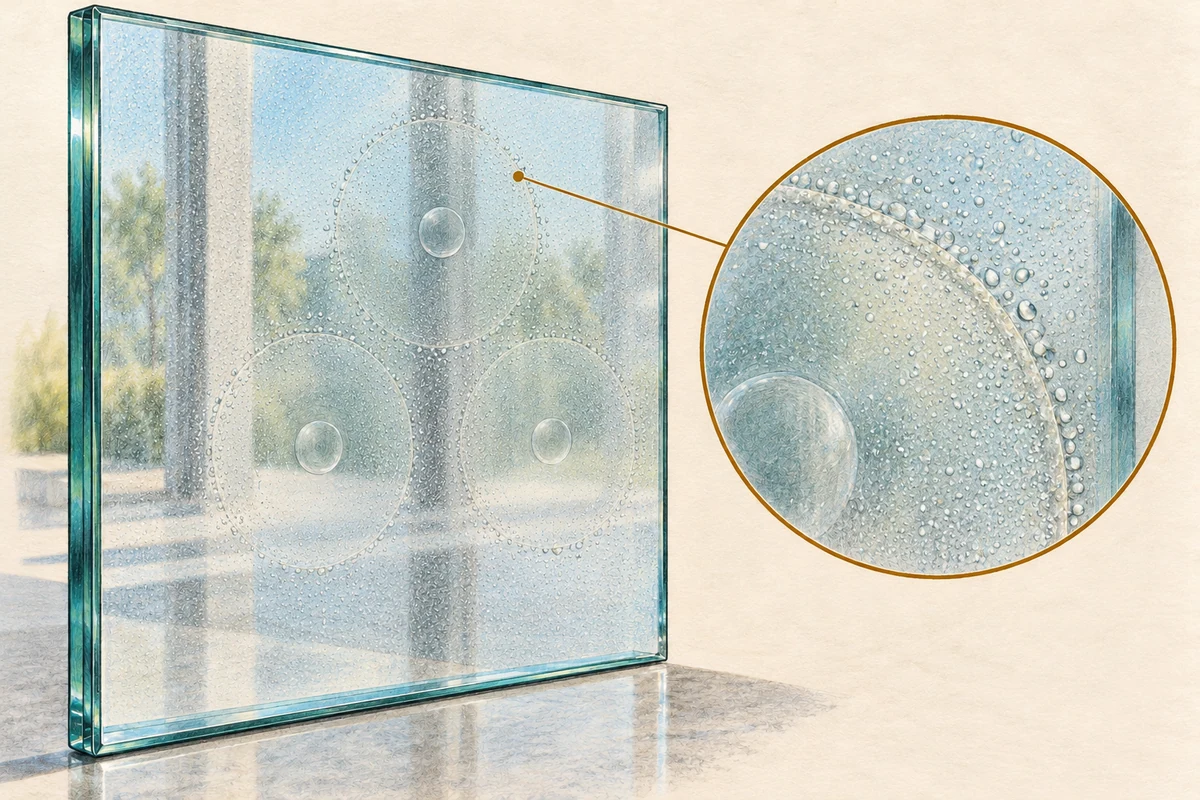
Suction cup rings are appearance changes on glass caused by vacuum lifter cups or manual suction tools during fabrication, transport, or install. They present as circular/oval rings, center pucks, or tri-/quad-lobe clusters reflecting multi-pad frames. Artifacts include transfer films (plasticizer, rubber, dust-print), pressure marks, or moisture halos; heavy dwell/heat can leave persistent veils.
Classification & Scope (Normative)
NormativeSuction cup rings are appearance changes on glass caused by vacuum lifter cups or manual suction tools during fabrication, transport, or install. They present as circular/oval rings, center pucks, or tri-/quad-lobe clusters reflecting multi-pad frames. Artifacts include transfer films (plasticizer, rubber, dust-print), pressure marks, or moisture halos; heavy dwell/heat can leave persistent veils. Classification is appearance-only per VIS (method-agnostic). Inspect after Non-Invasive Reveal under VIS lighting/geometry; record surface numbering and worked-surface status.
Typical Presentation (Informative)
Informative- Concentric ring (outer lip + inner puck), diameter commonly 80-400 mm depending on cup size; sometimes three-cup triangular or four-cup rectangular arrays.
- Soft, circular veil with darker edge ring (soil capture) and finger-like wipe arcs from hurried cleanups.
- Water-behavior contrast (beading) where hydrophobic mold-release or rubber plasticizer transferred.
Field Identification Cues (Normative)
NormativeSurface-catch class (MSRT)
- Typically SC-0 (film/pressure-only).
- SC-1 may appear where aged plasticizer or heat dwell induced slight micro-texture or converted film; SC-2 is uncommon-recheck classification if present.
- Perform one light, non-marring pass on a small revealed test patch (substrate), not over gummy islands. Polymer stylus if a functional coating is suspected. MSRT supports classification only.
Visual signature
- Perfect or near-perfect circles/ovals matching cup geometry; sometimes radial striations or vacuum port prints.
- Arrays align to spreader bar patterns (triangles/rectangles).
- No chip-flank sparkle (not mechanical scoring); no discrete fused pits (not hot-particle).
Viewing / lighting
- Evaluate clean & dry at 12 / 36 / 72 in, normal and oblique sweep (~60°-120°); raking reveals ring/lip edges, center puck, and wipe overlaps. Record distances/angles in-frame.
Location / access
- Record pane ID and surface numbering (#1-#4; laminate-internal). If fixed parallax shows the print within the IGU cavity (#2/#3), classify CAT-5 by location and refer.
Mechanism cue (context)
- Nearby glazing activities, spreader bars, vacuum lifter on site, crate marks, glass rack photos, or install sequencing.
Severity & CAT Mapping (Normative)
NormativeAssign CAT by visibility at acceptance geometry and MSRT after a controlled reveal on a small area. Depth values are indicative-field measurement not required.
- CAT-1 (Benign / non-relief): Thin ring/veil; SC-0 after reveal; primarily angle/raking visible. Indicative relief: 0-10 μm (optical).
- CAT-2 (Light): Persistent circular veil with wetting contrast or slight SC-1 (aged plasticizer/heat dwell); limited standard-view impact. Indicative relief: ~10-40 μm.
- CAT-3 (Moderate): Multiple rings/arrays legible at standard distance (visual clutter), with patchy SC-1 in ring lips; suggests extensive handling exposure. Indicative relief: ~40-120 μm.
- Reclassify when: After true residue lift, any modeled micro-texture or SC>0 persists on substrate → consider Ch.06.02 hydrophobic coating mismatch halo or Ch.04.03 alkaline/degreaser burn if strong cleaners were used.
- CAT-5 (by condition/location): Between-pane by parallax, integrity issues, or coated-face loss on the surface to be worked → CAT-5.
CAT is appearance-based; acceptance is separate under VIS-A at 12/36/72 in. Do not abrade to “force” removal during classification.
Differentiation & Mis-ID Pitfalls (Informative)
Informative- vs. Adhesive label/sticker ghost (R.01.05): Labels are smaller with die-cut corners; cup rings are larger round/oval with lip + puck geometry or multi-pad arrays.
- vs. Hydrophobic mismatch halo (Ch.06.02): Mismatch edges are irregular and field-wide; cup rings are precise circles matching pad size.
- vs. Silicone smear (R.01.01): Silicone tracks joints and shows corduroy; cup rings are isolated circles with wetting contrast.
- vs. Mineral rings (Ch.03.02): Mineral rings follow evaporation puddles and show concentric mineral deposits; cup rings have uniform interior with lip impression.
- vs. Paint overspray (R.02.01): Overspray is a speckled field without circular boundaries.
Evidence Package *(Documentation Requirements) (Normative)
Normative- Photo set (VIS): 12 / 36 / 72 in, normal + oblique; raking macros of ring lip, puck, wipe overlaps; context frames showing vacuum equipment or handling setup. Record distance/angle in-frame.
- MSRT result (substrate): After a small reveal test patch, perform one light, non-marring pass; record SC-class (SC-0/SC-1/SC-2).
- Forms: Pane ID; product family & surface numbering; worked surface Y/N; functional coating present on worked surface? (Y/N/Unknown); reveal status; lighting/time; geometry checklist; photos attached.
- Acceptance split: Post-restoration acceptance per VIS-A §6; classification ≠ acceptance. Coated-face appearance rules apply per VIS §6.2.e when the worked surface is a factory functional coating.
Reporting Language (Template)
Template- R.03.01 Suction Cup Rings - Circular/oval ring + center puck on surface #___; post-reveal test patch shows [SC-0/SC-1]; visible at [12/36/72 in] under VIS geometry. Morphology: cup-size circle(s), array pattern, wetting contrast; no chip-flank sparkle, no discrete pits. Classification: CAT-[1/2/3] by visibility and SC-class; CAT-5 if between-pane or coating-side loss on the surface to be worked. Forms + photo set attached; acceptance per VIS-A §6.
Related glossary terms
- Paint oversprayGRK-063
- Test patchGRK-144
- DepositGRK-045
Source and version
GlassRenu Damage Specification Sheets (DSS), DSS-R.03.01. Source revision and extraction date are recorded in the deployment manifest.
Open the complete published DSS with table of contents (PDF)
Normative and informative labels are preserved from the source. The downloadable one-sheet is a condensed classification aid; this web page retains the complete source-based specification content.