
On this page
- Diagnosis summary
- Safety and classification scope
- Classification & Scope (Normative)
- Typical Presentation (Informative)
- Field Identification Cues (Normative)
- Surface-catch class (MSRT)
- Visual signature
- Viewing / lighting
- Location / access
- Mechanism cue (context)
- Severity & CAT Mapping (Normative)
- Differentiation & Mis-ID Pitfalls (Informative)
- Evidence Package *(Documentation Requirements) (Normative)
- Reporting Language (Template)
- Related glossary terms
- Related DSS
- Source and version
DAMAGE SPECIFICATION STANDARD / METHOD-AGNOSTIC
DSS-R.05.03 — Neoprene Roller Transfer
Residue/transfer - conveyor/guide rollers, staging cradles; dotty/patchy nodes at roller pitch, smudged linear bands; typically SC-0, localized SC-1 where abrasive dust was present
Diagnosis summary
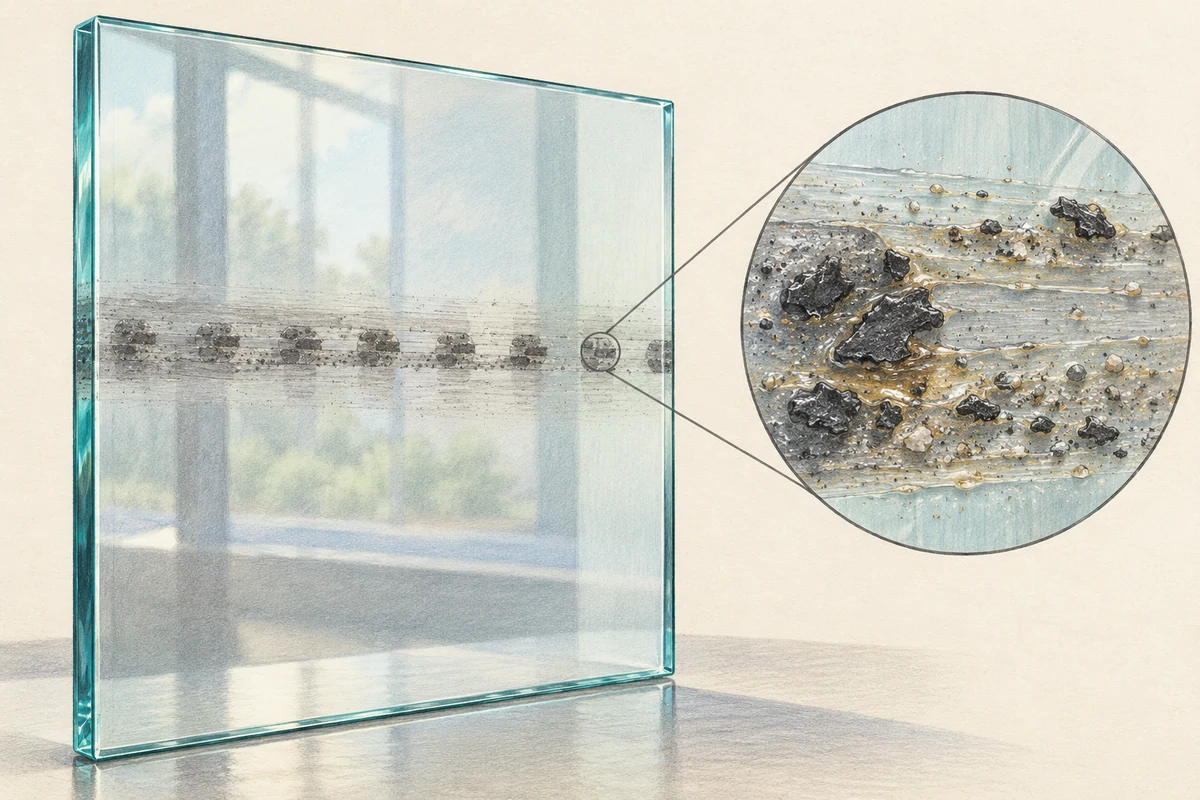
Neoprene roller transfer is an appearance change on glass caused by contact with neoprene-coated rollers or cradle pads during factory conveying, glass washing, staging, or transport. It presents as dotty or patchy contact nodes repeating at roller pitch, sometimes superimposed on smudged linear bands at consistent elevations. Deposits may include neoprene wear fines, plasticizers, and entrained shop dust.
Classification & Scope (Normative)
NormativeNeoprene roller transfer is an appearance change on glass caused by contact with neoprene-coated rollers or cradle pads during factory conveying, glass washing, staging, or transport. It presents as dotty or patchy contact nodes repeating at roller pitch, sometimes superimposed on smudged linear bands at consistent elevations. Deposits may include neoprene wear fines, plasticizers, and entrained shop dust. Classification is appearance-only per VIS (method-agnostic). Inspect after Non-Invasive Reveal under VIS lighting/geometry; record surface numbering and worked-surface status.
Typical Presentation (Informative)
Informative- Repeating “tick” or “node” marks at constant spacing (roller pitch), often along a single horizontal lane.
- Patchy, pebble-like dots (1-5 mm) where roller crowns or dirty sectors contacted the lite; may include a faint linear guide band.
- Multiple lites from the same run show identical elevation/pitch patterns.
Field Identification Cues (Normative)
NormativeSurface-catch class (MSRT)
- Typically SC-0 (soft transfer on surface).
- SC-1 may present where dust-laden contact or micro-vibration created very shallow micro-texture within the transfer lane; SC-2 suggests misclassification-reassess for M.01 conveyor/belt line scoring.
- Perform one light, non-marring pass on a small revealed test patch (substrate), not across gummy nodes. Use a polymer stylus if a functional coating is suspected. MSRT supports classification only.
Visual signature
- Evenly spaced node marks mirroring roller circumference; may show phase shift across adjacent panes if conveyed at different timings.
- Smudged band at the same height as storage cradle rails; no chip-flank sparkle (not incision); no fused pits (not hot particle).
Viewing / lighting
- Evaluate clean & dry at 12 / 36 / 72 in, normal incidence and oblique sweep (~60°-120°); raking macros to resolve node texture, pitch spacing, and band edges. Record distances/angles in-frame.
Location / access
- Record pane ID and surface numbering (#1-#4; laminate-internal). If fixed parallax places the pattern on #2/#3 (IGU cavity), classify CAT-5 by location and refer.
Mechanism cue (context)
- Factory conveyor line, glass washer exit, neoprene cradles, A-frame liners, or handling rollers visible in production/receiving documentation; patterns repeat across same batch.
Severity & CAT Mapping (Normative)
NormativeAssign CAT by visibility at acceptance geometry and MSRT after a controlled reveal. Depth values are indicative-field measurement not required.
- CAT-1 (Benign / non-relief): Faint node lane or light band; SC-0; mainly angle/raking visible. Indicative relief: 0-10 μm (optical film).
- CAT-2 (Light): Persistent node lane with localized SC-1 (dust-assisted micro-texture); limited standard-view impact. Indicative relief: ~10-40 μm.
- CAT-3 (Moderate): High-contrast, wide lane/band legible at standard distance; scattered SC-1 in nodes; multiple lanes or wide coverage. Indicative relief: ~40-120 μm.
- Reclassify when: After true residue lift, linear incisions with chip-flank sparkle or SC-2 persist → evaluate under M.01.04 Conveyor/belt line scoring or M.01 (linear scoring).
- CAT-5 (by condition/location): Between-pane/inaccessible by parallax, integrity indicators, or confirmed functional-coating loss on the surface to be worked → CAT-5.
CAT is appearance-based; acceptance is separate under VIS-A at 12/36/72 in. Do not abrade to “force” removal during classification.
Differentiation & Mis-ID Pitfalls (Informative)
Informative- vs. Roller / handling rail transfer (R.03.03): R.03.03 shows broad level bands without distinct node pitch; neoprene roller shows distinct repeating nodes at constant spacing.
- vs. Suction cup rings (R.03.01): Cup prints are large circles/ovals with lip+puck; neoprene nodes are small, evenly spaced ticks along a lane.
- vs. Paint overspray (R.02.01): Overspray is random speckle lacking constant pitch; neoprene nodes are periodic and align in tracks.
- vs. PVC plasticizer smear (R.05.02): PVC films are oily amber with wetting anomalies; neoprene nodes are grey/dark dots at roller periodicity.
- vs. Conveyor scoring (M.01.04): Scoring has sharp incised lines, chip-flank sparkle, and SC-2; neoprene is film/transfer with SC-0/SC-1.
Evidence Package *(Documentation Requirements) (Normative)
Normative- Photo set (VIS): 12 / 36 / 72 in, normal + oblique; raking macros of node pitch, lane edges, band texture; context frames showing consistent elevation across panes and any conveyors/cradles. Record distance/angle in-frame.
- MSRT result (substrate): After a small reveal test patch, perform one light, non-marring pass; record SC-class (SC-0/SC-1/SC-2).
- Forms: Pane ID; product family & surface numbering; worked surface Y/N; functional coating present on worked surface? (Y/N/Unknown); reveal status; lighting/time; geometry checklist; photos attached.
- Acceptance split: Post-restoration acceptance per VIS-A §6; classification ≠ acceptance. Coated-face appearance rules apply per VIS §6.2.e when the worked surface is a factory functional coating.
Reporting Language (Template)
Template- R.05.03 Neoprene Roller Transfer - Repeating node lane at roller pitch with smudged band on surface #___; post-reveal test patch shows [SC-0/SC-1]; visible at [12/36/72 in] under VIS geometry. Morphology: periodic ticks, constant elevation, no chip-flank sparkle, no pits. Classification: CAT-[1/2/3] by visibility and SC-class; reclassify to M.01.04 if incised lines persist; CAT-5 if between-pane or coating-side loss on the surface to be worked. Forms + photo set attached; acceptance per VIS-A §6.
Related glossary terms
- DepositGRK-045
- Paint oversprayGRK-063
- Test patchGRK-144
Source and version
GlassRenu Damage Specification Sheets (DSS), DSS-R.05.03. Source revision and extraction date are recorded in the deployment manifest.
Open the complete published DSS with table of contents (PDF)
Normative and informative labels are preserved from the source. The downloadable one-sheet is a condensed classification aid; this web page retains the complete source-based specification content.