
On this page
- Diagnosis summary
- Safety and classification scope
- Classification & Scope (Normative)
- Typical Presentation (Informative)
- Field Identification Cues (Normative)
- Visual signature
- Viewing / lighting
- Location / access
- Severity & CAT Mapping (Normative)
- Differentiation & Mis-ID Pitfalls (Informative)
- Evidence Package (Documentation Requirements) (Normative)
- Reporting Language (Template)
- Related glossary terms
- Related DSS
- Source and version
DAMAGE SPECIFICATION STANDARD / METHOD-AGNOSTIC
DSS-Th.03.02 — Spontaneous Tempered Break (NiS-related; documentation)
Thermal stress / material inclusion - post-fracture condition; out of in-place scope
Diagnosis summary
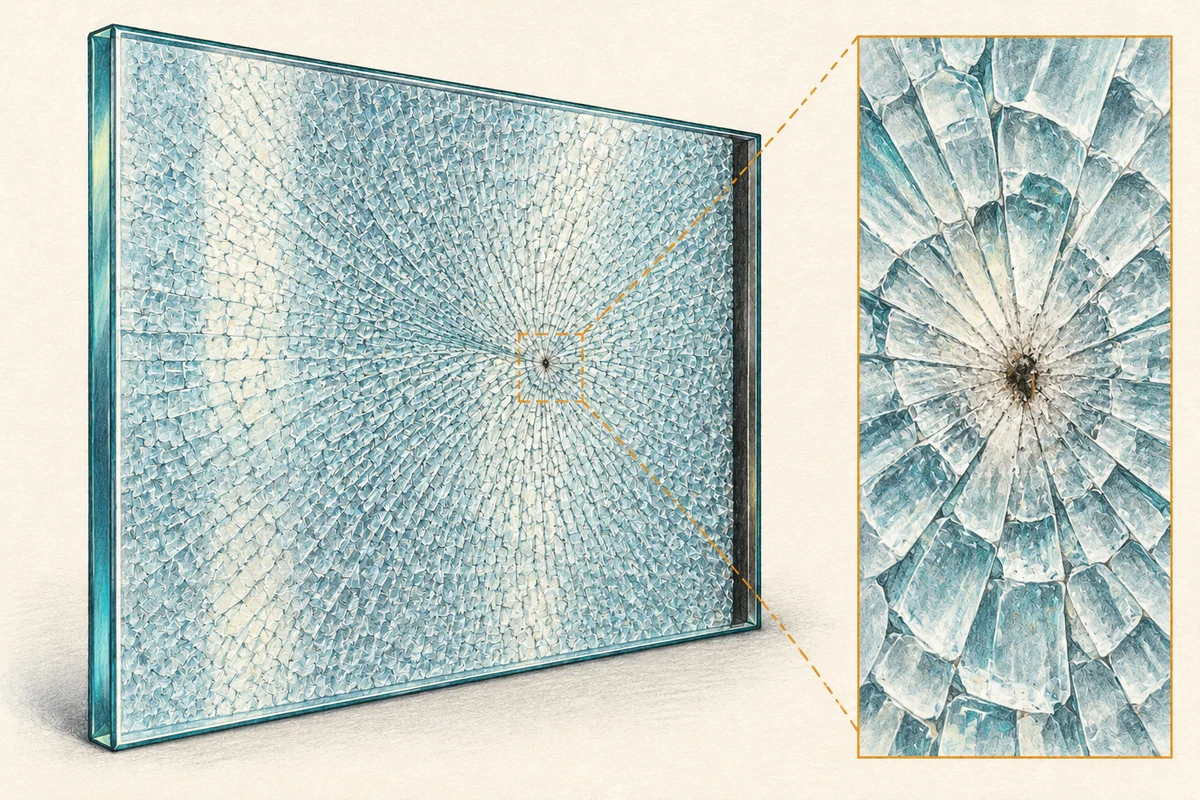
A spontaneous tempered break is a sudden fracture of fully tempered glass with no evident external impact, commonly associated with nickel sulfide (NiS) inclusions or residual/internal stresses. Result is the characteristic fine “dice” fragmentation. Any fractured lite is an integrity condition and is out of in-place restoration scope (CAT-5 by condition/location).
Classification & Scope (Normative)
NormativeA spontaneous tempered break is a sudden fracture of fully tempered glass with no evident external impact, commonly associated with nickel sulfide (NiS) inclusions or residual/internal stresses. Result is the characteristic fine “dice” fragmentation. Any fractured lite is an integrity condition and is out of in-place restoration scope (CAT-5 by condition/location). This DSS defines identification and documentation only; it does not prescribe repair. Inspect from a safe position under VIS lighting/geometry; record surface numbering and worked-surface status on Forms:
Typical Presentation (Informative)
Informative- Pane presents a uniform mosaic of small interlocking fragments (“dice”), often retained by gaskets/pressure plates or an interlayer (if laminated tempered).
- May show a rosette/dense crack nucleus near the suspected inclusion site; sometimes accompanied by a “ticking” sound as stresses equilibrate.
- No clear external impact nucleus (no bullseye/chip), and often no directional hot-particle peppering nearby.
- In IGUs, fragmentation occurs on one ply; the mate ply remains intact.
Field Identification Cues (Normative)
NormativeSafety / MSRT.
- Treat as unstable; do not perform MSRT. Secure area per site protocol before close documentation.
Visual signature
- Fine, uniform dice pattern across the pane (distinct from heat-strengthened fracture, which shows larger islands/longer ligaments).
- Absence of impact nucleus or mechanical contact evidence.
- If laminated tempered, offset dice patterns ply-to-ply with interlayer retention.
Viewing / lighting
- Document at 36 in and 72 in (12 in macros only if safe), normal incidence for overall state and oblique sweep (~60°-120°) to emphasize mosaic density and any suspected origin.
- For IGUs, use parallax/reflection to identify which ply (#1/#2 or #3/#4) has fragmented.
Location / access
- Record pane ID and surface numbering (#1-#4; laminate-internal). Note product family (tempered / laminated tempered / IGU).
Severity & CAT Mapping (Normative)
Normative- CAT-5 (default): Any fractured tempered lite → Non-Repairable / Out of In-Place Scope. Document and refer per project protocol (replacement; manufacturer/engineer review).
- Reassign only if unbroken: If re-inspection shows no fragmentation (e.g., only a crack system), classify under M.07.02 (through-thickness crack) or M.04.02 (impact star) as appropriate-still integrity (CAT-5).
CAT is governed by integrity/location; acceptance is evaluated separately under VIS-A §6.
Differentiation & Mis-ID Pitfalls (Informative)
Informative- vs. Impact star/bullseye (M.04.02): Impact presents a central nucleus with radial/annular arms; spontaneous break lacks a clear impact origin.
- vs. Heat-strengthened fracture: Heat-strengthened glass forms larger, irregular fragments and longer crack ligaments-dice size is a key discriminator.
- vs. Patterned/etched glass: Decorative patterns lack polygonal, fractured boundaries and loose granules; raking light and gentle observation (no touch) confirm.
- IGU confusion: Ensure you’ve identified which ply has fragmented via parallax; cavity debris/fogging (A.01 family) should be recorded separately.
Evidence Package (Documentation Requirements) (Normative)
Normative- Safety & stabilization. Confirm barricades/support before close approach; avoid loading the fractured lite.
- Photo set (VIS):
- Overall: 72 in and 36 in, normal incidence, full pane + framing.
- Oblique: at least one oblique sweep showing mosaic density and any suspected origin (rosette, edge zone).
- Detail (if safe): macro of representative fragmentation field; macro of suspected origin area.
- IGU/laminate: parallax/reflection shot establishing which ply is fragmented.
- Record distance/angle in-frame.
- Forms: Pane ID; product family; surface numbering; worked surface Y/N (generally N); reveal status (N/A); lighting/time; geometry checklist; photos attached.
- Optional fragment survey (off-lite only). If a removed specimen is available and safe to handle, a representative fragment size survey may be recorded for reference; do not attempt on an installed lite.
- Disposition. Record CAT-5 and notify responsible party per protocol (replacement, temporary shoring, manufacturer/engineer review). Mechanism note “suspected NiS-related spontaneous break” may be included (informative).
Reporting Language (Template)
Template- Th.03.02 Spontaneous Tempered Break (NiS-related; documentation) - Pane exhibits full “dice” fragmentation on surface #___ / ply [outboard/inboard] under VIS geometry (normal + oblique). No impact nucleus observed. Integrity condition; MSRT not applicable. Classification: CAT-5 (out of in-place scope). Photo set and forms attached; area secured per site protocol; acceptance per VIS-A §6 (separate).
Related glossary terms
- Fully tempered glassGRK-007
- Heat-strengthened glassGRK-006
- Raking lightGRK-129
Source and version
GlassRenu Damage Specification Sheets (DSS), DSS-Th.03.02. Source revision and extraction date are recorded in the deployment manifest.
Open the complete published DSS with table of contents (PDF)
Normative and informative labels are preserved from the source. The downloadable one-sheet is a condensed classification aid; this web page retains the complete source-based specification content.