
On this page
- Diagnosis summary
- Safety and classification scope
- Classification & Scope (Normative)
- Typical Presentation (Informative)
- Field Identification Cues (Normative)
- Surface-catch class (MSRT)
- Visual signature
- Viewing / lighting
- Location / access
- Severity & CAT Mapping (Normative)
- Differentiation & Mis-ID Pitfalls (Informative)
- Evidence Package (Documentation Requirements) (Normative)
- Reporting Language (Template)
- Related glossary terms
- Related DSS
- Source and version
DAMAGE SPECIFICATION STANDARD / METHOD-AGNOSTIC
DSS-M.07.02 — Through-Thickness Crack Propagation
Mechanical - fissure extending through the lite; integrity cue
Diagnosis summary
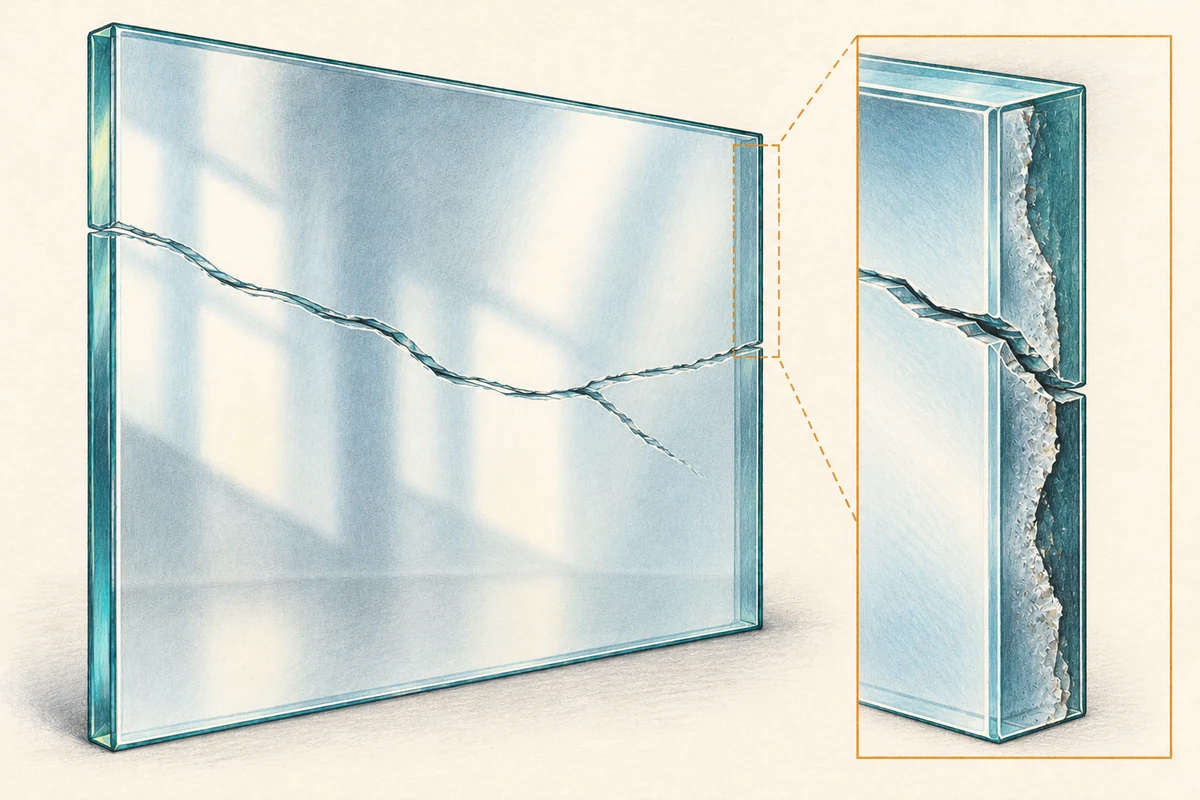
A through-thickness crack is a continuous fissure that extends through the glass thickness (or is actively propagating toward full depth) and may branch, curve, or run under residual/operational stress. Any confirmed crack is an integrity indicator and is out of in-place restoration scope under VIS (CAT-5 by condition/location). Classification here is appearance-only; methodology is out of scope.
Classification & Scope (Normative)
NormativeA through-thickness crack is a continuous fissure that extends through the glass thickness (or is actively propagating toward full depth) and may branch, curve, or run under residual/operational stress. Any confirmed crack is an integrity indicator and is out of in-place restoration scope under VIS (CAT-5 by condition/location). Classification here is appearance-only; methodology is out of scope. Inspect under VIS lighting/geometry after Non-Invasive Reveal; record surface numbering and worked-surface status on Forms:
Typical Presentation (Informative)
Informative- Filament-thin, continuous line that remains visible under small viewpoint shifts; may mirror on opposite surface reflections due to depth.
- Can display branching (hackle), kinks, or arrest marks; may originate at edge/corner, hole/notch root, impact origin, or thermal hot spot.
- Frequently apparent at standard view; oblique/raking views clarify the origin and continuity.
Field Identification Cues (Normative)
NormativeSurface-catch class (MSRT)
- Do not pass a stylus across any suspected crack. If needed, one light, non-marring pass adjacent to the feature may document nearby surface relief (for context only). MSRT is auxiliary and never determinative for integrity.
Visual signature
- Unbroken, phase-stable line that can cross faint residues or micro-texture without interruption; may show tip sharpening in the propagation direction.
- Under raking light, crack edges do not exhibit consistent abrasive chip-flank sparkle typical of scratches; instead, they read as a dark/bright contrast that remains with small viewpoint changes.
Viewing / lighting
- Evaluate clean & dry at 12 / 36 / 72 in, using normal incidence and oblique sweep (~60°-120°) with raking light. Capture both specular and, where possible, transmitted-light views to confirm depth.
Location / access
- Record pane ID and surface numbering (#1-#4; laminate-internal). If fixed parallax indicates a between-pane or laminate-internal crack, it remains CAT-5 by location and must be referred (out of in-place scope).
Severity & CAT Mapping (Normative)
NormativeAssign category by appearance + integrity:
- CAT-5 (default): Any confirmed through-thickness (or actively propagating) crack → Non-Repairable / Out of In-Place Scope. Document length, origin (edge/corner/hole/impact/thermal), and proximity to supports/hardware; refer per project protocol (e.g., replacement/manufacturer service).
- Reassign only if no crack is present:
- If the cue is an abrasive line (continuous score) with MSRT catch and chip-flank sparkle → classify under M.01 Linear scoring.
- If the cue is edge/penetration chipping without a continuous fissure → classify under M.03.01-M.03.04 or M.06.01 as appropriate.
CAT is governed by integrity/location for cracks; acceptance is evaluated separately under VIS §6.
Differentiation & Mis-ID Pitfalls (Informative)
Informative- vs. Linear scratch/score: Scratches show abrasive edges and clear MSRT catch; cracks remain phase-stable, can cross faint films without losing continuity, and must not be stylus-tested.
- vs. Thermal stress crack (Th.03.01): Thermal origins often align with localized heating or solar hot-spot geometry; mechanism note may be added, but classification remains crack = CAT-5.
- vs. Star break (M.04.02): Star/bullseye networks are impact-origin crack systems; default CAT-5 by integrity.
- vs. Laminate-internal feature / IGU cavity artifact: Use parallax and reflection tracking; internal = CAT-5 by location even if not structurally active on the exposed face.
Evidence Package (Documentation Requirements) (Normative)
Normative- Photo set (VIS): 12 / 36 / 72 in, normal + oblique, include raking macros that show continuous fissure and origin (edge, corner, hole/notch, impact). Add a context frame showing distance to edges/corners/hardware. Record distance/angle in-frame.
- MSRT note. If recorded, note adjacent SC-class only (do not cross the fissure); one light, non-marring pass; polymer stylus if a coating is suspected.
- Forms: Pane ID; surface numbering (#1-#4; laminate-internal); worked surface Y/N; functional coating on worked surface? (Y/N/Unknown); reveal status; lighting/time; geometry checklist; photos attached.
- Disposition. Mark CAT-5 for any confirmed crack. Note apparent stability (active tip vs. blunted), estimated length, origin, and nearest support/hardware. Refer per project protocol.
Reporting Language (Template)
Template- M.07.02 Through-Thickness Crack Propagation - Continuous fissure observed on surface #___ under VIS geometry (oblique + raking), originating at [edge/corner/hole/notch/impact/thermal]. MSRT not performed across fissure; adjacent reading SC-[ ] noted for context. Classification: CAT-5 (integrity/location). Surface numbering recorded; parallax checked. Photo set + forms attached; acceptance per VIS §6 (separate).
Related glossary terms
- CrackGRK-033
- Thermal stressGRK-024
- Raking lightGRK-129
- AbrasiveGRK-168
- ScratchGRK-032
Source and version
GlassRenu Damage Specification Sheets (DSS), DSS-M.07.02. Source revision and extraction date are recorded in the deployment manifest.
Open the complete published DSS with table of contents (PDF)
Normative and informative labels are preserved from the source. The downloadable one-sheet is a condensed classification aid; this web page retains the complete source-based specification content.