
On this page
- Diagnosis summary
- Safety and classification scope
- Classification & Scope (Normative)
- Typical Presentation (Informative)
- Field Identification Cues (Normative)
- Surface-catch class (MSRT)
- Visual signature
- Viewing / lighting
- Location / access
- Mechanism cue (context)
- Severity & CAT Mapping (Normative)
- Differentiation & Mis-ID Pitfalls (Informative)
- Evidence Package *(Documentation Requirements) (Normative)
- Reporting Language (Template)
- Related glossary terms
- Related DSS
- Source and version
DAMAGE SPECIFICATION STANDARD / METHOD-AGNOSTIC
DSS-V.01.01 — Sandblast / Abrasive-Blast Etch (Uniform Frosted Field)
Intentional surface modification - abrasive impact removal of surface glass; uniformly matte/frosted fields with boundary masks; typically SC-2 across worked areas; depth depends on media, pressure, dwell, and mask design
Diagnosis summary
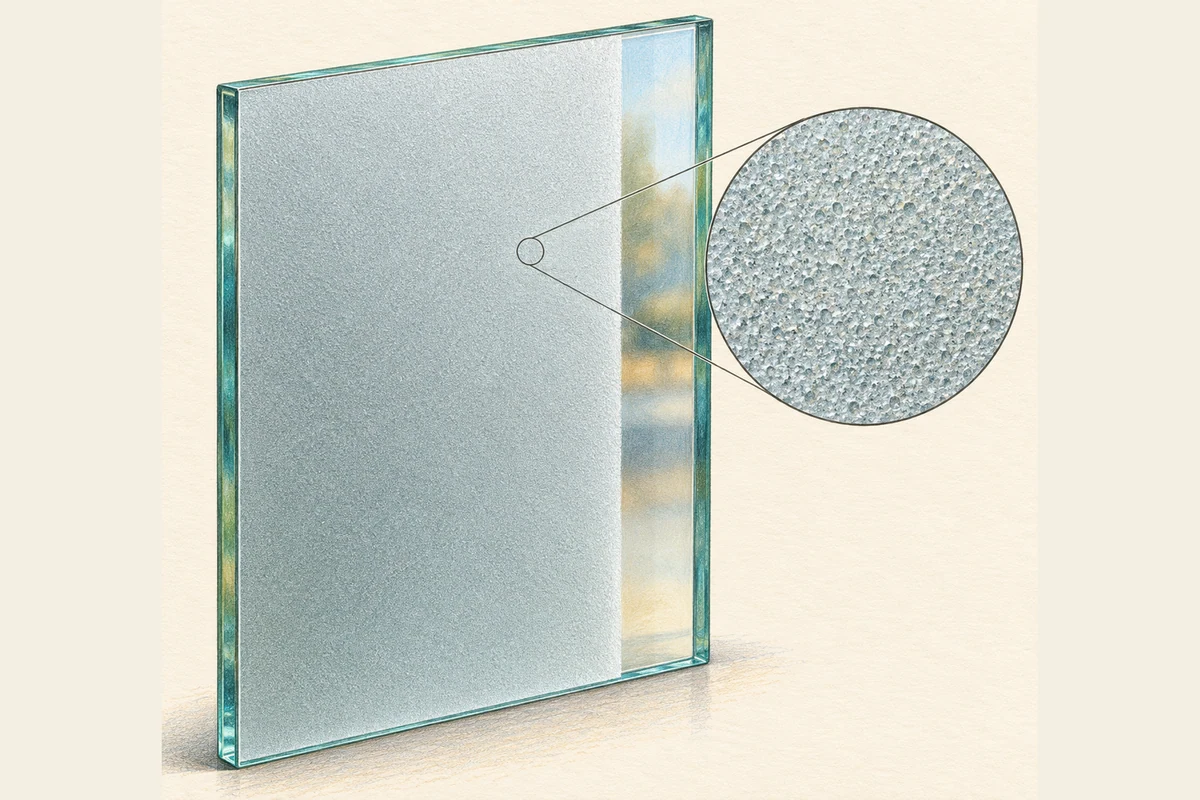
Sandblast / abrasive-blast etch is an appearance change on glass produced by propelled abrasive media (e.g., silica, aluminum oxide, garnet, glass bead, soda) that erodes the surface to create uniform or patterned matte/frosted fields. Presentations include full-field frosting, masked graphics, and stencil lettering. Classification is appearance-only per VIS (method-agnostic).
Classification & Scope (Normative)
NormativeSandblast / abrasive-blast etch is an appearance change on glass produced by propelled abrasive media (e.g., silica, aluminum oxide, garnet, glass bead, soda) that erodes the surface to create uniform or patterned matte/frosted fields. Presentations include full-field frosting, masked graphics, and stencil lettering. Classification is appearance-only per VIS (method-agnostic). Inspect after Non-Invasive Reveal under VIS lighting/geometry; record surface numbering and worked-surface status.
Typical Presentation (Informative)
Informative- Uniform matte/frosted fields with sharp boundaries at mask edges (letters, logos, bands).
- Texture is non-directional within the blasted area; contrast strongest at oblique/raking views and in reflection.
- May include overspray haze (faint halo) beyond the intended mask from stray media.
Field Identification Cues (Normative)
NormativeSurface-catch class (MSRT)
- SC-2 typical across blasted fields (distinct interruption, granular feel).
- SC-1 at light/feathered work or overspray halos; SC-0 outside the worked area.
- Perform one light, non-marring pass on a small revealed test patch (substrate). Use a polymer stylus if a functional coating is suspected. MSRT supports classification only.
Visual signature
- Uniform, non-directional frost within the field; abrupt transition edge at mask boundary (often visible as a clean line/ridge under raking).
- No chip-flank sparkle (not linear scoring); no fused nodules (not hot particle).
- Stipple/peen character may vary with media size-coarser media yields coarser frost.
Viewing / lighting
- Evaluate clean & dry at 12 / 36 / 72 in, normal incidence and oblique sweep (~60°-120°); employ low-angle raking to show field uniformity and mask edges. Record distances/angles in-frame.
Location / access
- Record pane ID and surface numbering (#1-#4; laminate-internal). Typically on exposed/accessible faces (#1 or #4). Between-pane by parallax on #2/#3 (e.g., pre-assembled interior face blasting in error) → CAT-5 by location.
Mechanism cue (context)
- Evidence of stencil/mask residue lines, uniform grain across large areas, or documented decorative intent. Overspray often seen as faint halo beyond graphics.
Severity & CAT Mapping (Normative)
NormativeAssign CAT by visibility at acceptance geometry and MSRT after a reveal patch. Depth values are indicative-field measurement not required.
- CAT-2 (Light): Feathered/overspray halo only; SC-1 within halo; limited standard-view impact outside raking. Indicative relief: ~10-40 μm.
- CAT-3 (Moderate): Defined decorative/graphic blast with clear matte field legible at standard distance; SC-2 prevalent within field. Indicative relief: ~40-150 μm.
- CAT-4 (Severe): Full-field or deep decorative blast producing high-contrast frosting visible at standard and wide-field views; SC-2 throughout, occasionally with micro-pitting from coarse media. Indicative relief: ~150-400+ μm (local maxima dependent on media and dwell).
- Reclassify when: If the presentation is acid-etched (chemical) rather than abrasive → V.02.02 / Ch.01.02 per chemistry; if linear score lines with chip flanks dominate → M.01; if fused metallic peppering is present → Th.01.02.
- CAT-5 (by condition/location): Between panes/inaccessible by parallax, integrity indicators, or confirmed functional-coating loss on the surface to be worked → CAT-5.
CAT is appearance-based; acceptance is separate under VIS-A at 12/36/72 in. Do not abrade to “force” a response during classification.
Differentiation & Mis-ID Pitfalls (Informative)
Informative- vs. Chemical etch (acid-cream / HF): Chemical etch often shows meniscus rings, runs, or brush/cream application texture; abrasive blast is uniformly stippled, bounded by mask-sharp edges, and granular to the touch (SC-2).
- vs. Eolian abrasion (E.02.01) / dust-storm micro-pitting (E.02.02): Environmental abrasion is directional or peppered with gradients; sandblast is intentional, bounded, and uniform within the field.
- vs. Coating anomalies (Co-family): Coating patchiness is planar on designated coated faces and lacks mask-sharp boundaries; blasting shows hard edges and granular catch.
- vs. Frosted decorative glass (P.03/P.04 design): Factory-produced frosted patterns may be acid-etched or ceramic, uniform without overspray halos; confirm manufacturing documentation vs field-applied blast (look for mask witness lines and edge halos).
Evidence Package *(Documentation Requirements) (Normative)
Normative- Photo set (VIS): 12 / 36 / 72 in, normal + oblique; raking macros of field texture and mask edge; context frames of full graphic/field. Record distance/angle in-frame.
- MSRT result (substrate): After a small reveal test patch, perform one light, non-marring pass in field and outside as control; record SC-class (SC-2 field, SC-0 control, SC-1 halo if present).
- Forms: Pane ID; product family & surface numbering; worked surface Y/N; functional coating present on worked surface? (Y/N/Unknown); reveal status; lighting/time; geometry checklist; photos attached.
- Acceptance split: Post-restoration acceptance per VIS-A §6; classification ≠ acceptance. Coated-face appearance rules apply per VIS §6.2.e when the worked surface is a factory functional coating.
Reporting Language (Template)
Template- V.01.01 Sandblast / Abrasive-Blast Etch - Uniform frosted field with mask-sharp boundary on surface #___; post-reveal test patch shows SC-2 within field / SC-0 outside; visible at [12/36/72 in] under VIS geometry. Morphology: non-directional granular frost, overspray halo [Y/N], no fused nodules, no chip-flank score lines. Classification: CAT-[2/3/4] by visibility and SC-class; reclassify per notes if chemical etch indicators or environmental abrasion signatures dominate; CAT-5 if between-pane or coating-side loss on the surface to be worked. Forms + photo set attached; acceptance per VIS-A §6.
Related glossary terms
- AbrasiveGRK-168
- Test patchGRK-144
- AbrasionGRK-035
- PittingGRK-078
Source and version
GlassRenu Damage Specification Sheets (DSS), DSS-V.01.01. Source revision and extraction date are recorded in the deployment manifest.
Open the complete published DSS with table of contents (PDF)
Normative and informative labels are preserved from the source. The downloadable one-sheet is a condensed classification aid; this web page retains the complete source-based specification content.