
On this page
- Diagnosis summary
- Safety and classification scope
- Classification & Scope (Normative)
- Typical Presentation (Informative)
- Field Identification Cues (Normative)
- Surface-catch class (MSRT)
- Visual signature
- Viewing / lighting
- Location / access
- Mechanism cue (context)
- Severity & CAT Mapping (Normative)
- Differentiation & Mis-ID Pitfalls (Informative)
- Evidence Package *(Documentation Requirements) (Normative)
- Reporting Language (Template)
- Related glossary terms
- Related DSS
- Source and version
DAMAGE SPECIFICATION STANDARD / METHOD-AGNOSTIC
DSS-E.03.04 — Avian Residue Acid Shadow
Biological/organic residue & acid shadowing - bird droppings with urates/organics; discrete splats with radial feathering, white urate crust; post-lift color/shine “shadow”; typically SC-0 for fresh residue, localized SC-1 where long dwell/heat induces very shallow micro-texture; reclassify to chemical etch if substrate matte persists
Diagnosis summary
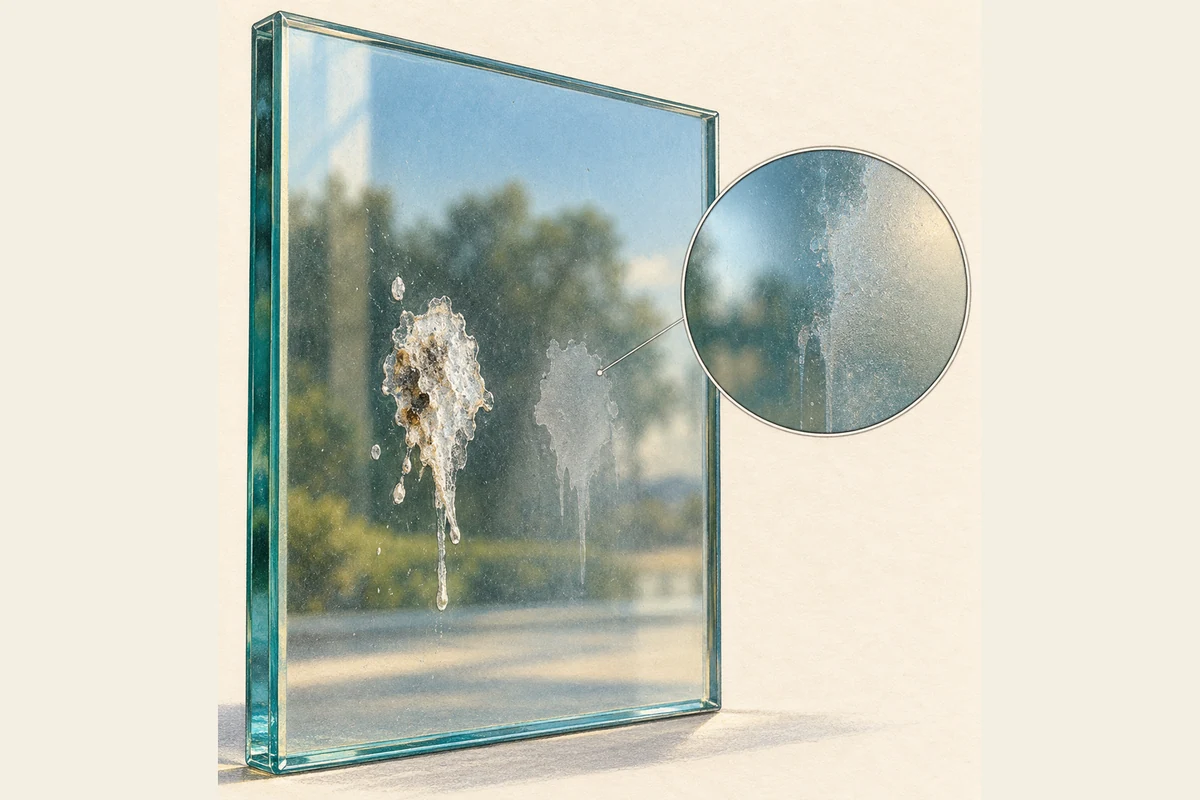
Avian residue acid shadow is an appearance change on glass produced by bird droppings (mixture of uric acid/urates, water, organics) that deposit as discrete splats and may bleach or dull the underlying glass after removal, leaving a color/shine “shadow.” High dwell time, sun/heat, and repeated incidents increase the likelihood of near-surface alteration. Classification is appearance-only per VIS (method-agnostic).
Classification & Scope (Normative)
NormativeAvian residue acid shadow is an appearance change on glass produced by bird droppings (mixture of uric acid/urates, water, organics) that deposit as discrete splats and may bleach or dull the underlying glass after removal, leaving a color/shine “shadow.” High dwell time, sun/heat, and repeated incidents increase the likelihood of near-surface alteration. Classification is appearance-only per VIS (method-agnostic). Inspect after Non-Invasive Reveal under VIS lighting/geometry; record surface numbering and worked-surface status.
Typical Presentation (Informative)
Informative- Discrete splats (10-50+ mm) with radial feathering and white urate crust; occasionally mixed brown/green organics.
- Run-legs from the splat on sloped panes or after dew; edge pooling at micro-texture inside the splat area.
- After residue lift: pale “ghost” or shadow area (reduced gloss, slight color shift).
Field Identification Cues (Normative)
NormativeSurface-catch class (MSRT)
- SC-0 for fresh/dry crust (residue on top).
- SC-1 localized if long dwell + heat produced very shallow micro-texture or trapped grit; SC-2 is atypical-if present after true residue lift, reassess for Ch.01 (acid attack) or Ch.03.03 (mineral etching).
- Perform one light, non-marring pass on a small revealed test patch (substrate). Use a polymer stylus if a functional coating is suspected. MSRT supports classification only.
Visual signature
- White crystalline/opaque urate crust with radial feathers and splat edge ring; may show brown/green organic center.
- Post-lift shadow: subtle loss of specular “snap” or color/shine change confined to the splat footprint.
- No chip-flank sparkle, no fused nodules.
Viewing / lighting
- Evaluate clean & dry at 12 / 36 / 72 in, normal incidence and oblique sweep (~60°-120°); use raking macros to show splat geometry, edge ring, and post-lift shadow boundary. Record distances/angles in-frame.
Location / access
- Record pane ID and surface numbering (#1-#4; laminate-internal). Common on outboard (#1) horizontal/near-horizontal surfaces (canopies, sills, skylights), signage ledges. Between-pane by parallax on #2/#3 → CAT-5 by location.
Mechanism cue (context)
- Avian perches above (sign letters, mullion caps), nesting/roost zones, overhangs; repetition beneath common perch points; co-evidence on frames/sills.
Severity & CAT Mapping (Normative)
NormativeAssign CAT by visibility at acceptance geometry and MSRT after a true residue lift test on a contained patch. Depth values are indicative-field measurement not required.
- CAT-1 (Benign / non-relief): Discrete splat residues that fully lift on reveal; SC-0; visible mainly at angle/raking. Indicative relief: 0-10 μm (optical film/crust only).
- CAT-2 (Light): Post-lift shadow (minor gloss/tone change) with localized SC-1; limited standard-view impact. Indicative relief: ~10-40 μm (incipient near-surface change).
- CAT-3 (Moderate): Multiple/overlapping splat shadows legible at standard distance, scattered SC-1; indicates long dwell, heat exposure, or repeated incidents. Indicative relief: ~40-120 μm
- Reclassify when: After true residue removal, if modeled matte persists with SC-1/2 beyond the splat footprint → consider Ch.01 (acid attack); if crystalline ring/etch halo consistent with hard-water dominates → Ch.03.03; if linear abrasion from cleaning attempts remains → M.02 abrasion fields.
- CAT-5 (by condition/location): Between-pane/inaccessible by parallax, integrity indicators, or confirmed functional-coating loss on the surface to be worked → CAT-5.
CAT is appearance-based; acceptance is separate under VIS-A at 12/36/72 in. Do not abrade to “force” a response during classification.
Differentiation & Mis-ID Pitfalls (Informative)
Informative- vs. Mineral staining/etch (Ch.03): Minerals present white/grey crystalline rings with run mapping; avian shows distinct splat morphology with urate crust and radial feathering.
- vs. Organic sap (E.03.03): Sap is amber/tacky with stringers; avian is white/grey crust with organic center and splat geometry.
- vs. Detergent/surfactant film (R.04.01): Detergent shows wipe streaks/iridescence; avian shows radial splash, ring, and localized post-lift shadow.
- vs. Atmospheric matte (E.01.02): Atmospheric is global/non-directional; avian is localized to splat footprints under perches.
Evidence Package *(Documentation Requirements) (Normative)
Normative- Photo set (VIS): 12 / 36 / 72 in, normal + oblique; raking macros of splat edge, feathering, post-lift shadow boundary; context frames showing perch/nesting features above. Record distance/angle in-frame.
- MSRT result (substrate): After a small reveal test patch and true residue lift, perform one light, non-marring pass; record SC-class (SC-0/SC-1/SC-2).
- Forms: Pane ID; product family & surface numbering; worked surface Y/N; functional coating present on worked surface? (Y/N/Unknown); reveal status; lighting/time; geometry checklist; photos attached.
- Acceptance split: Post-restoration acceptance per VIS-A §6; classification ≠ acceptance. Coated-face appearance rules apply per VIS §6.2.e when the worked surface is a factory functional coating.
Reporting Language (Template)
Template- E.03.04 Avian Residue Acid Shadow - Discrete splat with urate crust on surface #___ beneath [perch/letter/cap]; post-reveal test patch shows [SC-0 residue / SC-1 shadow]; visible at [12/36/72 in] under VIS geometry. Morphology: radial feathering, edge ring, localized post-lift shadow, no chip-flank sparkle, no pits. Classification: CAT-[1/2/3] by visibility and SC-class; reclassify per notes if broader acid etch or mineral halos dominate; CAT-5 if between-pane or coating-side loss on the surface to be worked. Forms + photo set attached; acceptance per VIS-A §6.
Related glossary terms
- Dwell timeGRK-180
- DepositGRK-045
- Acid attackGRK-074
- Test patchGRK-144
- AbrasionGRK-035
Source and version
GlassRenu Damage Specification Sheets (DSS), DSS-E.03.04. Source revision and extraction date are recorded in the deployment manifest.
Open the complete published DSS with table of contents (PDF)
Normative and informative labels are preserved from the source. The downloadable one-sheet is a condensed classification aid; this web page retains the complete source-based specification content.