
On this page
- Diagnosis summary
- Safety and classification scope
- Classification & Scope (Normative)
- Typical Presentation (Informative)
- Field Identification Cues (Normative)
- Surface-catch class (MSRT)
- Visual signature
- Viewing / lighting
- Location / access
- Mechanism cue (context)
- Severity & CAT Mapping (Normative)
- Differentiation & Mis-ID Pitfalls (Informative)
- Evidence Package *(Documentation Requirements) (Normative)
- Reporting Language (Template)
- Related glossary terms
- Related DSS
- Source and version
DAMAGE SPECIFICATION STANDARD / METHOD-AGNOSTIC
DSS-E.05.01 — UV-Induced Browning / Yellowing of Residues
Photo-degradation of films - chromophore formation/oxidation within organic residues; amber/yellow cast, loss of clarity, wetting anomalies; typically SC-0 for film-only, localized SC-1 where long dwell/UV yields very shallow micro-texture
Diagnosis summary
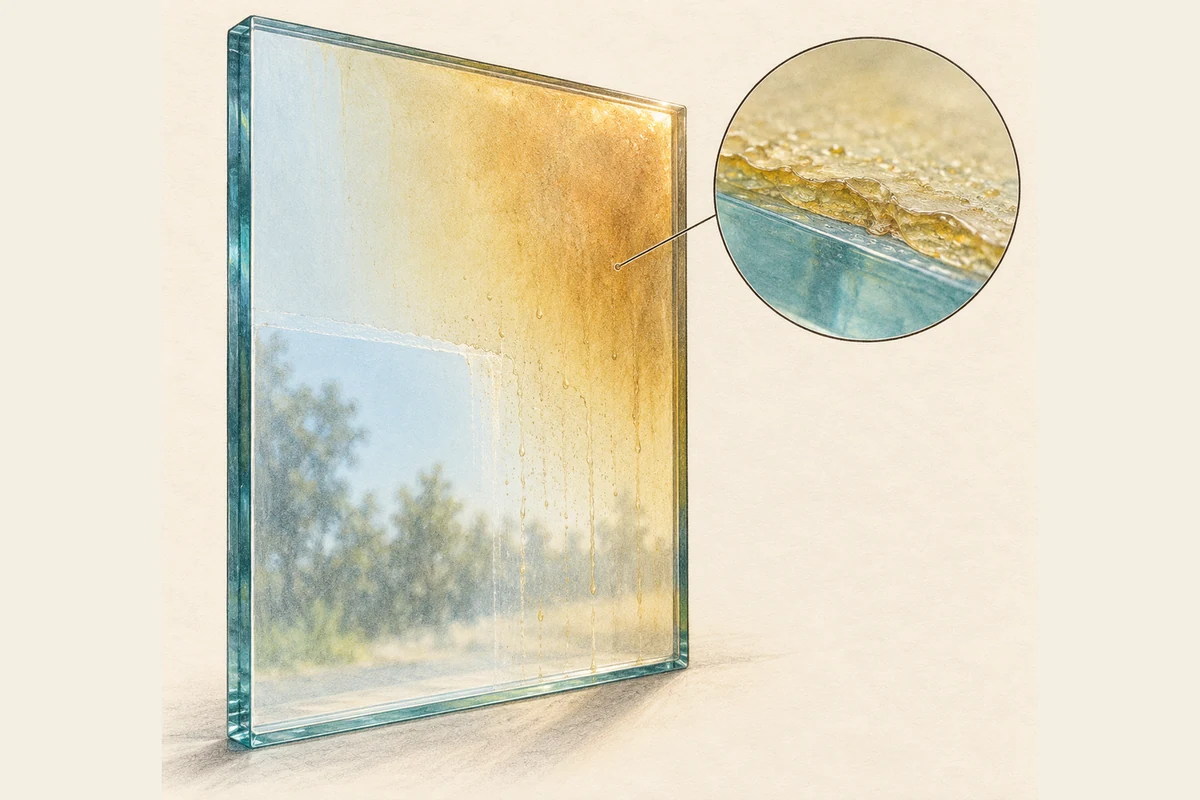
UV-induced browning/yellowing of residues is an appearance change on glass caused by photo-oxidation and polymerization within organic surface films (detergent remnants, maintenance additives, kitchen/HVAC aerosols, tree resins/honeydew carryover), producing a persistent amber/yellow veil and wetting anomalies. With prolonged exposure, very shallow micro-texture may develop beneath the film.
Classification & Scope (Normative)
NormativeUV-induced browning/yellowing of residues is an appearance change on glass caused by photo-oxidation and polymerization within organic surface films (detergent remnants, maintenance additives, kitchen/HVAC aerosols, tree resins/honeydew carryover), producing a persistent amber/yellow veil and wetting anomalies. With prolonged exposure, very shallow micro-texture may develop beneath the film. Classification is appearance-only per VIS (method-agnostic). Inspect after Non-Invasive Reveal under VIS lighting/geometry; record surface numbering and worked-surface status.
Typical Presentation (Informative)
Informative- Warm amber/yellow cast most apparent in reflections or when viewed across light-to-dark backgrounds; stronger on sun-exposed elevations.
- Patchy or uniform veils following wipe paths, spray cones, or airflow routes (interiors near kitchens/HVAC, exteriors near exhausts).
- Wetting contrast: areas bead/sheet differently due to altered surface energy.
Field Identification Cues (Normative)
NormativeSurface-catch class (MSRT)
- Typically SC-0 (film on top).
- Local SC-1 where long dwell + UV produced incipient substrate micro-texture or where grit was trapped in the film; SC-2 suggests misclassification-consider M.02 abrasion fields or Ch.03.03 mineral etching if matte persists after true film lift.
- Perform one light, non-marring pass on a small revealed test patch (substrate). Use polymer stylus if a functional coating is suspected. MSRT supports classification only.
Visual signature
- Amber/yellow veil with wipe geometry or air-path mapping; sometimes edges of patches appear slightly darker.
- No chip-flank sparkle, no discrete pits/fused nodules. After misting, wetting anomalies outline the film.
Viewing / lighting
- Evaluate clean & dry at 12 / 36 / 72 in, normal and oblique sweep (~60°-120°); use raking to reveal film thickness variations and edge outlines. Record distances/angles in-frame.
Location / access
- Record pane ID and surface numbering (#1-#4; laminate-internal). Occurs on outboard (#1) near exhaust/organics and inboard (#4) near kitchens/HVAC. Between-pane identification on #2/#3 via parallax → CAT-5 by location.
Mechanism cue (context)
- History of detergent/additive use, fragrance or surfactant residues, cooking aerosols, HVAC carryover, or nearby organics (sap/honeydew) with sun exposure.
Severity & CAT Mapping (Normative)
NormativeAssign CAT by visibility at acceptance geometry and MSRT after a true film-lift test. Depth values are indicative-field measurement not required.
- CAT-1 (Benign / non-relief): Thin amber veil; SC-0; angle/raking visible; clears fully on reveal patch. Indicative relief: 0-10 μm (optical film only).
- CAT-2 (Light): Persistent amber cast post-reveal with localized SC-1 (incipient substrate change); limited standard-view impact. Indicative relief: ~10-40 μm.
- CAT-3 (Moderate): Wide-area discoloration legible at standard distance, scattered SC-1; indicates long dwell/high UV dose or repeated deposition. Indicative relief: ~40-120 μm.
- Reclassify when: If oily/neutral film without yellowing dominates → R.04.03 HVAC oil or R.04.04 kitchen grease; if white/grey crystalline rims/etch dominate → Ch.03 mineral system; if linear swirls/webs persist → M.02 abrasion fields.
- CAT-5 (by condition/location): Between-pane/inaccessible by parallax, integrity indicators, or confirmed functional-coating loss on the surface to be worked → CAT-5.
CAT is appearance-based; acceptance is separate under VIS-A at 12/36/72 in. Do not abrade to “force” a response during classification.
Differentiation & Mis-ID Pitfalls (Informative)
Informative- vs. Nicotine/tar film (R.04.05): Nicotine is brown/amber with odor and interior air-path mapping; UV browning may present exterior as well and aligns with sun exposure and prior organic residues.
- vs. Tree sap shadow (E.03.03): Sap shows discrete beads/stringers and post-lift shadow; UV-browned films are more uniform/patchy with wipe or airflow geometry.
- vs. Coating anomalies (Co-family): Coating issues are planar/patchy on designated coated faces and persist independent of cleaning history; browned films respond to film-lift testing and track usage/exposure.
- vs. Atmospheric matte (E.01.02): Atmospheric matte is non-directional, often edge/rivulet-biased; browned films show wipe/air-path mapping and color shift.
Evidence Package *(Documentation Requirements) (Normative)
Normative- Photo set (VIS): 12 / 36 / 72 in, normal + oblique; raking macros of film edges, color cast, and wetting anomalies; context frames showing sun-exposed elevation or source zones (kitchen/HVAC/exhaust). Record distance/angle in-frame.
- MSRT result (substrate): After a small reveal test patch and true film-lift, perform one light, non-marring pass; record SC-class (SC-0/SC-1/SC-2).
- Forms: Pane ID; product family & surface numbering; worked surface Y/N; functional coating present on worked surface? (Y/N/Unknown); reveal status; lighting/time; geometry checklist; photos attached.
- Acceptance split: Post-restoration acceptance per VIS-A §6; classification ≠ acceptance. Coated-face appearance rules apply per VIS §6.2.e when the worked surface is a factory functional coating.
Reporting Language (Template)
Template- E.05.01 UV-Induced Browning / Yellowing of Residues - Amber/yellow veil with wipe/air-path geometry on surface #___; post-reveal test patch shows [SC-0 film / SC-1 localized]; visible at [12/36/72 in] under VIS geometry. Morphology: photo-browned organic film, wetting anomalies, no chip-flank sparkle, no pits. Classification: CAT-[1/2/3] by visibility and SC-class; reclassify to R.04.03/R.04.04 (oily films), Ch.03 (mineral), or M.02 (abrasion) as indicated; CAT-5 if between-pane or coating-side loss on the surface to be worked. Forms + photo set attached; acceptance per VIS-A §6.
Related glossary terms
- Surface filmGRK-044
- Test patchGRK-144
- AbrasionGRK-035
- DepositGRK-045
Source and version
GlassRenu Damage Specification Sheets (DSS), DSS-E.05.01. Source revision and extraction date are recorded in the deployment manifest.
Open the complete published DSS with table of contents (PDF)
Normative and informative labels are preserved from the source. The downloadable one-sheet is a condensed classification aid; this web page retains the complete source-based specification content.