
On this page
- Diagnosis summary
- Safety and classification scope
- Classification & Scope (Normative)
- Typical Presentation (Informative)
- Field Identification Cues (Normative)
- Surface-catch class (MSRT)
- Visual signature
- Viewing / lighting
- Location / access
- Mechanism cue (context)
- Severity & CAT Mapping (Normative)
- Differentiation & Mis-ID Pitfalls (Informative)
- Evidence Package *(Documentation Requirements) (Normative)
- Reporting Language (Template)
- Related glossary terms
- Related DSS
- Source and version
DAMAGE SPECIFICATION STANDARD / METHOD-AGNOSTIC
DSS-R.04.03 — HVAC Aerosol / Oil Film
Residue/film - airborne oils/plasticizers from HVAC/mechanical systems; uniform smeary veil, dust capture, grille-aligned gradients; typically SC-0, SC-1 where abrasion occurred
Diagnosis summary
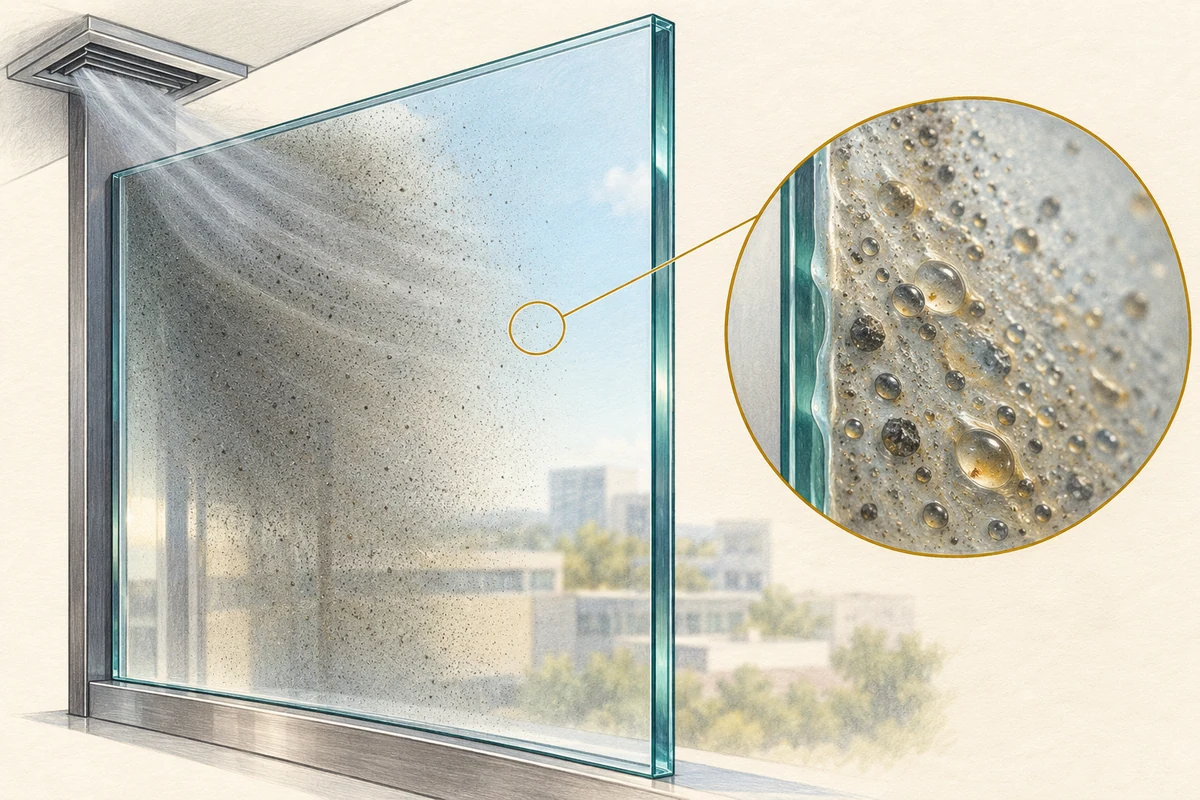
HVAC aerosol / oil film is an appearance change on glass from airborne oils, plasticizers, and fine condensables emitted or entrained by HVAC systems, kitchens, shop floors, or mechanical rooms, depositing as a uniform, slightly tacky veil that captures dust. It often shows gradients aligned to supply/return paths or equipment proximity. Classification is appearance-only per VIS (method-agnostic).
Classification & Scope (Normative)
NormativeHVAC aerosol / oil film is an appearance change on glass from airborne oils, plasticizers, and fine condensables emitted or entrained by HVAC systems, kitchens, shop floors, or mechanical rooms, depositing as a uniform, slightly tacky veil that captures dust. It often shows gradients aligned to supply/return paths or equipment proximity. Classification is appearance-only per VIS (method-agnostic). Inspect after Non-Invasive Reveal under VIS lighting/geometry; record surface numbering and worked-surface status.
Typical Presentation (Informative)
Informative- Broad, low-contrast smear/veil across interior faces near diffusers/returns, elevator lobbies, or shop areas (machining, forklifts).
- Dust-capture patterning (fine particulate embedded), finger wipe “windows” from ad-hoc cleaning, and edge build near frames.
- In raking: soft glow with wipe overlap arcs where partial cleanups occurred.
Field Identification Cues (Normative)
NormativeSurface-catch class (MSRT)
- Typically SC-0 (thin oil film).
- SC-1 may appear where abrasive cloths or dust-laden wipers produced very shallow micro-texture during attempts to clean; SC-2 uncommon-recheck classification if observed.
- Perform one light, non-marring pass on a small revealed test patch (substrate). Use a polymer stylus if a functional coating is suspected. MSRT supports classification only.
Visual signature
- Uniform smeary glow with dust capture; hand/finger “windows”; directional gradient pointing back to grille or process source.
- No chip-flank sparkle (not mechanical scoring); no discrete fused pits (not hot particle).
Viewing / lighting
- Evaluate clean & dry at 12 / 36 / 72 in, normal incidence and oblique sweep (~60°-120°); raking macros to resolve sheen, dust embed, and overlap edges. Record distances/angles in-frame.
Location / access
- Record pane ID and surface numbering (#1-#4; laminate-internal). Interior inboard (#4) faces are common. If fixed parallax places the veil between panes (#2/#3), classify CAT-5 by location (out of in-place scope) and refer.
Mechanism cue (context)
- Nearby supply/return diffusers, kitchen make-up air, mechanical rooms, industrial oils, vape/smoke areas, parking exhaust; presence of oily dust on frames/sills.
Severity & CAT Mapping (Normative)
NormativeAssign CAT by visibility at acceptance geometry and MSRT after a controlled reveal test. Depth values are indicative-field measurement not required.
- CAT-1 (Benign / non-relief): Thin oil veil; SC-0; seen mainly at angle/raking; minor dust capture. Indicative relief: 0-10 μm (optical).
- CAT-2 (Light): Persistent film with dust embed and localized SC-1 from prior wiping; limited impact at standard view. Indicative relief: ~10-40 μm.
- CAT-3 (Moderate): Wide-area contamination legible at standard distance (global haze, patterning near grilles); scattered SC-1 in wipe attempts. Indicative relief: ~40-120 μm (film stack).
- Reclassify when: After true residue lift, any modeled micro-texture or SC>0 persists → evaluate under M.02 (abrasion fields); if soot/combustion dominates, consider E.01.03 Soot/particulate pollution film.
- CAT-5 (by condition/location): Between-pane/inaccessible by parallax, integrity indicators, or confirmed functional-coating loss on the surface to be worked → CAT-5.
CAT is appearance-based; acceptance is separate under VIS-A at 12/36/72 in. Do not abrade to “force” removal during classification.
Differentiation & Mis-ID Pitfalls (Informative)
Informative- vs. Kitchen grease/aerosol film (R.04.04): Kitchen grease presents heavier tack, yellow/brown tone, and localized spatter near cooking lines; HVAC films are broader, gradiated with HVAC alignment.
- vs. Detergent/surfactant film (R.04.01): Detergent films show tool-path streaks and iridescence; HVAC films are uniform veils with dust embed and source-aligned gradient.
- vs. Fabric softener/additive film (R.04.02): Additive films show strong wetting contrast upon mist; HVAC films show less distinct wetting boundaries and more dust capture.
- vs. Soot/particulate pollution film (E.01.03): Soot films are darker/grey, particulate-dominant; HVAC oils are clear/amber, smear easily, and leave oily residue on a clean cloth.
Evidence Package *(Documentation Requirements) (Normative)
Normative- Photo set (VIS): 12 / 36 / 72 in, normal + oblique; raking macros of sheen/dust embed and wipe overlaps; context frames of HVAC grilles/returns showing alignment. Record distance/angle in-frame.
- MSRT result (substrate): After a small reveal test patch, perform one light, non-marring pass; record SC-class (SC-0/SC-1/SC-2).
- Forms: Pane ID; product family & surface numbering; worked surface Y/N; functional coating present on worked surface? (Y/N/Unknown); reveal status; lighting/time; geometry checklist; photos attached.
- Acceptance split: Post-restoration acceptance per VIS-A §6; classification ≠ acceptance. Coated-face appearance rules apply per VIS §6.2.e when the worked surface is a factory functional coating.
Reporting Language (Template)
Template- R.04.03 HVAC Aerosol / Oil Film - Uniform smeary veil with dust capture and source-aligned gradient on surface #___; post-reveal test patch shows [SC-0/SC-1]; visible at [12/36/72 in] under VIS geometry. Morphology: oily smear, finger wipe windows, no chip-flank sparkle, no pits. Classification: CAT-[1/2/3] by visibility and SC-class; CAT-5 if between-pane or coating-side loss on the surface to be worked. Forms + photo set attached; acceptance per VIS-A §6.
Related glossary terms
- DepositGRK-045
- Test patchGRK-144
- AbrasionGRK-035
- AbrasiveGRK-168
Source and version
GlassRenu Damage Specification Sheets (DSS), DSS-R.04.03. Source revision and extraction date are recorded in the deployment manifest.
Open the complete published DSS with table of contents (PDF)
Normative and informative labels are preserved from the source. The downloadable one-sheet is a condensed classification aid; this web page retains the complete source-based specification content.