
On this page
- Diagnosis summary
- Safety and classification scope
- Classification & Scope (Normative)
- Typical Presentation (Informative)
- Field Identification Cues (Normative)
- Surface-catch class (MSRT)
- Visual signature
- Viewing / lighting
- Location / access
- Mechanism cue (context)
- Severity & CAT Mapping (Normative)
- Differentiation & Mis-ID Pitfalls (Informative)
- Evidence Package *(Documentation Requirements) (Normative)
- Reporting Language (Template)
- Related glossary terms
- Related DSS
- Source and version
DAMAGE SPECIFICATION STANDARD / METHOD-AGNOSTIC
DSS-R.02.02 — Drywall Mud / Plaster Film
Residue/film - gypsum/setting compound particulate; chalky veil, drag wipes, particulate halos; typically SC-0, SC-1 if abrasion occurred during attempts to clean
Diagnosis summary
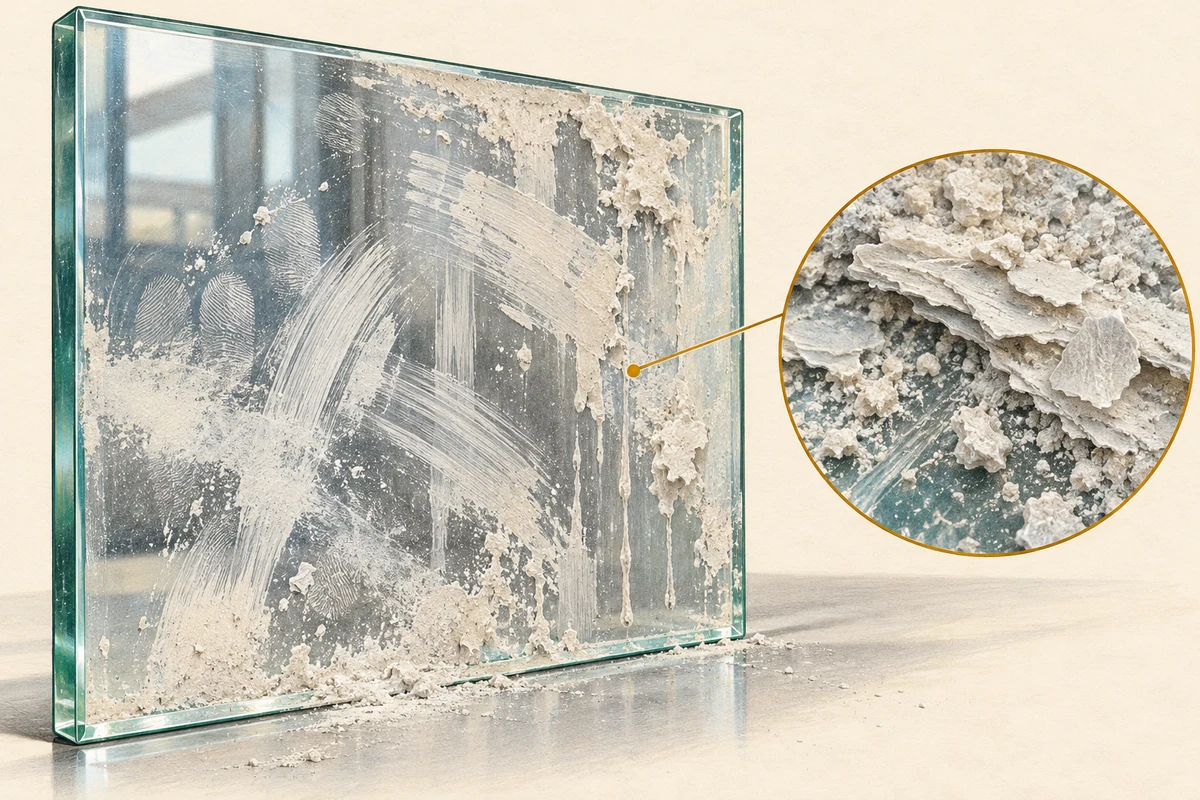
Drywall mud/plaster film is an appearance change on glass caused by gypsum-based joint compound or plaster particulates/binders deposited during taping, sanding, feathering, or cleanup. It presents as a chalky veil with drag wipes, finger/pad prints, and particulate halos, sometimes consolidated by moisture. Classification is appearance-only per VIS (method-agnostic).
Classification & Scope (Normative)
NormativeDrywall mud/plaster film is an appearance change on glass caused by gypsum-based joint compound or plaster particulates/binders deposited during taping, sanding, feathering, or cleanup. It presents as a chalky veil with drag wipes, finger/pad prints, and particulate halos, sometimes consolidated by moisture. Classification is appearance-only per VIS (method-agnostic). Inspect after Non-Invasive Reveal under VIS lighting/geometry; record surface numbering and worked-surface status.
Typical Presentation (Informative)
Informative- Powdery, matte veil with hand/cloth wipe arcs; heavier below joints/ceilings and at sill returns.
- Sanding plume footprints: broad fallout zones with feathered edges; drips/legs if water or wash-down occurred.
- Under raking: fine particulate pepper; may show tide lines where damp wipes dried.
Field Identification Cues (Normative)
NormativeSurface-catch class (MSRT)
- Typically SC-0 (loose/powder film on top of glass).
- SC-1 may appear when abrasive pads or dry wipe grinding created very shallow micro-texture during improper cleaning; SC-2 uncommon.
- Perform one light, non-marring pass on a small revealed test patch (substrate). Use polymer stylus if a functional coating is suspected. MSRT supports classification only.
Visual signature
- Uniform matte, chalky cast; wipe streaks with overlap edges; powder sheds to cloth.
- No chip-flank sparkle (not mechanical scoring unless later scrubbed with abrasive); no fused nodules/pits (not hot-particle).
Viewing / lighting
- Evaluate clean & dry at 12 / 36 / 72 in, normal incidence and oblique sweep (~60°-120°); use raking macros to resolve particulate and tide lines. Record distances/angles in-frame.=
Location / access
- Record pane ID and surface numbering (#1-#4; laminate-internal). If fallout is between panes (fixed parallax on #2/#3), classify CAT-5 by location (out of in-place scope) and refer.
Mechanism cue (context)
- Active drywall/plaster work, sanding, mixing stations, mud pans, sponge finishing, or power sanding nearby; protective film removed too early.
Severity & CAT Mapping (Normative)
NormativeAssign CAT by visibility at acceptance geometry and MSRT after a controlled reveal test. Depth values are indicative-field measurement not required.
- CAT-1 (Benign / non-relief): Chalky veil/particulate only; SC-0 after true reveal; primarily angle/raking visible. Indicative relief: 0-10 μm (optical film).
- CAT-2 (Light): Persistent residue with tide-line halos or slight SC-1 from prior abrasive wiping; limited impact at standard view. Indicative relief: ~10-40 μm.
- CAT-3 (Moderate): Broad, high-contrast matte fields legible at standard distance where residue consolidated with moisture or was abraded into micro-texture (SC-1→SC-2 localized). Indicative relief: ~40-120 μm.
- Reclassify when: If underlying alkaline etch is evident (e.g., from cementitious wash, not gypsum) or linear scoring is present from abrasive pads → evaluate under Ch.02 (alkaline attack) or M.02 (mechanical abrasion) as applicable.
- CAT-5 (by condition/location): Between-pane/inaccessible by parallax, integrity indicators, or confirmed functional-coating loss on the surface to be worked → CAT-5.
CAT is appearance-based; acceptance is separate under VIS-A at 12/36/72 in. Do not abrade to “force” removal during classification.
Differentiation & Mis-ID Pitfalls (Informative)
Informative- vs. Paint overspray (R.02.01): Overspray shows coalesced micro-droplets and sometimes color tone; drywall/plaster is white, powdery, non-gloss, transfers to cloth.
- vs. Stucco/lime residue (R.02.03) / alkaline attack (Ch.02): Stucco/lime is coarser/grainier, can leave alkaline burn or etch; gypsum films are softer, generally non-etch unless improper abrasive cleaning was used.
- vs. Mineral staining/etch (Ch.03): Mineral veils follow water arcs/runs and can show ring halos; gypsum fallout maps to sanding plumes and wipe zones.
- vs. Silicone or sealant smears (R.01.xx): Those read oily/iridescent with tool-mark corduroy; gypsum films are matte/powder with wipe streaks.
Evidence Package *(Documentation Requirements) (Normative)
Normative- Photo set (VIS): 12 / 36 / 72 in, normal + oblique; raking macros of powder texture, wipe overlaps, tide lines; context frames with active drywall/plaster areas. Record distance/angle in-frame.
- MSRT result (substrate): After a small reveal test patch, perform one light, non-marring pass; record SC-class (SC-0/SC-1/SC-2).
- Forms: Pane ID; product family & surface numbering; worked surface Y/N; functional coating present on worked surface? (Y/N/Unknown); reveal status; lighting/time; geometry checklist; photos attached.
- Acceptance split: Post-restoration acceptance per VIS-A §6; classification ≠ acceptance. Coated-face appearance rules apply per VIS §6.2.e when the worked surface is a factory functional coating.
Reporting Language (Template)
Template- R.02.02 Drywall Mud / Plaster Film - Chalky matte veil with wipe arcs/overlaps on surface #___; post-reveal test patch shows [SC-0/SC-1]; visible at [12/36/72 in] under VIS geometry. Morphology: powder particulate, tide lines, fallout plume; no chip-flank sparkle, no discrete pits. Classification: CAT-[1/2/3] by visibility and SC-class; CAT-5 if between-pane, integrity cues, or coating-side loss on the surface to be worked. Forms + photo set attached; acceptance per VIS-A §6.
Related glossary terms
- DepositGRK-045
- Alkaline attackGRK-075
- Paint oversprayGRK-063
- Test patchGRK-144
- AbrasionGRK-035
- AbrasiveGRK-168
- GrindingGRK-166
Source and version
GlassRenu Damage Specification Sheets (DSS), DSS-R.02.02. Source revision and extraction date are recorded in the deployment manifest.
Open the complete published DSS with table of contents (PDF)
Normative and informative labels are preserved from the source. The downloadable one-sheet is a condensed classification aid; this web page retains the complete source-based specification content.