
On this page
- Diagnosis summary
- Safety and classification scope
- Classification & Scope (Normative)
- Typical Presentation (Informative)
- Field Identification Cues (Normative)
- Surface-catch class (MSRT)
- Visual signature
- Viewing / lighting
- Location / access
- Mechanism cue (context)
- Severity & CAT Mapping (Normative)
- Differentiation & Mis-ID Pitfalls (Informative)
- Evidence Package *(Documentation Requirements) (Normative)
- Reporting Language (Template)
- Related glossary terms
- Related DSS
- Source and version
DAMAGE SPECIFICATION STANDARD / METHOD-AGNOSTIC
DSS-R.02.03 — Stucco / Lime Film (residue)
Residue/film - cementitious/stucco/lime splash or wash-down; chalk-grain veil, runs/rings, alkaline footprint; typically SC-0, SC-1 if consolidated or lightly abraded
Diagnosis summary
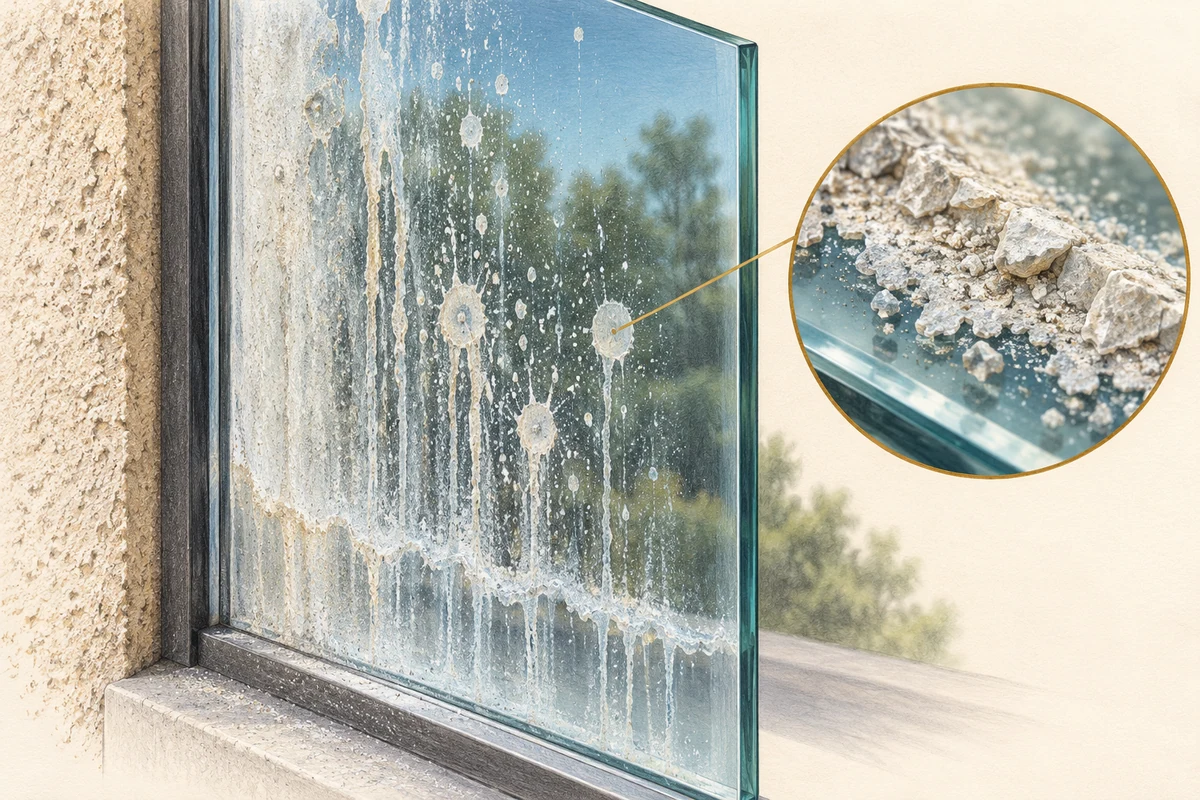
Stucco/lime film (residue) is an appearance change on glass from cementitious or lime-rich materials (stucco brown/finish coats, scratch coats, slurry, limewashes) deposited during application, float/rod work, cutting/grinding, or cleanup/rinse-downs. It presents as a chalk–grain veil with runs/rings and tide-line halos that follow gravity paths and splash footprints.
Classification & Scope (Normative)
NormativeStucco/lime film (residue) is an appearance change on glass from cementitious or lime-rich materials (stucco brown/finish coats, scratch coats, slurry, limewashes) deposited during application, float/rod work, cutting/grinding, or cleanup/rinse-downs. It presents as a chalk-grain veil with runs/rings and tide-line halos that follow gravity paths and splash footprints. This entry covers residual films (removable/partially removable) and does not include confirmed alkaline etch (see Ch.02 Alkaline Attack). Classification is appearance-only per VIS (method-agnostic). Inspect after Non-Invasive Reveal per VIS §5; record surface numbering and worked-surface status.
Typical Presentation (Informative)
Informative- Grainy, light-colored veil (off-white/grey/tan) with drip legs, sling arcs, or roller splash consistent with stucco work lines; sometimes aggregate specks.
- Tide-line rings where hose-downs dried; heavier at head/jamb/sill interfaces and below scaffolding.
- Under raking: mineral particulate sparkle (non-metallic), micro-grain texture, feathered run edges.
Field Identification Cues (Normative)
NormativeSurface-catch class (MSRT)
- Typically SC-0 (loose/consolidated film on top of glass).
- SC-1 may occur where paste consolidated (sun/heat) or where improper abrasive wiping introduced very shallow micro-texture. SC-2 suggests misclassification-re-evaluate for alkaline etch (Ch.02) or mechanical abrasion (M-family).
- Perform one light, non-marring pass on a small revealed test patch; use polymer stylus if a functional coating is suspected. MSRT supports classification only.
Visual signature
- Chalk-grain veil with drip legs/runs, splash arcs, roller spatter; ring/tide lines from rinse-down.
- No chip-flank sparkle (not linear scoring); no fused nodules/pits (not hot particle).
- May show coarse grains (sand/aggregate fines) adhered within run paths.
Viewing / lighting
- Evaluate clean & dry at 12 / 36 / 72 in, with normal incidence and oblique sweep (~60°-120°); raking macros to resolve grain, run edges, and rings. Record distances/angles in-frame.
Location / access
- Record pane ID and surface numbering (#1-#4; laminate-internal). If fixed parallax indicates residue on #2/#3 (IGU cavity), classify CAT-5 by location (out of in-place scope) and refer.
Mechanism cue (context)
- Active stucco/lath work, scratch/brown/finish operations, EIFS basecoats, limewashes, hose/rinse-down without shielding; cut/grind near openings.
Severity & CAT Mapping (Normative)
NormativeAssign CAT by visibility at acceptance geometry and MSRT after a controlled reveal on a small area. Depth values are indicative-field measurement not required.
- CAT-1 (Benign / non-relief): Light chalk-grain veil/runs; SC-0 after reveal; mainly angle/raking visible; minimal at standard view. Indicative relief: 0-10 μm (optical film).
- CAT-2 (Light): Persistent consolidated residue or tide-line rings with SC-1 (sun-baked paste, slight shallow texture from mishandling); limited standard-view impact. Indicative relief: ~10-40 μm.
- CAT-3 (Moderate): Broad run fields/rings legible at standard distance; SC-1 in worst zones; context suggests extended dwell/heat or heavy splash. Indicative relief: ~40-120 μm.
- Reclassify when: If, after true residue removal, substrate exhibits modeled micro-texture, matte patches, or SC-2 → evaluate under Ch.02.01/Ch.02.02 (Alkaline Attack: cement/mortar slurry/cement run-off etch).
- CAT-5 (by condition/location): Between-pane/inaccessible by parallax, integrity indicators, or confirmed functional-coating loss on the surface to be worked → CAT-5.
CAT is appearance-based; acceptance is separate under VIS-A at 12/36/72 in. Do not abrade to “force” removal during classification.
Differentiation & Mis-ID Pitfalls (Informative)
Informative- vs. Drywall/plaster film (R.02.02): Gypsum films are softer/chalky, often uniform with wipe arcs; stucco/lime shows grainier residue, distinct runs/splash arcs, and alkaline context (exterior elevations).
- vs. Paint overspray (R.02.01): Overspray presents micro-droplet dots and binder gloss; stucco/lime shows grain and non-gloss matte with run legs.
- vs. Alkaline attack (Ch.02): True etch exhibits modeled micro-texture persisting after residue lift and may show SC-2; R.02.03 is residue (film) with SC-0/SC-1, removable in principle.
- vs. Mineral staining/etch (Ch.03): Mineral patterns follow spray/rings from water systems and can be glassy/ring-like; stucco/lime tracks trade work (trowel splash, hose rinse paths) and features grain embed.
- vs. Silicone/PIB smears (R.01.xx): Sealant smears read oily/tarry with corduroy or stringers; stucco/lime is powder/grain matte with run legs and no organics sheen.
Evidence Package *(Documentation Requirements) (Normative)
Normative- Photo set (VIS): 12 / 36 / 72 in, normal + oblique; raking macros of grain, run legs, rings/tide lines; context frames of stucco/lime operations, scaffolds, hose-down zones. Record distance/angle in-frame.
- MSRT result (substrate): After a small reveal test patch, perform one light, non-marring pass; record SC-class (SC-0/SC-1/SC-2).
- Forms: Pane ID; product family & surface numbering; worked surface Y/N; functional coating present on worked surface? (Y/N/Unknown); reveal status; lighting/time; geometry checklist; photos attached.
- Acceptance split: Post-restoration acceptance per VIS-A §6; classification ≠ acceptance. Coated-face appearance rules apply per VIS §6.2.e when the worked surface is a factory functional coating.
Reporting Language (Template)
Template- R.02.03 Stucco / Lime Film (residue) - Grainy, light-colored veil with runs/tide-line rings on surface #___; post-reveal test patch shows [SC-0/SC-1]; visible at [12/36/72 in] under VIS geometry. Morphology: grain/aggregate fines, splash arcs, feathered run edges; no chip-flank sparkle, no discrete pits. Classification: CAT-[1/2/3] by visibility and SC-class; reclassify to Ch.02 (alkaline attack) if etch/SC-2 persists after true residue lift; CAT-5 if between-pane or coating-side loss on the surface to be worked. Forms + photo set attached; acceptance per VIS-A §6.
Related glossary terms
- GrindingGRK-166
- DepositGRK-045
- ScratchGRK-032
- Alkaline attackGRK-075
- Paint oversprayGRK-063
- Test patchGRK-144
- AbrasionGRK-035
- AbrasiveGRK-168
Source and version
GlassRenu Damage Specification Sheets (DSS), DSS-R.02.03. Source revision and extraction date are recorded in the deployment manifest.
Open the complete published DSS with table of contents (PDF)
Normative and informative labels are preserved from the source. The downloadable one-sheet is a condensed classification aid; this web page retains the complete source-based specification content.