
On this page
- Diagnosis summary
- Safety and classification scope
- Classification & Scope (Normative)
- Typical Presentation (Informative)
- Field Identification Cues (Normative)
- Surface-catch class (MSRT)
- Visual signature
- Viewing / lighting
- Location / access
- Mechanism cue (context)
- Severity & CAT Mapping (Normative)
- Differentiation & Mis-ID Pitfalls (Informative)
- Evidence Package *(Documentation Requirements) (Normative)
- Reporting Language (Template)
- Related glossary terms
- Related DSS
- Source and version
DAMAGE SPECIFICATION STANDARD / METHOD-AGNOSTIC
DSS-U.01.04 — Directional Patterning with Intermittent Chip Flanks (Uncertain Tool/Pad)
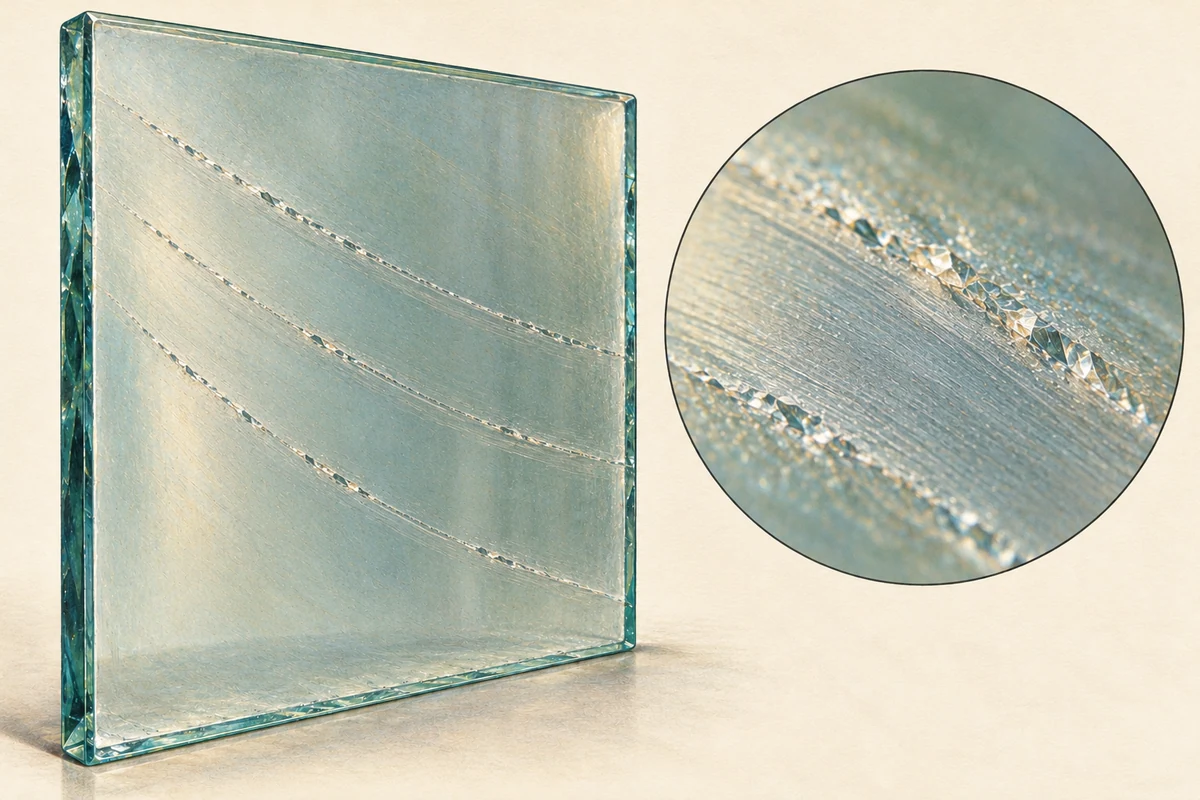
Unknown/mixed mechanism - directional lines/arcs with periodic edge sparkle and variable relief; suggests intermittent hard-point contact within an otherwise pad/cloth motion; SC-1 along most paths with localized SC-2 “spikes” at higher-pressure segments or entrained particulates
Diagnosis summary
Directional patterning with intermittent chip flanks is an appearance change characterized by linear or arced paths (often repeating in lanes or sweeps) where most of the path reads as shallow abrasion (SC-1) but localized segments exhibit chip-flank sparkle (SC-2) indicative of momentary hard-point contact (entrained grit, damaged pad edge, nicked squeegee, or tool corner).
Classification & Scope (Normative)
NormativeDirectional patterning with intermittent chip flanks is an appearance change characterized by linear or arced paths (often repeating in lanes or sweeps) where most of the path reads as shallow abrasion (SC-1) but localized segments exhibit chip-flank sparkle (SC-2) indicative of momentary hard-point contact (entrained grit, damaged pad edge, nicked squeegee, or tool corner). Motion geometry may reflect hand arcs, DA/pad sweeps, straightedge assists, or repetitive maintenance strokes. Classification is appearance-only per VIS (method-agnostic). Inspect after Non-Invasive Reveal under VIS lighting/geometry; record surface numbering and worked-surface status.
Typical Presentation (Informative)
Informative- Ribbon-like lanes or overlapped arcs with mostly matte/scuff appearance, punctuated by bright sparkles at discrete segments (the “spikes”).
- Stroke alignment: parallel passes, consistent radius arcs, or start/stop hesitation marks; lane spacing matches pad diameter or arm span.
- No fused nodules; no uniform granular frost; not purely random-paths show operator rhythm.
Field Identification Cues (Normative)
NormativeSurface-catch class (MSRT)
- Predominantly SC-1 along the abrasion path (shallow micro-texture).
- SC-2 at intermittent sparkle points where a hard particle/edge dug briefly (micro-chipping visible under raking).
- Perform one light, non-marring pass on a small revealed test patch crossing (a) matte path and (b) sparkle nodes; record both responses. Use a polymer stylus if a functional coating is suspected. MSRT supports classification only.
Visual signature
- Directional continuity (lanes/arcs) with periodic edge sparkle only at nodes; between nodes, path appears soft, scuffed, or hazy.
- Chip flanks, when present, are short and localized, often at stroke apex, entry/exit, or overlaps.
- No meniscus rings/runs (argues against chemical-only); no continuous incised groove (argues against pure scribing).
Viewing / lighting
- Evaluate clean & dry at 12 / 36 / 72 in, normal and oblique sweep (~60°-120°); use low-angle raking to make sparkle nodes pop and to read stroke rhythm. Record distances/angles in-frame.
Location / access
- Record pane ID and surface numbering (#1-#4; laminate-internal). Common on exposed faces in post-construction cleaning or attempted restoration. Between-pane by parallax on #2/#3 → CAT-5 by location.
Mechanism cue (context)
- Abrasive pad/cloth used over dust, DA/polisher with contaminated interface, squeegee with nicked blade, or straightedge with grit. May follow attempts to “correct” chemical haze-hence mixed origin.
Severity & CAT Mapping (Normative)
NormativeAssign CAT by visibility at acceptance geometry and MSRT. Depth values are indicative-field measurement not required.
- CAT-2 (Light): Few lanes; nodes infrequent; SC-1 predominant with rare SC-2 pin-points; minimal standard-view impact. Indicative relief: path ~10-40 μm; nodes ~20-60 μm.
- CAT-3 (Moderate): Multiple lanes or dense arcs legible at standard distance; regular SC-2 nodes at overlaps/apexes. Indicative relief: path ~40-120 μm; nodes ~60-150 μm.
- CAT-4 (Severe): Wide-area patterning across panels, frequent SC-2 nodes, occasional short incised segments; pane appearance compromised at standard and wide-field views. Indicative relief: path ~120-200 μm; local node maxima ~150-300+ μm.
- Reclassify when (dominance clarifies mechanism):
- Chemical halos/runs/meniscus dominate with scarce directionality → Ch.01/Ch.02/Ch.03 families.
- Continuous grooves with persistent chip flanks → M.01 Linear scoring.
- Uniform swirl fields without discrete chip-sparkle nodes → M.02 Abrasion swirls/pad trails.
- Fused metallic peppering in or along lanes → add Th.01.02 Hot particle component.
- CAT-5 (by condition/location): Between-pane/inaccessible by parallax, integrity indicators, or confirmed functional-coating loss on the surface to be worked → CAT-5.
CAT is appearance-based; acceptance is separate under VIS-A at 12/36/72 in. Do not abrade to “force” a response during classification.
Differentiation & Mis-ID Pitfalls (Informative)
Informative- vs. M.02 Abrasion fields: M.02 shows broad directional haze or swirl webs with consistent SC-1 and lacks discrete SC-2 nodes.
- vs. M.01 Scoring: Scoring yields continuous sharp grooves with chip flanks along most of the line, not intermittent.
- vs. V.01.02 Scribed marks: Scribing forms intentional letters/icons with consistent groove relief; U.01.04 shows maintenance-like paths and pressure-dependent nodes.
- vs. Ch.03 Mineral etch: Mineral systems show ringed halos and non-directional etch tied to wetting; U.01.04 is directional with operator rhythm.
Evidence Package *(Documentation Requirements) (Normative)
Normative- Photo set (VIS): 12 / 36 / 72 in, normal + oblique; raking macros capturing (a) matte path and (b) sparkle node; overview frames to show lane spacing/rhythm. Record distance/angle in-frame.
- MSRT results: After a small reveal test patch, record SC-class along path (SC-1), at node (SC-2), and outside control (SC-0).
- Forms: Pane ID; product family & surface numbering; worked surface Y/N; functional coating on worked surface? (Y/N/Unknown); reveal status; lighting/time; geometry checklist; photos attached.
- Acceptance split: Post-restoration acceptance per VIS-A §6; classification ≠ acceptance. Coated-face appearance rules apply per VIS §6.2.e when the worked surface is a factory functional coating.
Reporting Language (Template)
Template- U.01.04 Directional Patterning with Intermittent Chip Flanks - Parallel lanes/arcs with localized sparkle nodes on surface #___; post-reveal test patch shows SC-1 along paths and SC-2 at nodes; visible at [12/36/72 in] under VIS geometry. Morphology: maintenance-like stroke rhythm, pressure-dependent chip flanks at overlaps/apexes, no fused nodules, no continuous incised groove. Classification: CAT-[2/3/4] by visibility and SC-pattern; reclassify per notes if chemical, scoring, or pure abrasion signatures dominate; CAT-5 if between-pane or coating-side loss on the surface to be worked. Forms + photo set attached; acceptance per VIS-A §6.
Related glossary terms
- ChipGRK-034
- AbrasionGRK-035
- Test patchGRK-144
- AbrasiveGRK-168
Source and version
GlassRenu Damage Specification Sheets (DSS), DSS-U.01.04. Source revision and extraction date are recorded in the deployment manifest.
Open the complete published DSS with table of contents (PDF)
Normative and informative labels are preserved from the source. The downloadable one-sheet is a condensed classification aid; this web page retains the complete source-based specification content.