
On this page
- Diagnosis summary
- Safety and classification scope
- Classification & Scope (Normative)
- Typical Presentation (Informative)
- Field Identification Cues (Normative)
- Surface-catch class (MSRT)
- Visual signature
- Viewing / lighting
- Location / access
- Mechanism cue (context)
- Severity & CAT Mapping (Normative)
- Differentiation & Mis-ID Pitfalls (Informative)
- Evidence Package *(Documentation Requirements) (Normative)
- Reporting Language (Template)
- Related glossary terms
- Related DSS
- Source and version
DAMAGE SPECIFICATION STANDARD / METHOD-AGNOSTIC
DSS-V.01.02 — Scribed / Engraved Tool Marks
Intentional surface modification - hard-point incision of glass with metal/ceramic tools; discrete linear grooves, alphanumerics, or graphic outlines; chip-flank sparkle under raking; typically SC-2 along grooves, SC-1 at feathered tails
Diagnosis summary
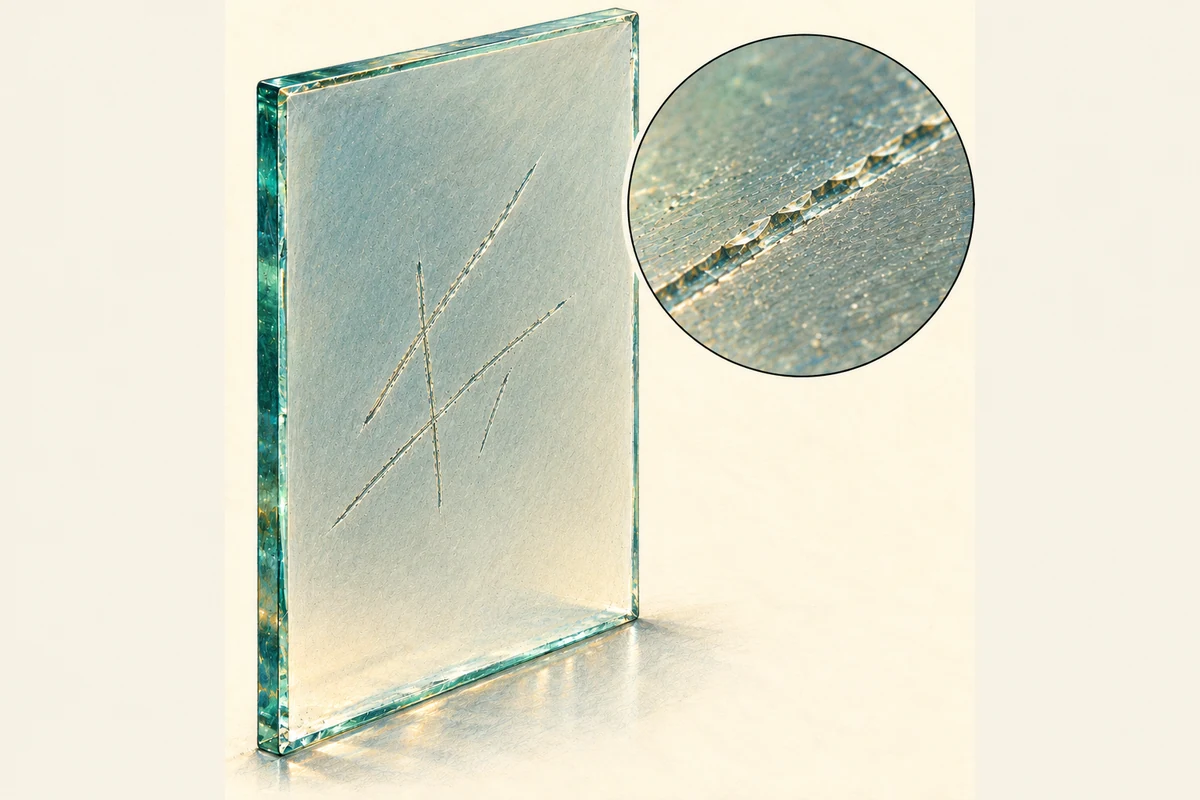
Scribed / engraved tool marks are appearance changes created by hard-point contact (carbide/steel points, diamonds, glass cutters, masonry nails, ceramic chips) drawn across the glass surface to inscribe letters, numbers, outlines, or linear tags. The action cuts and plows the surface, producing grooves with micro-chipping (chip flanks) and bright edge sparkle in raking light.
Classification & Scope (Normative)
NormativeScribed / engraved tool marks are appearance changes created by hard-point contact (carbide/steel points, diamonds, glass cutters, masonry nails, ceramic chips) drawn across the glass surface to inscribe letters, numbers, outlines, or linear tags. The action cuts and plows the surface, producing grooves with micro-chipping (chip flanks) and bright edge sparkle in raking light. Classification is appearance-only per VIS (method-agnostic). Inspect after Non-Invasive Reveal under VIS lighting/geometry; record surface numbering and worked-surface status.
Typical Presentation (Informative)
Informative- Discrete incised lines (often high-contrast at raking) forming alphanumerics, initials, simple icons, or linear tags.
- Entry/exit features: pick-in points, directional tearing, burred ends, feathered tails at flicks.
- Variable depth along strokes from pressure modulation; intersections show flaked nodes.
Field Identification Cues (Normative)
NormativeSurface-catch class (MSRT)
- SC-2 along primary grooves (distinct interruption; granular edge feel).
- SC-1 at light passes/feathered tails; SC-0 outside the inscription.
- Perform one light, non-marring pass on a small revealed test patch (substrate). Use polymer stylus if a functional coating is suspected. MSRT supports classification only.
Visual signature
- Continuous, directional grooves with chip-flank sparkle at oblique; micro-chipping more pronounced on outer (tensile) edge of curve strokes.
- No fused nodules (not hot particle); not uniform matte (not abrasive blast).
- Stroke rhythm reveals hand motion (speed changes, hesitations, overlaps).
Viewing / lighting
- Evaluate clean & dry at 12 / 36 / 72 in, normal and oblique sweep (~60°-120°); use low-angle raking to catch edge sparkle and entry/exit morphology. Record distances/angles in-frame.
Location / access
- Record pane ID and surface numbering (#1-#4; laminate-internal). Usually on exposed faces (#1 or #4). Between-pane by parallax on #2/#3 → CAT-5 by location.
Mechanism cue (context)
- Presence/history of accessible public interface, hand reach, graffiti prevalence; sometimes co-present with paint tags (V.03.01) or acid tags (V.02.01).
Severity & CAT Mapping (Normative)
NormativeAssign CAT by visibility at acceptance geometry and MSRT after a reveal patch. Depth values are indicative-field measurement not required.
- CAT-2 (Light): Fine incised lines legible in raking, intermittent SC-1-SC-2, minimal impact at standard view; micro-chips sparse. Indicative relief: ~20-60 μm.
- CAT-3 (Moderate): Clearly legible strokes/letters at standard distance; consistent SC-2; chip flanks evident along runs and at intersections. Indicative relief: ~60-150 μm.
- CAT-4 (Severe): Bold, deep engraving and/or dense inscriptions visible at standard and wide-field; frequent micro-fracture islands, flaked nodes, occasional local divots. Indicative relief: ~150-350+ μm local maxima.
- Reclassify when: If the field is uniform matte within masked boundaries → V.01.01 abrasive blast; if cream/meniscus residue, runs, or brush texture present → V.02.02/Ch.01 acid etch; if linear scoring with long straight guides across panes → M.01.02 straightedge scoring rather than intentional inscription.
- CAT-5 (by condition/location): Between-pane/inaccessible by parallax, integrity indicators, or confirmed functional-coating loss on the surface to be worked → CAT-5.
CAT is appearance-based; acceptance is separate under VIS-A at 12/36/72 in. Do not abrade to “force” a response during classification.
Differentiation & Mis-ID Pitfalls (Informative)
Informative- vs. Razor/scraper scoring (M.01.01): Scraper lines are often parallel, straight, construction-context, and may track cleaning paths; scribed vandalism shows alphanumerics/icons, variable depth, entry/exit features.
- vs. Acid-etch graffiti (V.02.01): Acid tags leave whitened, modeled micro-texture with flow/cream artifacts; scribed marks are cut grooves with chip-flank sparkle and tactile catch.
- vs. Fine abrasion swirls (M.02.01): Swirls are curvilinear fields lacking clear stroke intent, typically SC-1; scribing is deliberate strokework with SC-2 grooves.
- vs. Hot particle peppering (Th.01.02): Hot particle shows discrete pits/fused nodules; scribing presents continuous incisions.
Evidence Package *(Documentation Requirements) (Normative)
Normative- Photo set (VIS): 12 / 36 / 72 in, normal + oblique; raking macros of chip flanks, entry/exit points, intersections; context frames showing reach/access. Record distance/angle in-frame.
- MSRT result (substrate): After a small reveal test patch, perform one light, non-marring pass through stroke body and tail; record SC-class (SC-2 body, SC-1 tail, SC-0 control).
- Forms: Pane ID; product family & surface numbering; worked surface Y/N; functional coating present on worked surface? (Y/N/Unknown); reveal status; lighting/time; geometry checklist; photos attached.
- Acceptance split: Post-restoration acceptance per VIS-A §6; classification ≠ acceptance. Coated-face appearance rules apply per VIS §6.2.e when the worked surface is a factory functional coating.
Reporting Language (Template)
Template- V.01.02 Scribed / Engraved Tool Marks - Incised alphanumerics/lines with chip-flank sparkle on surface #___; post-reveal test patch shows SC-2 along grooves / SC-1 at tails; visible at [12/36/72 in] under VIS geometry. Morphology: continuous grooves, entry/exit features, intersection flaking, no fused nodules, not a uniform matte field. Classification: CAT-[2/3/4] by visibility and SC-class; reclassify per notes if acid-etch/abrasive-blast/environmental abrasion criteria are met; CAT-5 if between-pane or coating-side loss on the surface to be worked. Forms + photo set attached; acceptance per VIS-A §6.
Related glossary terms
- Raking lightGRK-129
- ChipGRK-034
- Test patchGRK-144
- AbrasionGRK-035
- AbrasiveGRK-168
Source and version
GlassRenu Damage Specification Sheets (DSS), DSS-V.01.02. Source revision and extraction date are recorded in the deployment manifest.
Open the complete published DSS with table of contents (PDF)
Normative and informative labels are preserved from the source. The downloadable one-sheet is a condensed classification aid; this web page retains the complete source-based specification content.