
On this page
- Diagnosis summary
- Safety and classification scope
- Classification & Scope (Normative)
- Typical Presentation (Informative)
- Field Identification Cues (Normative)
- Surface-catch class (MSRT)
- Visual signature
- Viewing / lighting
- Location / access
- Mechanism cue (context)
- Severity & CAT Mapping (Normative)
- Differentiation & Mis-ID Pitfalls (Informative)
- Evidence Package (Documentation Requirements) (Normative)
- Reporting Language (Template)
- Related glossary terms
- Related DSS
- Source and version
DAMAGE SPECIFICATION STANDARD / METHOD-AGNOSTIC
DSS-Ch.01.01 — Acid-Etch Graffiti (HF / BOE)
Chemical - hydrofluoric/fluorosilicate attack; subsurface micro-texture “frost” with runs/lettering
Diagnosis summary
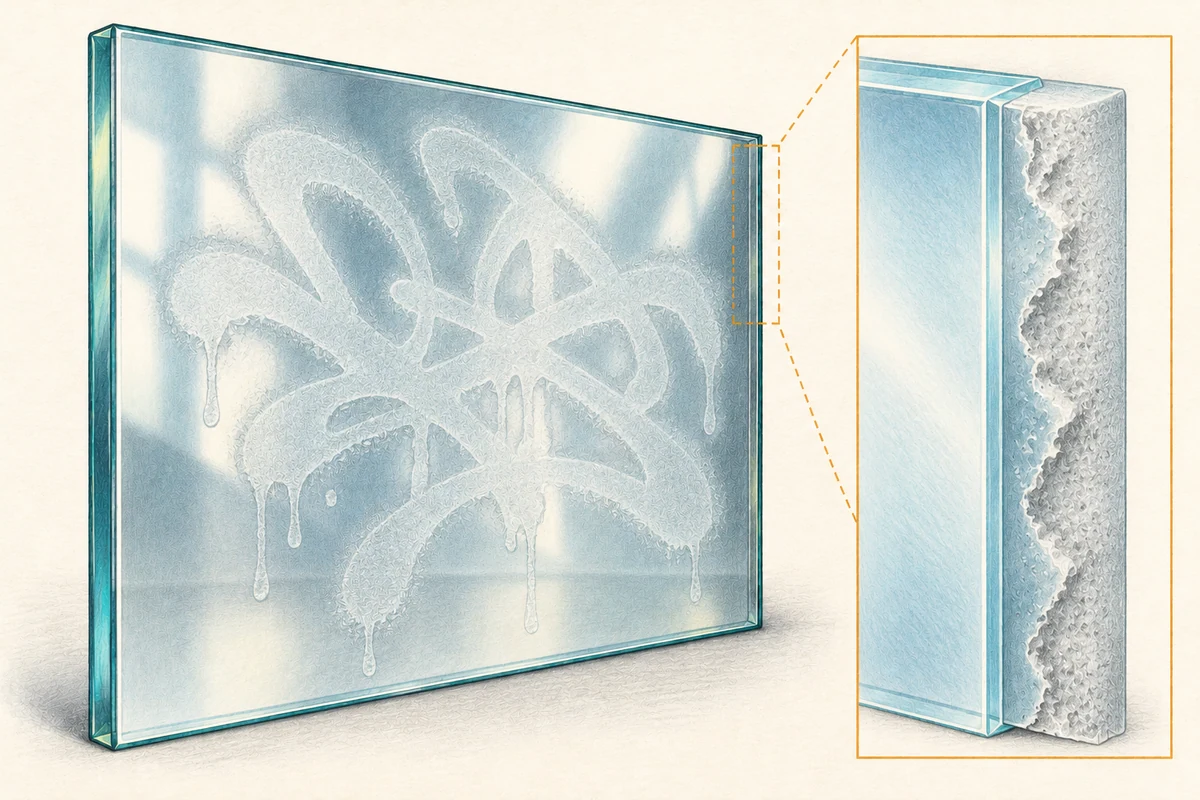
Acid-etch graffiti is a chemically etched pattern (letters, tags, symbols, swirls) produced by hydrofluoric-bearing agents (e.g., HF gels, Buffered Oxide Etch/BOE). Reaction dissolves silica, leaving subsurface micro-texture (“frost”) and often drip legs or pooling halos. Classification is appearance-only per VIS (method-agnostic). Inspect after Non-Invasive Reveal under VIS lighting/geometry;
Classification & Scope (Normative)
NormativeAcid-etch graffiti is a chemically etched pattern (letters, tags, symbols, swirls) produced by hydrofluoric-bearing agents (e.g., HF gels, Buffered Oxide Etch/BOE). Reaction dissolves silica, leaving subsurface micro-texture (“frost”) and often drip legs or pooling halos. Classification is appearance-only per VIS (method-agnostic). Inspect after Non-Invasive Reveal under VIS lighting/geometry; record surface numbering and worked-surface status on Forms:
Safety note (informative): treat any fresh, wet, or unknown residue as hazardous; do not touch-document visually and defer cleaning to site protocols.
Typical Presentation (Informative)
Informative- Readable tag geometry (initials, loops, strokes) with soft-edged “frosted” fill; contrast increases on dark backdrops.
- Drip legs descending from stroke ends; puddle/stop halos at start/finish points; occasional brush/dauber width consistency.
- In raking light, etched areas exhibit non-directional, modeled micro-texture (whitish haze) rather than linear scratches.
Field Identification Cues (Normative)
NormativeSurface-catch class (MSRT)
- Typically SC-2 (clear) within etched strokes; can read SC-1 at lighter attacks. Perform one light, non-marring pass; do not abrade. Use polymer stylus if a coating is suspected. MSRT supports classification only.
Visual signature
- Continuous, filled strokes (not just line scratches), with soft boundaries and no chip-flank sparkle; drip legs and pooling halos common.
- No discrete pits/nodules (separates from hot-particle pepper). No abrasive flank sparkle continuous over long run-length (separates from mechanical scoring).
Viewing / lighting
- Evaluate clean & dry at 12 / 36 / 72 in using normal incidence and oblique sweep (~60°-120°) with raking light to resolve modeled micro-texture. Document distances/angles in-frame.
Location / access
- Record pane ID and surface numbering (#1-#4; laminate-internal). If fixed parallax indicates a between-pane presentation, classify CAT-5 by location (out of in-place scope) and refer per protocol.
Mechanism cue (context)
- Presence of acid applicators (daubers/etch-cream tubes), glove prints, or fresh chemical odor; proximity to public-facing elevations and transit nodes.
Severity & CAT Mapping (Normative)
NormativeAssign CAT by appearance + MSRT + morphology (three-part cueing). Depth bands are indicative; numeric measurement not required.
- CAT-2 (Light): Thin, pale strokes with SC-1 to light SC-2; visible mainly under raking; minimal contrast at standard view. Indicative relief: ~10-40 μm.
- CAT-3 (Moderate): Readable tag with SC-2 across strokes; modeled micro-texture clearly apparent at standard distance; drip legs/halos present. Indicative relief: ~40-120 μm.
- CAT-4 (Severe): Dense, frosted fill or repeated over-etching with strong SC-2, high contrast at standard & wide-field views; occasional milkiness beyond stroke edges. Indicative relief: ~120-300 μm+.
- CAT-5 (by location/condition): Between-pane/inaccessible by parallax, active cracks/pane instability, or confirmed functional-coating loss on the surface to be worked → CAT-5 (non-repairable/out of in-place scope).
CAT is appearance-based; acceptance is separate under VIS-A §6 at 12/36/72 in. Do not “probe” with MSRT.
Differentiation & Mis-ID Pitfalls (Informative)
Informative- vs. Mechanical scratch graffiti (M.01 / V.01.02): Mechanical tags show directional lineation with abrasive chip-flank sparkle along edges; acid-etch reads as filled, frosted strokes with modeled texture.
- vs. Etch-cream (consumer) patterns (V.02.02): Creams can mimic HF but often yield more uniform matte with cleaner stencil edges; industrial HF/BOE shows runs/drips and variable intensity.
- vs. Paint/marker coatings (V.03.01 / R.02.01): Coatings sit on the surface and remove at reveal; acid-etched areas remain with SC-class > 0.
- vs. Alkaline cement/mortar etch (Ch.02.01/.02): Alkaline attacks appear as flow fields and sheeting patterns tied to runoff; HF tags show intentional stroke geometry and drip legs from application points.
- vs. Coating anomalies (Co-family): Coating rub/patchiness yields sheen/color shifts but no etched relief; on a worked coated surface any anomaly is not permitted at acceptance (VIS §6.2.e).
Evidence Package (Documentation Requirements) (Normative)
Normative- Photo set (VIS): 12 / 36 / 72 in; normal + oblique; include raking macros that resolve modeled micro-texture within strokes, plus at least one context frame capturing full tag geometry and surroundings. Record distance/angle in-frame.
- MSRT result: One light, non-marring pass on a representative stroke to record SC-class (SC-1/SC-2). Polymer stylus if coating is suspected.
- Forms: Pane ID; product family & surface numbering; worked surface Y/N; functional coating present on worked surface? (Y/N/Unknown); reveal status; lighting/time; geometry checklist; photos attached.
- Acceptance split: Post-restoration acceptance per VIS-A §6 at 12/36/72 in; classification ≠ acceptance. Coated-face appearance rules apply per VIS §6.2.e.
Reporting Language (Template)
Template- Ch.01.01 Acid-Etch Graffiti (HF/BOE) - Etched tag strokes with [SC-1/SC-2] on surface #___, visible at [12/36/72 in] under VIS geometry after Non-Invasive Reveal. Morphology: frosted fill, modeled micro-texture, [drip legs/pool halos present/absent]; no chip-flank sparkle. Classification: CAT-[2/3/4] by relief/visibility; CAT-5 if between-pane, integrity cues, or coating-side loss on the surface to be worked. Forms + photo set completed; acceptance per VIS-A §6 (separate).
Related glossary terms
- Alkaline attackGRK-075
- Raking lightGRK-129
- Coating rubGRK-115
- AbrasiveGRK-168
- ScratchGRK-032
Source and version
GlassRenu Damage Specification Sheets (DSS), DSS-Ch.01.01. Source revision and extraction date are recorded in the deployment manifest.
Open the complete published DSS with table of contents (PDF)
Normative and informative labels are preserved from the source. The downloadable one-sheet is a condensed classification aid; this web page retains the complete source-based specification content.