
On this page
- Diagnosis summary
- Safety and classification scope
- Classification & Scope (Normative)
- Typical Presentation (Informative)
- Field Identification Cues (Normative)
- Surface-catch class (MSRT)
- Visual signature
- Viewing / lighting
- Location / access
- Mechanism cue (context)
- Severity & CAT Mapping (Normative)
- Differentiation & Mis-ID Pitfalls (Informative)
- Evidence Package *(Documentation Requirements) (Normative)
- Reporting Language (Template)
- Related glossary terms
- Related DSS
- Source and version
DAMAGE SPECIFICATION STANDARD / METHOD-AGNOSTIC
DSS-V.02.02 — Etch-Cream Patterning (Consumer Etchant Traces)
Intentional chemical etch - store-bought glass/ceramic etch creams and gels; patchy white/milky fields, brush/dauber swirls, pooled meniscus rims; typically SC-2 within worked areas, SC-1 in feathered halos; depth varies with dwell/reapplication
Diagnosis summary
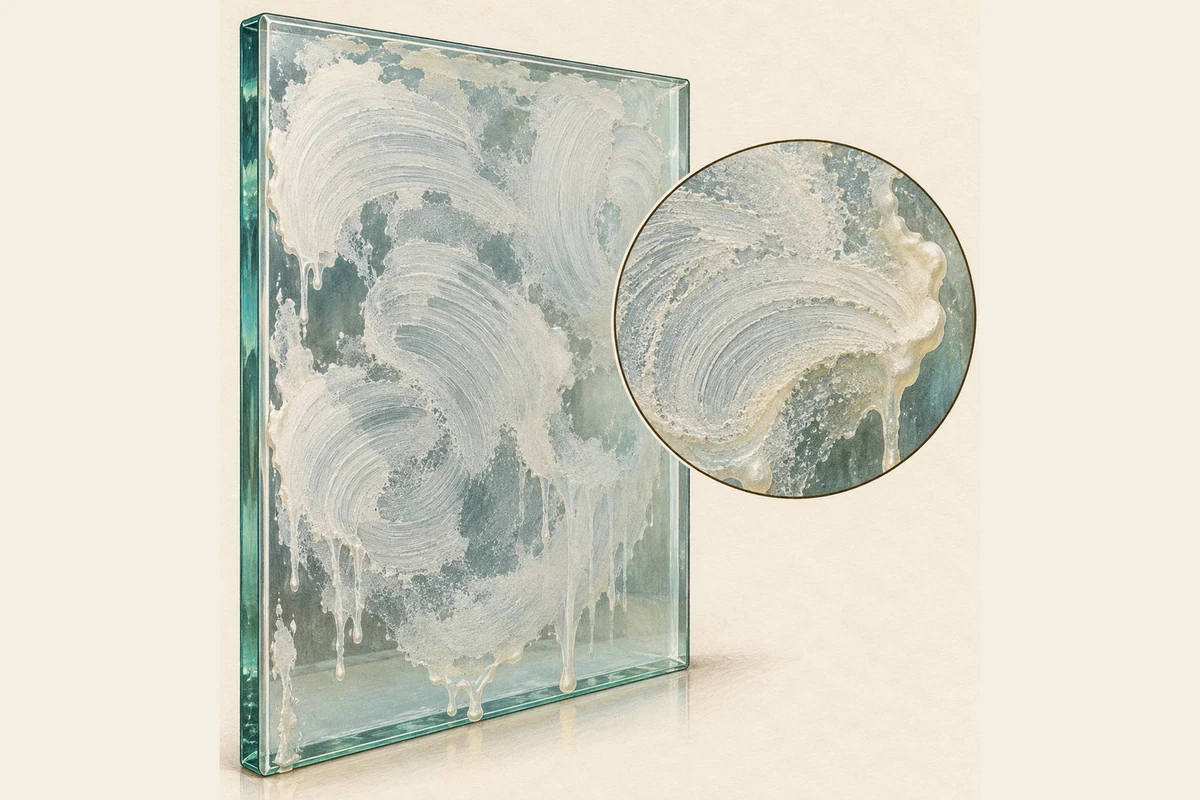
Etch-cream patterning is an appearance change created by consumer or contractor-grade etching creams/gels (commonly fluorides/acidic bases intended for glass/ceramics). Application by brush, dauber, sponge, or finger yields patchy white/milky micro-texture with tool-mark swirls, pooling at edges, and drip legs if over-applied.
Classification & Scope (Normative)
NormativeEtch-cream patterning is an appearance change created by consumer or contractor-grade etching creams/gels (commonly fluorides/acidic bases intended for glass/ceramics). Application by brush, dauber, sponge, or finger yields patchy white/milky micro-texture with tool-mark swirls, pooling at edges, and drip legs if over-applied. Presentations include filled rectangles, stenciled bands, hand-applied patches, or attempted “frost effect.”
Classification is appearance-only per VIS (method-agnostic). Inspect after Non-Invasive Reveal under VIS lighting/geometry; record surface numbering and worked-surface status.
Typical Presentation (Informative)
Informative- Opaque to semi-opaque white/milky fields; non-uniform density with brush/dauber arcs and cross-hatch where re-worked.
- Meniscus rims at stencil edges; pooled, brighter islands where cream collected; occasional vertical drips below the field.
- Stencil witness lines from vinyl/mask; finger smudges or glove prints in thin zones.
Field Identification Cues (Normative)
NormativeSurface-catch class (MSRT)
- SC-2 across worked micro-textured fields (distinct interruption).
- SC-1 in feathered halos/thin film; SC-0 outside the treated area.
- Perform one light, non-marring pass on a small revealed test patch (substrate). Use polymer stylus if a functional coating is suspected. MSRT supports classification only; do not abrade to “prove” relief.
Visual signature
- Modeled, non-directional micro-texture with application artifacts: brush arcs, dabs, swirls, pooling meniscus rims; whitened opacity proportional to dwell/re-application.
- No chip-flank sparkle (not scribed); no uniform granular blast field (not abrasive blast); no fused nodules (not hot particle).
Viewing / lighting
- Evaluate clean & dry at 12 / 36 / 72 in, normal incidence and oblique sweep (~60°-120°); use low-angle raking to emphasize swirls, rims, and density variation. Record distances/angles in-frame.
Location / access
- Record pane ID and surface numbering (#1-#4; laminate-internal). Typically on exposed faces (#1 or #4). Between-pane identification by parallax on #2/#3 → CAT-5 by location.
Mechanism cue (context)
- Craft/decor attempts, privacy “frosting”, ad-hoc graffiti removal gone wrong, or vandalism; masking materials (vinyl, tape) and residual adhesive may be nearby.
Severity & CAT Mapping (Normative)
NormativeAssign CAT by visibility at acceptance geometry and MSRT after a reveal patch. Depth values are indicative-field measurement not required.
- CAT-2 (Light): Thin cream haze with SC-1-SC-2 intermittent, faint swirls, limited standard-view impact. Indicative relief: ~10-40 μm.
- CAT-3 (Moderate): Clearly legible etched panels/bands visible at standard distance; SC-2 consistent; swirl/meniscus artifacts evident. Indicative relief: ~40-120 μm.
- CAT-4 (Severe): Dense, re-worked fills with strong whitening, multiple passes, runs/pools; visible at standard and wide-field; SC-2 throughout. Indicative relief: ~120-300+ μm local maxima (chemistry/dwell dependent).
- Reclassify when: Sharp grooves with chip-flank sparkle → V.01.02 scribed; uniform mask-bounded granular frost → V.01.01 abrasive blast; white/grey ringed halos from water chemistry → Ch.03 mineral system.
- CAT-5 (by condition/location): Between-pane/inaccessible by parallax, integrity indicators, or confirmed functional-coating loss on the surface to be worked → CAT-5.
CAT is appearance-based; acceptance is separate under VIS-A at 12/36/72 in. Do not abrade to “force” a response during classification.
Differentiation & Mis-ID Pitfalls (Informative)
Informative- vs. Acid-marker tagging (V.02.01): Markers form stroke geometry with run legs; creams form area fills/panels with brush/dauber swirls and meniscus pooling.
- vs. Abrasive blast (V.01.01): Blast is uniform within masks, granular to touch; creams are modeled/mottled, show swirls and variable opacity.
- vs. Mineral etch (Ch.03.03): Mineral etch follows wetting/drip geometry with crystalline rings; cream fields have application geometry and tool marks.
- vs. Factory acid-etched/frosted glass (P.04): Factory finishes are uniform and documented; field cream leaves swirl artifacts and edge pools; seek product docs.
Evidence Package *(Documentation Requirements) (Normative)
Normative- Photo set (VIS): 12 / 36 / 72 in, normal + oblique; raking macros highlighting swirls, meniscus rims, density variation; overview of full treated area. Record distance/angle in-frame.
- MSRT result (substrate): After a small reveal test patch, perform one light, non-marring pass within field and outside; record SC-class (SC-2 field, SC-1 feather, SC-0 control).
- Forms: Pane ID; product family & surface numbering; worked surface Y/N; functional coating present on worked surface? (Y/N/Unknown); reveal status; lighting/time; geometry checklist; photos attached.
- Acceptance split: Post-restoration acceptance per VIS-A §6; classification ≠ acceptance. Coated-face appearance rules apply per VIS §6.2.e when the worked surface is a factory functional coating.
Reporting Language (Template)
Template- V.02.02 Etch-Cream Patterning - Milky etched panel with brush/dauber swirls and meniscus rims on surface #___; post-reveal test patch shows SC-2 in field / SC-1 in halo; visible at [12/36/72 in] under VIS geometry. Morphology: modeled chemical micro-texture, pooling islands, no chip-flank sparkle, not a uniform blast frost. Classification: CAT-[2/3/4] by visibility and SC-class; reclassify per notes if scribed/blast/mineral criteria dominate; CAT-5 if between-pane or coating-side loss on the surface to be worked. Forms + photo set attached; acceptance per VIS-A §6.
Related glossary terms
- Test patchGRK-144
- AbrasiveGRK-168
Source and version
GlassRenu Damage Specification Sheets (DSS), DSS-V.02.02. Source revision and extraction date are recorded in the deployment manifest.
Open the complete published DSS with table of contents (PDF)
Normative and informative labels are preserved from the source. The downloadable one-sheet is a condensed classification aid; this web page retains the complete source-based specification content.