
On this page
- Diagnosis summary
- Safety and classification scope
- Classification & Scope (Normative)
- Typical Presentation (Informative)
- Field Identification Cues (Normative)
- Surface-catch class (MSRT)
- Visual signature
- Viewing / lighting
- Location / access
- Mechanism cue (context)
- Severity & CAT Mapping (Normative)
- Differentiation & Mis-ID Pitfalls (Informative)
- Evidence Package *(Documentation Requirements) (Normative)
- Reporting Language (Template)
- Related glossary terms
- Related DSS
- Source and version
DAMAGE SPECIFICATION STANDARD / METHOD-AGNOSTIC
DSS-V.03.01 — Spray Paint / Marker Coatings
Intentional applied coatings - paint/ink films deposited on glass; opaque/semi-opaque color fields, drips, feathered overspray, felt-tip stroke geometry; typically SC-0 for film-on-top, localized SC-1 only where prior abrasive attempts introduced shallow micro-texture; reclassify to chemical/mechanical families if substrate alteration persists after true film lift
Diagnosis summary
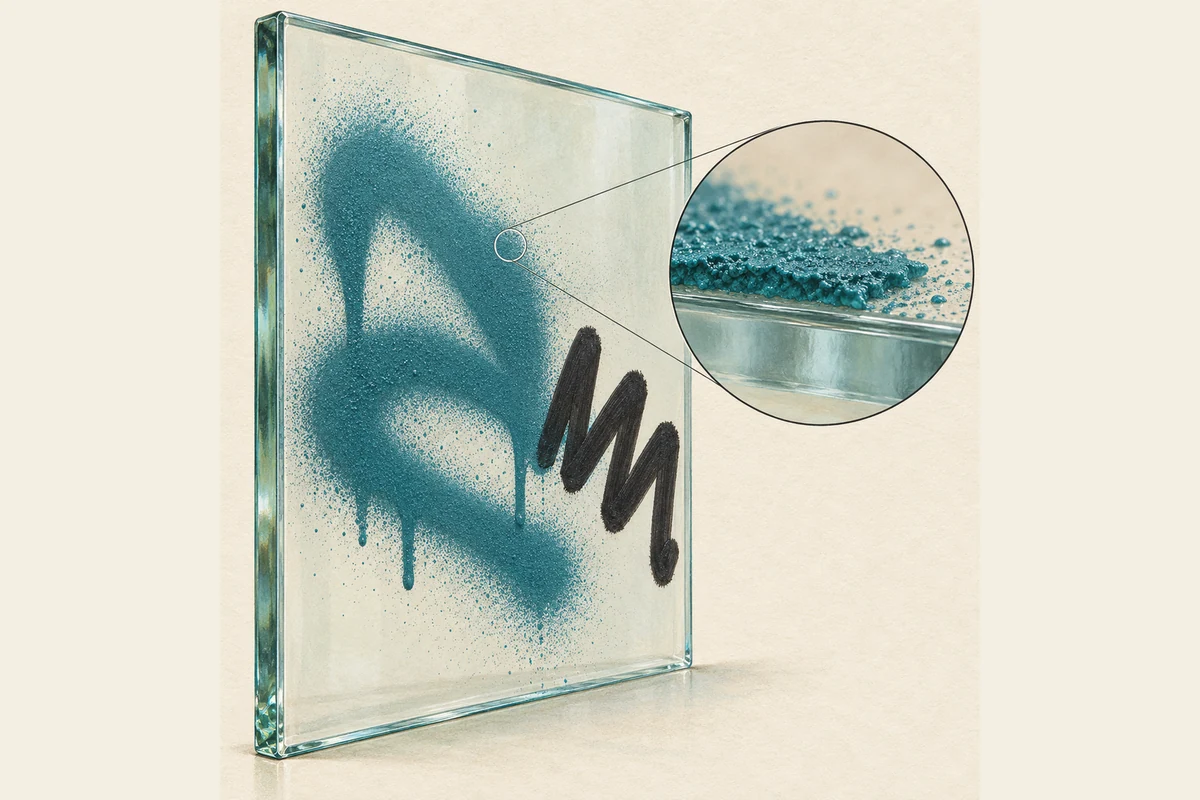
Spray paint / marker coatings are appearance changes caused by deliberate application of paints or inks (aerosol lacquer/acrylic/alkyd, enamel, permanent markers, paint pens) onto the glass surface, producing opaque or semi-opaque films, stenciled fills, or freehand tags. The applied medium sits atop the glass and, absent prior abrasive attempts, does not alter the substrate.
Classification & Scope (Normative)
NormativeSpray paint / marker coatings are appearance changes caused by deliberate application of paints or inks (aerosol lacquer/acrylic/alkyd, enamel, permanent markers, paint pens) onto the glass surface, producing opaque or semi-opaque films, stenciled fills, or freehand tags. The applied medium sits atop the glass and, absent prior abrasive attempts, does not alter the substrate. Classification is appearance-only per VIS (method-agnostic). Inspect after Non-Invasive Reveal under VIS lighting/geometry; record surface numbering and worked-surface status.
Typical Presentation (Informative)
Informative- Spray paint: Opaque color panels, feathered overspray halos, sag drips, spatter at start/stop; stencil witness edges where masking used.
- Marker/paint pen: High-contrast strokes, felt-tip or valve-pen stroke edges, pump-dot blobs, ink pooling at stroke overlaps; colors black, silver, white, neon.
- Multi-layer tags (marker over paint, or vice-versa) common in high-traffic zones.
Field Identification Cues (Normative)
NormativeSurface-catch class (MSRT)
- SC-0 for intact film-on-top (paint/ink is exogenous).
- SC-1 only where a prior abrasive attempt created very shallow substrate micro-texture beneath residual film edges. SC-2 implies misclassification-consider V.01.02 scribed or V.02 acid-etch.
- Perform one light, non-marring pass on a small revealed test patch (substrate). Use polymer stylus if a functional coating is suspected. MSRT supports classification only; do not abrade to “prove” relief.
Visual signature
- Film continuity with edge meniscus; no chip-flank sparkle, no granular frost, no pits.
- Overspray feather (fine particulate halo) around sprayed fields; drip legs vertical from heavy passes; marker stroke texture reveals felt/valve chatter.
Viewing / lighting
- Evaluate clean & dry at 12 / 36 / 72 in, normal and oblique sweep (~60°-120°); raking highlights film thickness variation, overspray, drips, and stroke edges. Record distances/angles in-frame.
Location / access
- Record pane ID and surface numbering (#1-#4; laminate-internal). Typically on public-facing exposed faces (#1 or #4). Between-pane by parallax on #2/#3 (rare; usually pre-assembly contamination) → CAT-5 by location.
Mechanism cue (context)
- Transit nodes, storefronts, hand-reach corridors, co-presence of paint caps, markers, stickers; multiple tags in cluster; historic tagging visible on adjacent substrates.
Severity & CAT Mapping (Normative)
NormativeAssign CAT by visibility at acceptance geometry and MSRT after a true film-lift test on a contained patch (without abrading substrate). Depth values are indicative-field measurement not required.
- CAT-1 (Benign / non-relief): Thin paint/ink film or overspray legible mainly at angle/raking; SC-0; film lifts on test patch leaving no shadow. Indicative relief: 0-10 μm (optical film only).
- CAT-2 (Light): Heavier film with minor drip/overlap thickness; SC-0 (substrate unaltered). If a faint post-lift tone remains from prolonged dwell of solvent-rich inks, record SC-0/SC-1 localized. Indicative relief: ~10-40 μm (film stack).
- CAT-3 (Moderate): Opaque painted panels/tags readily visible at standard distance, with drips/sags and overspray halos; substrate still SC-0 after lift. Indicative relief: ~40-120 μm (film stack).
- Reclassify when: After true film lift, if modeled matte persists (SC-1/2) → assess V.02 (acid-etch) or M.02 (abrasion); if chip-flank sparkle present → V.01.02 scribed; if uniform granular frost within masked outlines → V.01.01 abrasive blast.
- CAT-5 (by condition/location): Between-pane/inaccessible by parallax, integrity indicators, or confirmed functional-coating loss on the surface to be worked → CAT-5.
CAT is appearance-based; acceptance is separate under VIS-A at 12/36/72 in. Do not abrade to “force” a response during classification.
Differentiation & Mis-ID Pitfalls (Informative)
Informative- vs. Acid-marker (V.02.01) / etch-cream (V.02.02): Those leave substrate micro-texture (SC-2) with whitened etched appearance, runs/cream swirls. Paint/marker is film-on-top (SC-0) with color opacity and overspray/stroke artifacts.
- vs. Scribed grooves (V.01.02): Scribing shows sharp grooves, chip flanks, SC-2; paint shows meniscus edges, drips, no groove.
- vs. Coating anomalies (Co family): Coating issues are planar, on designated coated faces, and do not present overspray drifts/drips; paint/marker shows application geometry.
- vs. Oily films (R.04.03/04): Oily films are transparent/iridescent and track air paths; paint/marker is opaque/semi-opaque with clear application edges.
Evidence Package *(Documentation Requirements) (Normative)
Normative- Photo set (VIS): 12 / 36 / 72 in, normal + oblique; raking macros of overspray, drips/sags, stroke edges; overviews showing extent and access context. Record distance/angle in-frame.
- MSRT result (substrate): After a small true film-lift test patch (no abrasion), perform one light, non-marring pass on substrate and adjacent control; record SC-class (SC-0 substrate, SC-0 control; SC-1 localized only if prior abrasion evident).
- Forms: Pane ID; product family & surface numbering; worked surface Y/N; functional coating present on worked surface? (Y/N/Unknown); reveal status; lighting/time; geometry checklist; photos attached.
- Acceptance split: Post-restoration acceptance per VIS-A §6; classification ≠ acceptance. Coated-face appearance rules apply per VIS §6.2.e when the worked surface is a factory functional coating.
Reporting Language (Template)
Template- V.03.01 Spray Paint / Marker Coatings - Opaque/semi-opaque film with overspray/drips or felt-tip stroke geometry on surface #___; true film-lift test patch confirms SC-0 substrate; visible at [12/36/72 in] under VIS geometry. Morphology: meniscus edges, feathered overspray, drip legs / pump-dots, no chip-flank sparkle, no granular frost. Classification: CAT-[1/2/3] by visibility and film mass; reclassify per notes if substrate etch/abrasion signatures are present; CAT-5 if between-pane or coating-side loss on the surface to be worked. Forms + photo set attached; acceptance per VIS-A §6.
Related glossary terms
- AbrasiveGRK-168
- Test patchGRK-144
- AbrasionGRK-035
Source and version
GlassRenu Damage Specification Sheets (DSS), DSS-V.03.01. Source revision and extraction date are recorded in the deployment manifest.
Open the complete published DSS with table of contents (PDF)
Normative and informative labels are preserved from the source. The downloadable one-sheet is a condensed classification aid; this web page retains the complete source-based specification content.