
On this page
- Diagnosis summary
- Safety and classification scope
- Classification & Scope (Normative)
- Typical Presentation (Informative)
- Field Identification Cues (Normative)
- Surface-catch class (MSRT)
- Visual signature
- Viewing / lighting
- Location / access
- Mechanism cue (context)
- Severity & CAT Mapping (Normative)
- Differentiation & Mis-ID Pitfalls (Informative)
- Evidence Package *(Documentation Requirements) (Normative)
- Reporting Language (Template)
- ⭐ DSS-R
- Damage Specification Standards 2026
- DSS-R Residues/Films/Transfers
- Draft v1.0
- R.01 Sealants & Adhesives
- R.02 Construction Overspray & Films
- R.03 Handling & Packaging
- R.04 Operations/Maintenance Films
- R.05 Rubber/Plastic Transfers
- R.06 Metallic Transfer
- Related glossary terms
- Related DSS
- Source and version
DAMAGE SPECIFICATION STANDARD / METHOD-AGNOSTIC
DSS-Ch.06.03 — Anti-Graffiti Coating Ghost (chemically altered)
Chemical/interaction - altered or partially removed sacrificial/permanent barrier; optical veil/patchiness ± shallow micro-texture, boundary lap lines
Diagnosis summary
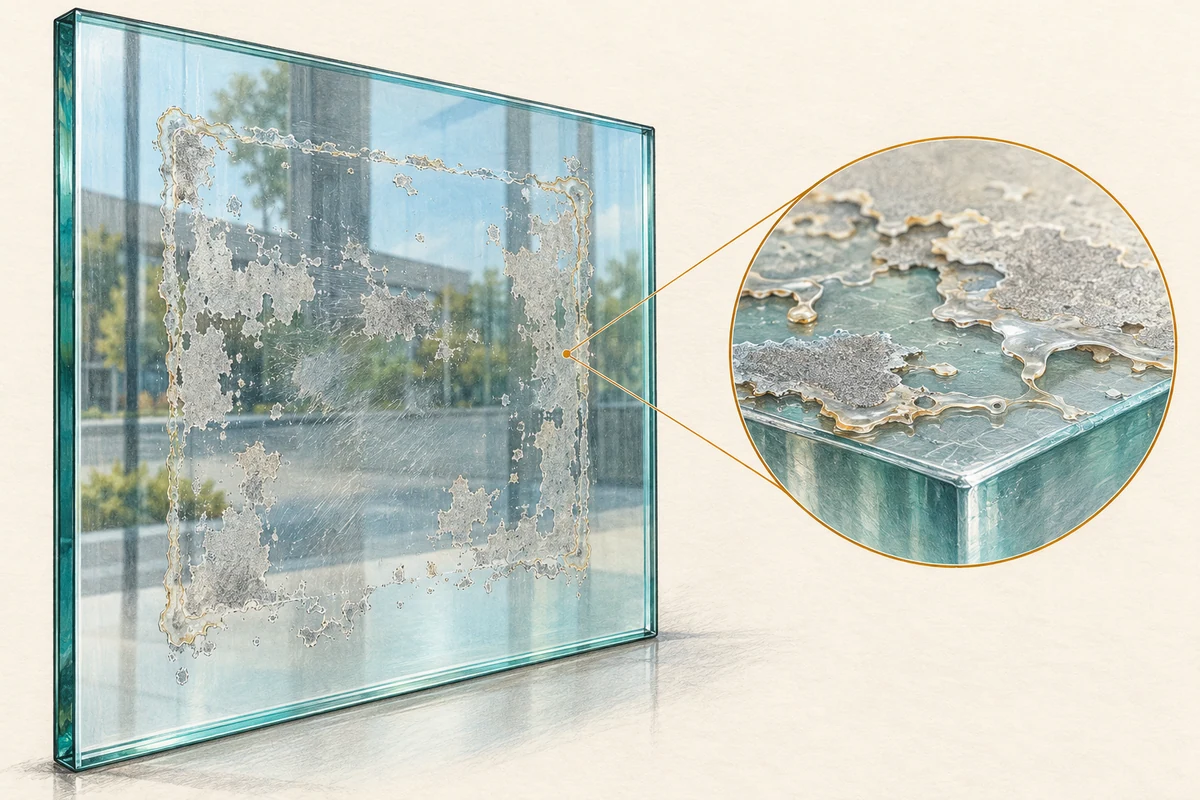
Anti-graffiti coating ghost is an appearance change on glass resulting from application, partial removal, or chemical alteration of anti-graffiti barrier products (sacrificial wax/polymer films or “permanent” polysiloxane/fluoropolymer systems).
Classification & Scope (Normative)
NormativeAnti-graffiti coating ghost is an appearance change on glass resulting from application, partial removal, or chemical alteration of anti-graffiti barrier products (sacrificial wax/polymer films or “permanent” polysiloxane/fluoropolymer systems). After cleaning events (alkaline/solvent/oxidizer) or weathering, the barrier can leave optical veils, patch maps, edge laps, and in aged cases very shallow micro-texture within affected zones. Classification is appearance-only per VIS (method-agnostic). Inspect after Non-Invasive Reveal under VIS lighting/geometry; record surface numbering and worked-surface status. Treat unknown residues as chemical exposure zones; document per site safety.
Typical Presentation (Informative)
Informative- Patchy sheen with rectilinear or roller/cloth arcs reflecting prior application/removal paths; edge-lap lines and holidays (“missed” islands) may be visible.
- Water-behavior contrast (beading vs. sheeting) across patch boundaries if hydrophobic character remains.
- Aged or chemically attacked films can show dirty tide lines (preferential soil load) and, at raking, very fine modeled micro-texture.
Field Identification Cues (Normative)
NormativeSurface-catch class (MSRT)
- Commonly SC-0 (film/wetting difference only).
- SC-1 (slight) may appear on aged / cross-linked or chemically attacked zones; SC-2 uncommon.
- Perform one light, non-marring pass on a revealed test patch (substrate) only; polymer stylus if a factory functional coating may be present. MSRT supports classification only.
Visual signature
- Application geometry: roller stops, cloth arcs, rectangular mask lines, or overlap seams; optical veil/patch within boundaries.
- No chip-flank sparkle (not mechanical scoring); no discrete fused nodules/pits (not hot-particle).
Functional cue (optional wetting test).
- Light mist test may reveal contact-angle contrast across the ghost boundary (beading on treated side). Photograph immediately; avoid flooding IGU edges.
Viewing / lighting
- Evaluate clean & dry at 12 / 36 / 72 in, normal incidence and oblique sweep (~60°-120°); use raking light for boundary/veil readability. Record distances/angles in-frame.
Location / access
- Record pane ID and surface numbering (#1-#4; laminate-internal). If fixed parallax indicates between-pane condition (cavity contamination), classify CAT-5 by location and refer.
Mechanism cue (context)
- Evidence of graffiti response (tags, removal notes), contractor logs citing anti-graffiti products, pressure-washing / chemical removal, or remaining masking lines.
Severity & CAT Mapping (Normative)
NormativeAssign CAT by visibility impact and MSRT after reveal. Depth values are indicative-field measurement not required.
- CAT-1 (Benign / non-relief): Optical veil/patchiness or wetting contrast only; SC-0; visible mainly in angle/raking. Indicative relief: 0-10 μm (optical).
- CAT-2 (Light): Persistent halo/patch with SC-1 on aged/altered zones; limited impact at standard view. Indicative relief: ~10-40 μm.
- CAT-3 (Moderate): Broader patch map / edge-lap network legible at standard distance; SC-1 → SC-2 in most affected areas. Indicative relief: ~40-120 μm.
- CAT-4 (Severe): Rare for anti-graffiti alone; where pronounced matte fields or widespread micro-texture exist, consider mixed chemistry (alkali/oxidizer stacks) and re-evaluate under applicable DSS. Indicative relief: ~120-300 μm+.
- CAT-5 (by condition/location): Between-pane/inaccessible by parallax, integrity indicators (active cracks/pane movement), or confirmed functional-coating loss on the surface to be worked → CAT-5.
CAT is appearance-based; acceptance is separate under VIS-A at 12/36/72 in. For factory functional coated faces, see VIS §6.2.e (appearance on worked coated surfaces).
Differentiation & Mis-ID Pitfalls (Informative)
Informative- vs. Hydrophobic coating mismatch (Ch.06.02): Both show wetting edges; mismatch halos track consumer hydrophobics with crisp arcs/blocks across open glass fields; anti-graffiti ghosts often correlate with graffiti-adjacent zones and removal patterns (roller/brush rectangles, pressure-wash fans).
- vs. Silane/siloxane migration (Ch.06.01): Migration halos align to masonry treatment geometry/weep paths; anti-graffiti ghosts align to glass-only application/removal and graffiti events.
- vs. Mineral staining/etch (Ch.03): Mineral phenomena show rings/runs and may exhibit modeled micro-texture within those footprints; ghosts exhibit boundary maps from coating work, often with wetting contrast.
- vs. Residue films (R-family): General films lack distinct application geometry and wetting discontinuities.
- vs. Coating anomalies (Co-family manufacturing): Factory coating rub/patchiness resides typically on #2/#3 faces and follows production/handling logic; anti-graffiti ghosts are field-applied on the exposed face and correlate with graffiti mitigation.
Evidence Package *(Documentation Requirements) (Normative)
Normative- Photo set (VIS): 12 / 36 / 72 in, normal + oblique; include raking macros of edge-lap lines, patch interiors, and any holiday regions; add context frames (tag remnants, masking, equipment). Record distance/angle in-frame.
- Wetting behavior documentation (supplemental). Light mist test straddling a boundary; photograph immediate beading/sheeting contrast. Avoid flooding edges/IGU seals.
- MSRT result: One light, non-marring pass on a clean test patch; record SC-class (SC-0/SC-1/SC-2). Polymer stylus if a factory functional coating may be present.
- Forms: Pane ID; product family & surface numbering; worked surface Y/N; functional coating present on worked surface? (Y/N/Unknown); reveal status; lighting/time; geometry checklist; wetting test photos attached.
- Acceptance split: Post-restoration acceptance per VIS-A §6; classification ≠ acceptance. Coated-face appearance rules apply per VIS §6.2.e when the worked surface is a factory functional coating.
Reporting Language (Template)
Template- Ch.06.03 Anti-Graffiti Coating Ghost (chemically altered) - Patch/edge-lap map with optical veil on surface #___; mist test shows wetting contrast across boundaries. Post-reveal test patch reads [SC-0/SC-1]; visible at [12/36/72 in] under VIS geometry. Morphology: roller/cloth arcs, rectangular mask lines, holidays; no chip-flank sparkle, no discrete pepper. Classification: CAT-[1/2/3/4] by visibility and SC-class; CAT-5 if between-pane, integrity cues, or coating-side loss on the surface to be worked. Forms + photo + wetting documentation attached; acceptance per VIS-A §6.
⭐ DSS-R
Damage Specification Standards 2026
DSS-R Residues/Films/Transfers
Draft v1.0
R.01 Sealants & Adhesives
- R.01.01 Silicone smear / tool‐mark film
- R.01.02 Butyl/PIB/IG sealant smear
- R.01.03 Polysulfide/polyurethane smear
- R.01.04 Mastic/bitumen/tar transfer
- R.01.05 Adhesive label/sticker ghost
- R.01.06 Protective film adhesive residue (aged)
R.02 Construction Overspray & Films
- R.02.01 Paint overspray film (latex/alkyd)
- R.02.02 Drywall mud/plaster film
- R.02.03 Stucco/lime film (residue)
R.03 Handling & Packaging
- R.03.01 Suction cup rings (residue/pressure mark)
- R.03.02 Separator pad ghost / “waffle” print
- R.03.03 Roller/handling rail transfer
R.04 Operations/Maintenance Films
- R.04.01 Detergent/surfactant film
- R.04.02 Fabric softener/cleaner additive film
- R.04.03 HVAC aerosol/oil film
- R.04.04 Kitchen grease/aerosol film
- R.04.05 Nicotine/tar film
R.05 Rubber/Plastic Transfers
- R.05.01 EPDM gasket black rub
- R.05.02 PVC plasticizer smear/migration film
- R.05.03 Neoprene roller transfer
R.06 Metallic Transfer
- R.06.01 Aluminum rub/grey smear
- R.06.02 Steel/ferrous rub/black smear
Related glossary terms
- Adhesive residueGRK-061
- Paint oversprayGRK-063
- Raking lightGRK-129
- Coating rubGRK-115
- Test patchGRK-144
Source and version
GlassRenu Damage Specification Sheets (DSS), DSS-Ch.06.03. Source revision and extraction date are recorded in the deployment manifest.
Open the complete published DSS with table of contents (PDF)
Normative and informative labels are preserved from the source. The downloadable one-sheet is a condensed classification aid; this web page retains the complete source-based specification content.