
On this page
- Diagnosis summary
- Safety and classification scope
- Classification & Scope (Normative)
- Typical Presentation (Informative)
- Field Identification Cues (Normative)
- Surface-catch class (MSRT)
- Visual signature
- Viewing / lighting
- Location / access
- Mechanism cue (context)
- Severity & CAT Mapping (Normative)
- Differentiation & Mis-ID Pitfalls (Informative)
- Evidence Package *(Documentation Requirements) (Normative)
- Reporting Language (Template)
- Related glossary terms
- Related DSS
- Source and version
DAMAGE SPECIFICATION STANDARD / METHOD-AGNOSTIC
DSS-E.01.04 — Condensation / Runoff Patterns
Environmental residue/attack - recurring moisture paths concentrating soils/minerals; rivulet maps, drip legs, head-to-sill curtains; typically SC-0 for residue films, SC-1 where micro-texture develops from cyclic deposition
Diagnosis summary
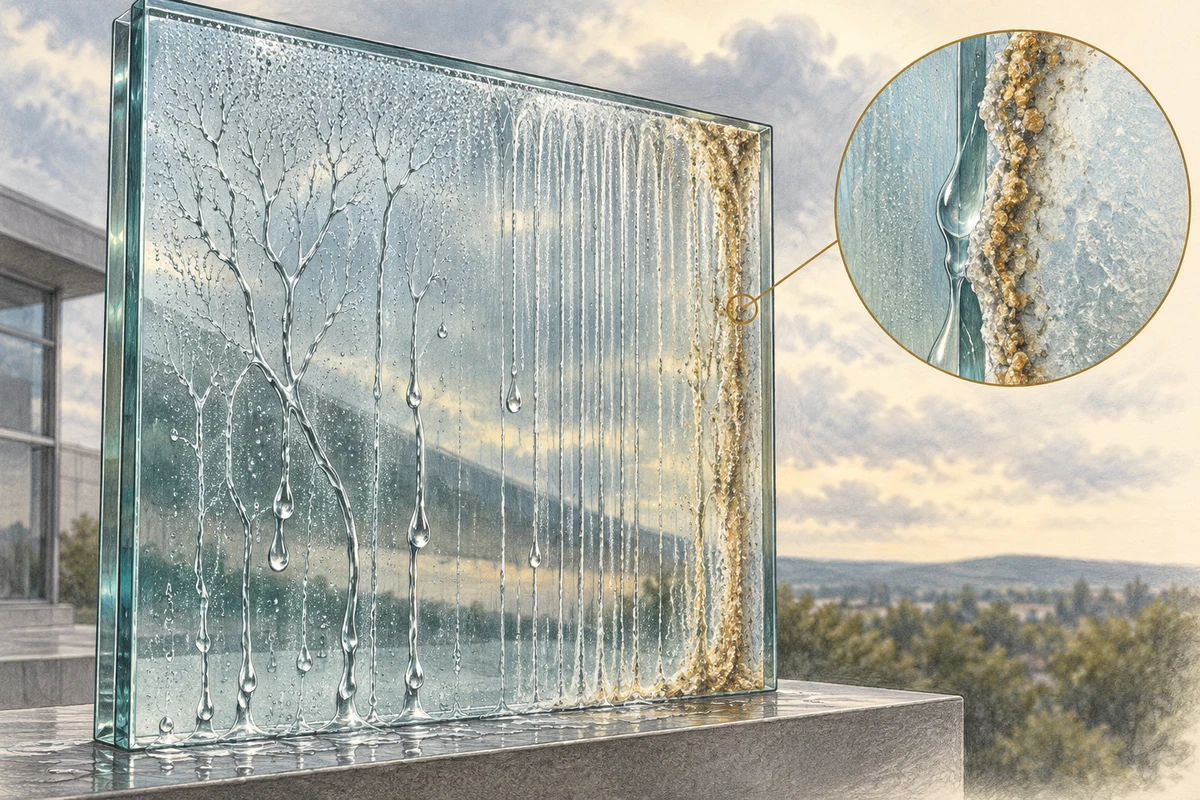
Condensation / runoff patterns are appearance changes on glass driven by recurrent water paths (dew, HVAC condensation, building runoff, irrigation overspray) that concentrate dissolved soils/minerals and produce rivulet maps, drip legs, curtains, and edge blooms. With prolonged cycling, very shallow micro-texture may form in preferred paths. Classification is appearance-only per VIS (method-agnostic).
Classification & Scope (Normative)
NormativeCondensation / runoff patterns are appearance changes on glass driven by recurrent water paths (dew, HVAC condensation, building runoff, irrigation overspray) that concentrate dissolved soils/minerals and produce rivulet maps, drip legs, curtains, and edge blooms. With prolonged cycling, very shallow micro-texture may form in preferred paths. Classification is appearance-only per VIS (method-agnostic). Inspect after Non-Invasive Reveal under VIS lighting/geometry; record surface numbering and worked-surface status.
Typical Presentation (Informative)
Informative- Vertical “drip legs” emanating from head frames, mullions, signage, or projection elements; fan-shaped curtains from head to sill.
- Rivulet networks that repeat pane-to-pane based on façade geometry; edge blooms where water pools/dwells at gaskets.
- Under raking: sheen discontinuities along flow lines; where cycling is long-term, low-contrast matte within the path.
Field Identification Cues (Normative)
NormativeSurface-catch class (MSRT)
- SC-0 for residue films that lift on reveal.
- SC-1 where incipient micro-texture is present inside flow paths (slight tactile interruption, no chip flanks). SC-2 suggests misclassification-evaluate Ch.03.03 mineral etching or M.02 abrasion if present.
- Perform one light, non-marring pass on a small revealed test patch (substrate). Use polymer stylus if a functional coating is suspected. MSRT supports classification only.
Visual signature
- Continuous flow lines from a discernible origin (head/drip edge/hardware) to sill; branching rivulets that merge/split; repeating geometry across adjacent lites.
- No chip-flank sparkle (not linear scoring); no fused pits/nodules (not hot particle).
Viewing / lighting
- Evaluate clean & dry at 12 / 36 / 72 in, normal incidence and oblique sweep (~60°-120°); use raking to reveal flow edges and matte inside paths. Record distances/angles in-frame.
Location / access
- Record pane ID and surface numbering (#1-#4; laminate-internal). Most common on outboard (#1) faces; interiors (#4) where condensation is recurrent (pools, natatoriums, chilled beams). Between-pane by parallax on #2/#3 → CAT-5 by location.
Mechanism cue (context)
- Roof/facade runoffs, misaligned drips, sprinkler overspray, condensation from HVAC diffusers, uninsulated frames, or thermal bridges producing interior condensate trails.
Severity & CAT Mapping (Normative)
NormativeAssign CAT by visibility at acceptance geometry and MSRT after a reveal patch. Depth values are indicative-field measurement not required.
- CAT-1 (Benign / non-relief): Clear rivulet/drip pattern comprised of residue only; SC-0; mainly angle/raking visible; lifts on reveal patch. Indicative relief: 0-10 μm (optical film).
- CAT-2 (Light): Persistent flow mapping post-reveal with localized SC-1 (incipient micro-texture from cycling); limited standard-view impact. Indicative relief: ~10-40 μm.
- CAT-3 (Moderate): Wide-area, legible flow curtains at standard distance with consistent SC-1 and low-contrast matte inside paths; indicates long dwell/high frequency. Indicative relief: ~40-120 μm.
- Reclassify when: Distinct white/grey crystalline rims or etched halos dominate → evaluate Ch.03 (mineral deposits/staining/etching); linear swirl/abrasion → M.02 abrasion fields.
- CAT-5 (by condition/location): Between-pane/inaccessible by parallax, integrity indicators, or confirmed functional-coating loss on the surface to be worked → CAT-5.
CAT is appearance-based; acceptance is separate under VIS-A at 12/36/72 in. Do not abrade to “force” a response during classification.
Differentiation & Mis-ID Pitfalls (Informative)
Informative- vs. Hard-water mineral system (Ch.03): Minerals show crystalline rings/rims and can progress to etch; pure runoff mapping may lack crystals and lifts on reveal.
- vs. Detergent/surfactant film (R.04.01): Detergent presents tool-path streaks/iridescence; runoff follows gravity paths from a structural origin with no wipe geometry.
- vs. Atmospheric corrosion matte (E.01.02): Atmospheric matte is global/non-directional; runoff patterns are directional with clear origins and branching trails.
- vs. Kitchen/HVAC films (R.04.03/04): Those show oily/tacky veils and wetting anomalies; runoff is flow-path specific and often coincident with drip edges or sprinkler arcs.
Evidence Package *(Documentation Requirements) (Normative)
Normative- Photo set (VIS): 12 / 36 / 72 in, normal + oblique; raking macros of flow edges/matte fields; context frames of origins (head/drip edge/sprinkler/diffuser) and multiple adjacent lites to show repeatability. Record distance/angle in-frame.
- MSRT result (substrate): After a small reveal test patch, perform one light, non-marring pass; record SC-class (SC-0/SC-1/SC-2).
- Forms: Pane ID; product family & surface numbering; worked surface Y/N; functional coating present on worked surface? (Y/N/Unknown); reveal status; lighting/time; geometry checklist; photos attached.
- Acceptance split: Post-restoration acceptance per VIS-A §6; classification ≠ acceptance. Coated-face appearance rules apply per VIS §6.2.e when the worked surface is a factory functional coating.
Reporting Language (Template)
Template- E.01.04 Condensation / Runoff Patterns - Directional rivulet/drip mapping from [origin: head frame / sprinkler / diffuser / hardware] on surface #___; post-reveal test patch shows [SC-0/SC-1]; visible at [12/36/72 in] under VIS geometry. Morphology: flow lines, curtains, edge blooms; no chip-flank sparkle, no pits. Classification: CAT-[1/2/3] by visibility and SC-class; reclassify to Ch.03 if crystalline rims/etch halos dominate; CAT-5 if between-pane or coating-side loss on the surface to be worked. Forms + photo set attached; acceptance per VIS-A §6.
Related glossary terms
- RepeatabilityGRK-150
- Test patchGRK-144
- AbrasionGRK-035
- DepositGRK-045
Source and version
GlassRenu Damage Specification Sheets (DSS), DSS-E.01.04. Source revision and extraction date are recorded in the deployment manifest.
Open the complete published DSS with table of contents (PDF)
Normative and informative labels are preserved from the source. The downloadable one-sheet is a condensed classification aid; this web page retains the complete source-based specification content.