
On this page
- Diagnosis summary
- Safety and classification scope
- Classification & Scope (Normative)
- Typical Presentation (Informative)
- Field Identification Cues (Normative)
- Surface-catch class (MSRT)
- Visual signature
- Viewing / lighting
- Location / access
- Mechanism cue (context)
- Severity & CAT Mapping (Normative)
- Differentiation & Mis-ID Pitfalls (Informative)
- Evidence Package *(Documentation Requirements) (Normative)
- Reporting Language (Template)
- Related glossary terms
- Related DSS
- Source and version
DAMAGE SPECIFICATION STANDARD / METHOD-AGNOSTIC
DSS-E.02.01 — Wind-Borne Sand Abrasion (Eolian)
Environmental abrasion - airborne mineral particulates driven by wind; directional frosting, lee-side bias, frame-adjacent “blast” zones; typically SC-1 to SC-2 where micro-texture/incisions exist
Diagnosis summary
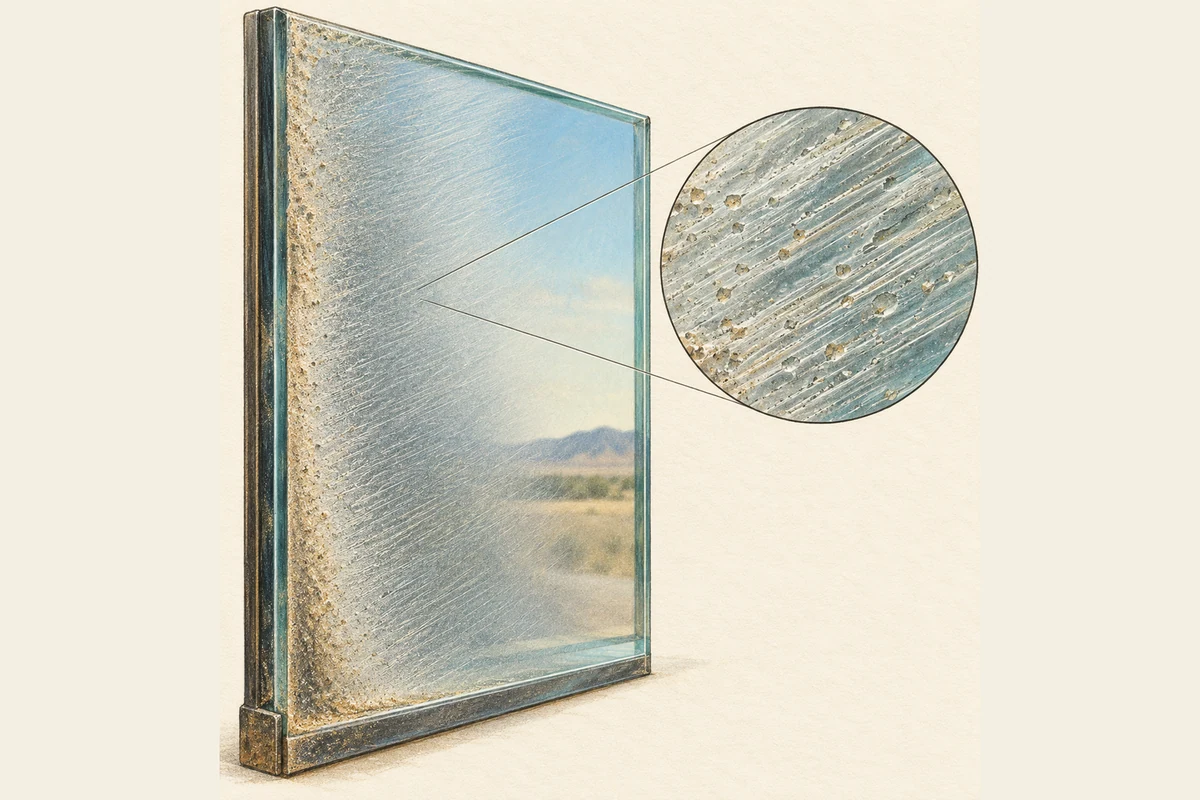
Wind-borne sand abrasion is an appearance change on glass caused by air-entrained mineral particulates (silica, feldspar, grit) scouring exposed faces under sustained winds. It presents as directional frosting/haze, micro-pitting, and fine linear incisions concentrated on windward elevations and edge “blast” zones near frames and corners. Classification is appearance-only per VIS (method-agnostic).
Classification & Scope (Normative)
NormativeWind-borne sand abrasion is an appearance change on glass caused by air-entrained mineral particulates (silica, feldspar, grit) scouring exposed faces under sustained winds. It presents as directional frosting/haze, micro-pitting, and fine linear incisions concentrated on windward elevations and edge “blast” zones near frames and corners. Classification is appearance-only per VIS (method-agnostic). Inspect after Non-Invasive Reveal under VIS lighting/geometry; record surface numbering and worked-surface status.
Typical Presentation (Informative)
Informative- Matte/frosted fields with grain-aligned directionality (prevailing wind).
- Heavier strike at leading edges, mullion reveals, parapet-level lites, and near grade in arid sites.
- Under raking: uniform scatter from micro-texture, interspersed with fine, shallow incisions; may show height gradient (stronger low, tapering upward).
Field Identification Cues (Normative)
NormativeSurface-catch class (MSRT)
- Commonly SC-1 (fine micro-texture) progressing to SC-2 where micro-pits/incipient incisions are present; SC-0 only at earliest film-only stages.
- Perform one light, non-marring pass on a small revealed test patch (substrate). Use a polymer stylus if a functional coating is suspected. MSRT supports classification only.
Visual signature
- Directional matte (frosted look) with grain-wise streaking; no oily gloss, no wipe arcs.
- Under oblique sweep, sparkle is absent (not chip-flank sparkle) but catch is tactile where incisions/pits exist.
Viewing / lighting
- Evaluate clean & dry at 12 / 36 / 72 in, normal and oblique sweep (~60°-120°); use low-angle raking to reveal directional micro-texture and localized edge blast. Record distances/angles in-frame.
Location / access
- Record pane ID and surface numbering (#1-#4; laminate-internal). Predominant on outboard (#1) faces. Between-pane by parallax on #2/#3 → CAT-5 by location.
Mechanism cue (context)
- Arid/coastal dunes, construction sites with exposed soils, high-wind corridors, sand storms; adjacent abrasive landscaping media or unpaved lots.
Severity & CAT Mapping (Normative)
NormativeAssign CAT by visibility at acceptance geometry and MSRT after a reveal patch. Depth values are indicative-field measurement not required.
- CAT-2 (Light): Incipient directional haze; SC-1 (micro-texture), minimal standard-view impact; isolated shallow ticks. Indicative relief: ~10-40 μm.
- CAT-3 (Moderate): Distinct directional frosting legible at standard distance; consistent SC-1 with scattered SC-2 from micro-pits/incisions. Indicative relief: ~40-120 μm.
- CAT-4 (Severe): Wide-area matte/frosted fields and roughened strike zones clearly visible at standard and wide-field views; SC-2 prevalent with micro-pitting. Indicative relief: ~120-300 μm (local maxima can exceed).
- Reclassify when: If fused nodules/peppering or rust-toned dots appear → evaluate Th.01.02 grinder spark embed; if patterns are non-directional milky without catch → consider E.01.02 atmospheric matte; if linear, incised score lines dominate with chip-flank sparkle → evaluate M.01 linear scoring.
- CAT-5 (by condition/location): Between-pane/inaccessible by parallax, integrity indicators, or confirmed functional-coating loss on the surface to be worked → CAT-5.
CAT is appearance-based; acceptance is separate under VIS-A at 12/36/72 in. Do not abrade to “force” a response during classification.
Differentiation & Mis-ID Pitfalls (Informative)
Informative- vs. Atmospheric corrosion matte (E.01.02): Atmospheric matte is non-directional and edge/rivulet biased; eolian abrasion is directional with prevailing-wind alignment.
- vs. Residue films (R-family): Residues show wipe geometry, wetting anomalies, or odor; eolian abrasion shows grain-aligned scatter, no wipe arcs, and tactile catch at SC-1/2.
- vs. Mineral etching (Ch.03.03): Mineral etch maps drip/ring halos; eolian abrasion forms broad directional fields and edge blast unrelated to water paths.
- vs. Hot particle (Th.01): Hot particle shows discrete pits/fused nodules (pepper); eolian abrasion shows continuous frost with micro-pitting, not fused beads.
Evidence Package *(Documentation Requirements) (Normative)
Normative- Photo set (VIS): 12 / 36 / 72 in, normal + oblique; raking macros of directional micro-texture, edge blast, and height gradient; façade context showing ground conditions/wind exposure. Record distance/angle in-frame.
- MSRT result (substrate): After a small reveal test patch, perform one light, non-marring pass; record SC-class (SC-1/SC-2, or SC-0 if truly film-only).
- Forms: Pane ID; product family & surface numbering; worked surface Y/N; functional coating present on worked surface? (Y/N/Unknown); reveal status; lighting/time; geometry checklist; photos attached.
- Acceptance split: Post-restoration acceptance per VIS-A §6; classification ≠ acceptance. Coated-face appearance rules apply per VIS §6.2.e when the worked surface is a factory functional coating.
Reporting Language (Template)
Template- E.02.01 Wind-Borne Sand Abrasion - Directional frosting with edge blast on surface #___ (windward); post-reveal test patch shows [SC-1/SC-2]; visible at [12/36/72 in] under VIS geometry. Morphology: grain-aligned scatter, micro-pitting/incisions, no wipe arcs, no fused nodules. Classification: CAT-[2/3/4] by visibility and SC-class; reclassify per notes if peppering/nodules or non-directional matte is observed; CAT-5 if between-pane or coating-side loss on the surface to be worked. Forms + photo set attached; acceptance per VIS-A §6.
Related glossary terms
Source and version
GlassRenu Damage Specification Sheets (DSS), DSS-E.02.01. Source revision and extraction date are recorded in the deployment manifest.
Open the complete published DSS with table of contents (PDF)
Normative and informative labels are preserved from the source. The downloadable one-sheet is a condensed classification aid; this web page retains the complete source-based specification content.