
On this page
- Diagnosis summary
- Safety and classification scope
- Classification & Scope (Normative)
- Typical Presentation (Informative)
- Field Identification Cues (Normative)
- Surface-catch class (MSRT)
- Visual signature
- Viewing / lighting
- Location / access
- Mechanism cue (context)
- Severity & CAT Mapping (Normative)
- Differentiation & Mis-ID Pitfalls (Informative)
- Evidence Package *(Documentation Requirements) (Normative)
- Reporting Language (Template)
- DSS-E.04.02 - Thermal Bridging Condensation Patterning
- Classification & Scope (Normative)
- Typical Presentation (Informative)
- Field Identification Cues (Normative)
- Surface-catch class (MSRT)
- Visual signature
- Viewing / lighting
- Location / access
- Mechanism cue (context)
- Severity & CAT Mapping (Normative)
- Differentiation & Mis-ID Pitfalls (Informative)
- Evidence Package *(Documentation Requirements) (Normative)
- Reporting Language (Template)
- Related glossary terms
- Related DSS
- Source and version
DAMAGE SPECIFICATION STANDARD / METHOD-AGNOSTIC
DSS-E.04.01 — Recurring Drip / Run Staining Pattern
Environmental residue/attack - repetitive gravity-flow paths concentrating soils/minerals from architectural features; vertical drip legs, fan runs, repeat at identical elevations; typically SC-0 for residue films, SC-1 where cyclic deposition forms very shallow micro-texture; reclassify to mineral system if crystalline rims/etch are dominant
Diagnosis summary
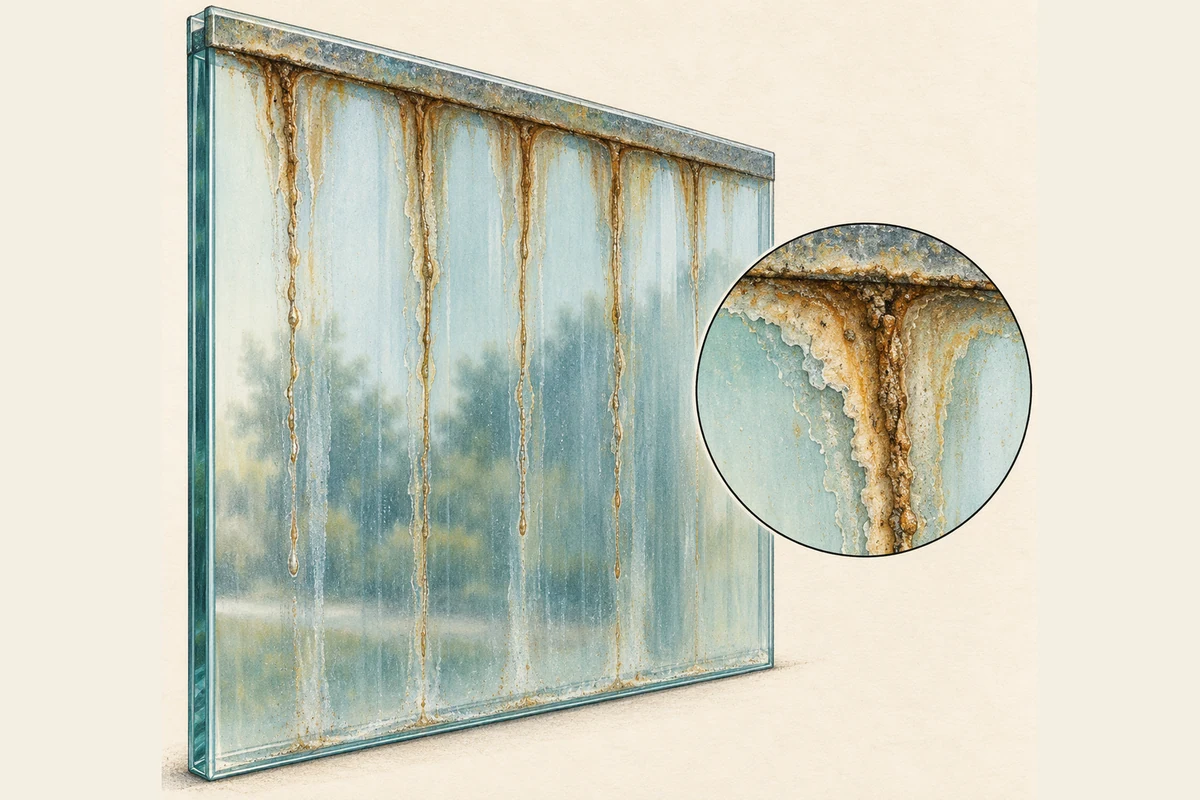
Recurring drip/run staining is an appearance change on glass caused by repeated gravity-driven moisture paths that carry soils/minerals/organics from upstream features (caps, signage letters, flashings, parapets, shading fins). It presents as vertical “drip legs,” fan-shaped runs, or curtains that repeat at the same height across adjacent lites beneath the same source detail.
Classification & Scope (Normative)
NormativeRecurring drip/run staining is an appearance change on glass caused by repeated gravity-driven moisture paths that carry soils/minerals/organics from upstream features (caps, signage letters, flashings, parapets, shading fins). It presents as vertical “drip legs,” fan-shaped runs, or curtains that repeat at the same height across adjacent lites beneath the same source detail. With extended cycling, very shallow micro-texture may form within the flow paths. Classification is appearance-only per VIS (method-agnostic). Inspect after Non-Invasive Reveal under VIS lighting/geometry; record surface numbering and worked-surface status.
Typical Presentation (Informative)
Informative- Parallel drip legs or fan runs that start at a common elevation (beneath a continuous head/cap or line of letters) and extend toward the sill.
- Density/width increases beneath joints or fasteners where leakage starts; pane-to-pane repeatability is common.
- Under raking: sheen change along leg edges; in long-dwell cases, a low-contrast matte appears inside the path.
Field Identification Cues (Normative)
NormativeSurface-catch class (MSRT)
- SC-0 where contamination is residual film only and lifts on reveal.
- SC-1 where incipient micro-texture exists from cyclic deposition/soils. SC-2 suggests misclassification-consider Ch.03.03 mineral etching or M.02 abrasion.
- Perform one light, non-marring pass on a small revealed test patch (substrate). Use a polymer stylus if a functional coating is suspected. MSRT supports classification only
Visual signature
- Directional, gravity-consistent flow mapping with a discernible origin line (elevation) and repetition on adjacent lites.
- No chip-flank sparkle (not scoring); no fused pits (not hot particle).
Viewing / lighting
- Evaluate clean & dry at 12 / 36 / 72 in, normal and oblique sweep (~60°-120°); use raking to reveal leg edges and interior matte. Record distances/angles in-frame.
Location / access
- Record pane ID and surface numbering (#1-#4; laminate-internal). Typically outboard (#1); between-pane by parallax on #2/#3 → CAT-5 by location.
Mechanism cue (context)
- Architectural drip sources visible above (parapet caps, letterforms, shading devices, leaking joints), irrigation overspray from height, or condensate rails.
Severity & CAT Mapping (Normative)
NormativeAssign CAT by visibility at acceptance geometry and MSRT after a reveal patch. Depth values are indicative-field measurement not required.
- CAT-1 (Benign / non-relief): Legible drip runs comprised of residue film only; SC-0; mainly angle/raking visible; lifts on reveal. Indicative relief: 0-10 μm.
- CAT-2 (Light): Persistent runs post-reveal with localized SC-1 (incipient micro-texture); limited standard-view impact. Indicative relief: ~10-40 μm.
- CAT-3 (Moderate): Wide-area run curtains legible at standard distance with consistent SC-1 and interior low-contrast matte; indicates long dwell/high frequency. Indicative relief: ~40-120 μm.
- Reclassify when: White/grey crystalline rims, ringed edges, or etched halos dominate → Ch.03 Mineral system (Deposits/Staining/Etching). If linear swirl from cleaning attempts persists → M.02 Abrasion fields.
- CAT-5 (by condition/location): Between-pane/inaccessible by parallax, integrity indicators, or confirmed functional-coating loss on the surface to be worked → CAT-5.
CAT is appearance-based; acceptance is separate under VIS-A at 12/36/72 in. Do not abrade to “force” a response during classification.
Differentiation & Mis-ID Pitfalls (Informative)
Informative- vs. Condensation/runoff (E.01.04 general): E.01.04 covers the general phenomenon; E.04.01 is used when repeatable source-specific runs from architectural details are the dominant presentation (spec use case).
- vs. Hard-water mineral system (Ch.03): Minerals exhibit crystalline rims/etch; recurring drip runs may be film-only-verify with reveal + MSRT.
- vs. Detergent/surfactant film (R.04.01): Detergent shows tool-path streaks/iridescence; recurring runs follow gravity from a common elevation with no wipe geometry.
- vs. Atmospheric matte (E.01.02): Atmospheric is global/non-directional; recurring runs are directional, repeat by pane, and tie to visible sources.
Evidence Package *(Documentation Requirements) (Normative)
Normative- Photo set (VIS): 12 / 36 / 72 in, normal + oblique; raking macros of leg edges/interior matte; context frames of source detail and adjacent panes showing height repetition. Record distance/angle in-frame.
- MSRT result (substrate): After a small reveal test patch, perform one light, non-marring pass; record SC-class (SC-0/SC-1/SC-2).
- Forms: Pane ID; product family & surface numbering; worked surface Y/N; functional coating present on worked surface? (Y/N/Unknown); reveal status; lighting/time; geometry checklist; photos attached.
- Acceptance split: Post-restoration acceptance per VIS-A §6; classification ≠ acceptance. Coated-face appearance rules apply per VIS §6.2.e when the worked surface is a factory functional coating.
Reporting Language (Template)
Template- E.04.01 Recurring Drip / Run Staining Pattern - Directional drip legs/fan runs repeating at [elevation] beneath [source detail] on surface #___; post-reveal test patch shows [SC-0/SC-1]; visible at [12/36/72 in] under VIS geometry. Morphology: gravity-consistent flow, pane-to-pane repetition, no chip-flank sparkle, no pits. Classification: CAT-[1/2/3] by visibility and SC-class; reclassify to Ch.03 if crystalline rims/etch dominate; CAT-5 if between-pane or coating-side loss on the surface to be worked. Forms + photo set attached; acceptance per VIS-A §6.
DSS-E.04.02 - Thermal Bridging Condensation Patterning
(Environmental residue/attack - interior or exterior moisture condensing along cold bridges and isotherms; ghosted grids/stripes at mullions/spandrels, oval “cold spots”; typically SC-0 for residue films, localized SC-1 where cyclic wet/dry leaves very shallow micro-texture)
Classification & Scope (Normative)
NormativeThermal bridging condensation patterning is an appearance change on glass caused by recurrent condensation along thermal bridges (metal mullions, anchors, frame receptors, spandrels, poorly insulated interfaces) and isotherm lines. Moisture cycles deposit/redistribute soils or dissolved minerals, yielding ghosted grids, stripes, ovals, or edge blooms that mirror the underlying framing or cold-spot geometry. Classification is appearance-only per VIS (method-agnostic). Inspect after Non-Invasive Reveal under VIS lighting/geometry; record surface numbering and worked-surface status.
Typical Presentation (Informative)
Informative- Interior (#4) winter cases: Pale bands/rectangles tracing mullion locations, pane edges, or spandrel transitions; strongest during/after cold snaps or high indoor humidity.
- Exterior (#1) summer cases: Ghosted ovals/bands at thermal bridges (shadow boxes, anchors) where nighttime cooling and morning dew repeat.
- Edge blooms or narrow outlines following setting blocks/gaskets; repeatable pane-to-pane at identical structural locations.
Field Identification Cues (Normative)
NormativeSurface-catch class (MSRT)
- SC-0 for film-only residues that lift on reveal.
- SC-1 localized where long dwell/cycling leaves very shallow micro-texture inside the condensation footprint; SC-2 suggests misclassification-consider Ch.03.03 mineral etching or M.02 abrasion if present.
- Perform one light, non-marring pass on a small revealed test patch (substrate). Use polymer stylus if a functional coating is suspected. MSRT supports classification only.
Visual signature
- Geometry-locked mapping (grids/stripes/ovals) that matches framing/anchors/spandrel boundaries; uniform tone shift rather than linear scoring; no chip-flank sparkle; no pits.
- Under raking: sheen discontinuity along pattern edges; interior cases often show breathing with HVAC cycles.
Viewing / lighting
- Evaluate clean & dry at 12 / 36 / 72 in, normal and oblique sweep (~60°-120°); use raking to reveal pattern edges and any interior matte. Record distances/angles in-frame.
Location / access
- Record pane ID and surface numbering (#1-#4; laminate-internal). Interior (#4) presentations are common in cold-weather condensation; exterior (#1) in dew cycles. Between-pane mapping on #2/#3 via parallax → CAT-5 by location.
Mechanism cue (context)
- Thermal bridges (continuous aluminum, poorly broken frames), high indoor RH, HVAC setbacks, night sky cooling, shadow box/spandrel transitions, edge spacer influence.
Severity & CAT Mapping (Normative)
NormativeAssign CAT by visibility at acceptance geometry and MSRT after a reveal patch. Depth values are indicative-field measurement not required.
- CAT-1 (Benign / non-relief): Ghosted grid/oval comprised of residue film only; SC-0; mainly angle/raking visible; lifts on reveal. Indicative relief: 0-10 μm.
- CAT-2 (Light): Persistent geometry post-reveal with localized SC-1 (incipient micro-texture from cycling); limited standard-view impact. Indicative relief: ~10-40 μm.
- CAT-3 (Moderate): Wide-area pane-to-pane pattern legible at standard distance with consistent SC-1; indicates long dwell/high frequency cycles. Indicative relief: ~40-120 μm.
- Reclassify when: Crystalline rims/etched halos dominate (rings/runs) → Ch.03 Mineral system; linear wipes/iridescence → R.04.01 Detergent/surfactant film; directional frosting/pits → E.02 eolian / dust-storm; pits/fused nodules → Th.01 hot particle.
- CAT-5 (by condition/location): Between-pane/inaccessible by parallax, integrity indicators, or confirmed functional-coating loss on the surface to be worked → CAT-5.
CAT is appearance-based; acceptance is separate under VIS-A at 12/36/72 in. Do not abrade to “force” a response during classification.
Differentiation & Mis-ID Pitfalls (Informative)
Informative- vs. Ch.03 mineral system: Minerals show white/grey crystalline rims/etched run halos; thermal-bridge mapping is geometry-locked to framing/anchors and may lack crystalline borders.
- vs. Atmospheric matte (E.01.02): Atmospheric is global/non-directional; thermal-bridging is geometric and repeatable.
- vs. Coating anomalies (Co-family): Coating patchiness is often on designated coated faces and not tied to thermal geometry; thermal patterns correlate with substrate temperature fields.
- vs. Residues from cleaning (R.04.01/02): Cleaning films show tool-path streaks/iridescence; thermal patterns follow isotherms, not wipe trajectories.
Evidence Package *(Documentation Requirements) (Normative)
Normative- Photo set (VIS): 12 / 36 / 72 in, normal + oblique; raking macros of pattern edges; context frames of mullion/spandrel layout and adjacent panes to show repeatability. Record distance/angle in-frame.
- MSRT result (substrate): After a small reveal test patch, perform one light, non-marring pass; record SC-class (SC-0/SC-1/SC-2).
- Forms: Pane ID; product family & surface numbering; worked surface Y/N; functional coating present on worked surface? (Y/N/Unknown); reveal status; lighting/time; geometry checklist; photos attached.
- Acceptance split: Post-restoration acceptance per VIS-A §6; classification ≠ acceptance. Coated-face appearance rules apply per VIS §6.2.e when the worked surface is a factory functional coating.
Reporting Language (Template)
Template- E.04.02 Thermal Bridging Condensation Patterning - Geometry-locked ghosting aligned with [mullions/spandrel/anchors/edges] on surface #___; post-reveal test patch shows [SC-0/SC-1]; visible at [12/36/72 in] under VIS geometry. Morphology: grid/stripe/oval mapping of cold-spot isotherms, no chip-flank sparkle, no pits. Classification: CAT-[1/2/3] by visibility and SC-class; reclassify to Ch.03 if crystalline rims/etch dominate, or to R.04.01 if wipe/iridescence patterns are present; CAT-5 if between-pane or coating-side loss on the surface to be worked. Forms + photo set attached; acceptance per VIS-A §6.
Related glossary terms
- StainGRK-046
- RepeatabilityGRK-150
- Setting blockGRK-208
- Test patchGRK-144
- AbrasionGRK-035
- DepositGRK-045
Source and version
GlassRenu Damage Specification Sheets (DSS), DSS-E.04.01. Source revision and extraction date are recorded in the deployment manifest.
Open the complete published DSS with table of contents (PDF)
Normative and informative labels are preserved from the source. The downloadable one-sheet is a condensed classification aid; this web page retains the complete source-based specification content.