
On this page
- Diagnosis summary
- Safety and classification scope
- Definition (Reference)
- Typical Presentation (Informative)
- Classification Mapping (to VIS-DA) (Normative)
- Indicative Relief / Depth (Informative)
- Differentiation & False Positives (Informative)
- Evidence Package (Documentation Requirements) (Normative)
- Related glossary terms
- Related DSS
- Source and version
DAMAGE SPECIFICATION STANDARD / METHOD-AGNOSTIC
DSS-M.03.01 — Edge Micro-Chipping (minor)
Mechanical - perimeter/arris
Diagnosis summary
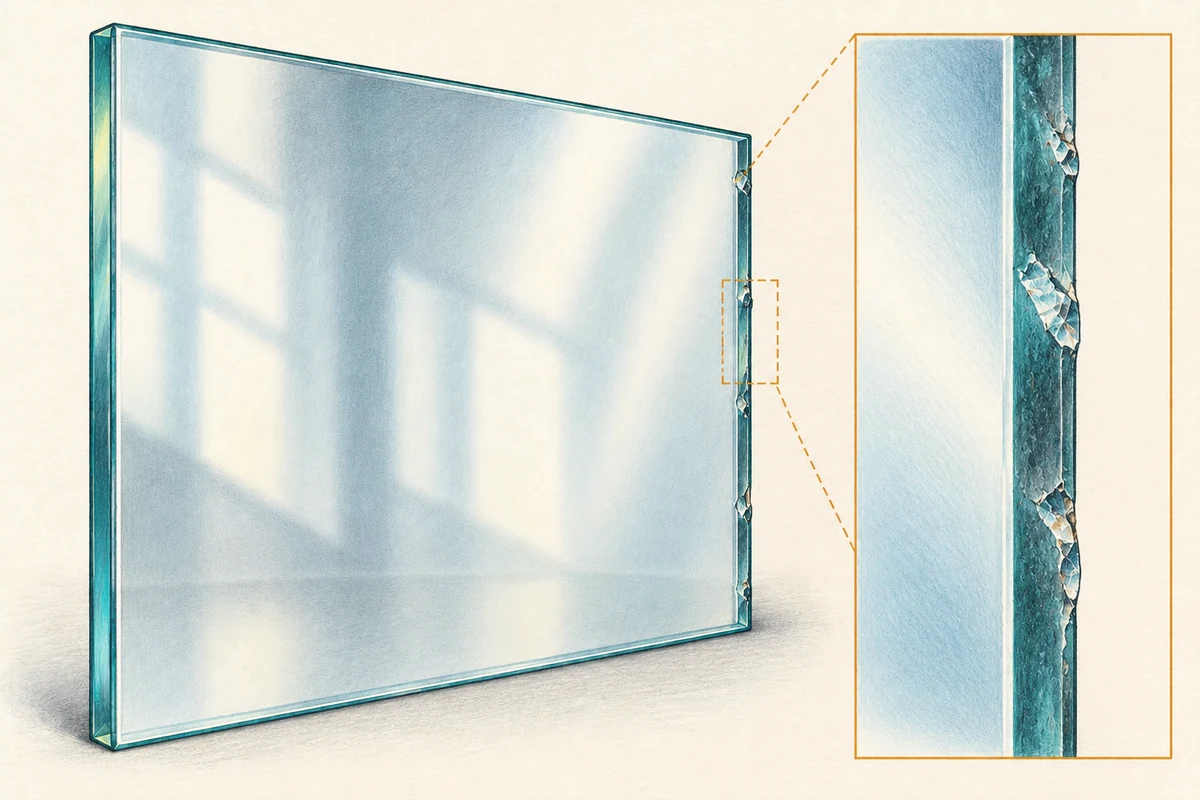
Small, bright edge fractures or “nicks” at or just inside the perimeter arris. Under raking light they present as sparkly facets; at higher severities they may form short “chip flanks” pointing into the face. “Micro-chipping” and “chip flank” are defined in VIS terminology and used here strictly as appearance/morphology cues (classification is appearance-only).
Definition (Reference)
ReferenceSmall, bright edge fractures or “nicks” at or just inside the perimeter arris. Under raking light they present as sparkly facets; at higher severities they may form short “chip flanks” pointing into the face. “Micro-chipping” and “chip flank” are defined in VIS terminology and used here strictly as appearance/morphology cues (classification is appearance-only).
Typical Presentation (Informative)
Informative- Pinpoint to sub-millimetre chips along the edge/arris; isolated or lightly scattered.
- Bright, faceted reflections in raking views; little to no continuous lineation across the face.
- More visible on dark backdrops; persistence after a Non-Invasive Reveal (clean & dry). Field Identification Cues (Normative)
- Surface-catch class (MSRT): SC-1 (slight) to SC-2 (clear) when the stylus traverses a chip that intrudes onto the exposed face. One light, non-marring pass only per VIS §5.5; do not abrade or “probe.” Prefer a polymer stylus on suspected coated faces.
- Visual signature: Discrete, bright facets at the perimeter; may show tiny chip flanks where depth increases. Lack of continuous lineation distinguishes from scoring/tracks.
- Viewing / lighting: Evaluate at 12 / 36 / 72 in, normal incidence + oblique sweep (~60°-120°) under raking light; surfaces must be clean & dry.
- Location / access: Record pane ID, product family, and surface numbering (#1-#4; laminate-internal if applicable) on forms; acceptance pertains to the exposed surface being evaluated.
Classification Mapping (to VIS-DA) (Normative)
Normative- CAT-2 (Light): Small, shallow chips with SC-1 and clean edges, minimal visibility at standard view.
- CAT-3 (Moderate): Clear catch (SC-2) and minor chip flanks; noticeable at standard view.
- CAT-4 (Severe): Pronounced flanks and/or gross edge chipping extending onto the face; pits/craters present.
- CAT-5 (Out of in-place scope): If indicators show the condition is between panes/inaccessible (fixed parallax in IGU) → CAT-5 by location; refer per protocol.
Indicative Relief / Depth (Informative)
InformativeNumeric depth is not required for classification; use MSRT class + morphology. Minor edge micro-chipping that just kisses the face typically reads SC-1 to SC-2 qualitatively (shallow to moderate relief by feel).
Differentiation & False Positives (Informative)
Informative- vs. Seamed/arris edge texture (P.03.01): Factory arris shows a uniform frosted band or fine grind lines with SC-0 on the adjacent face and no chip-flank sparkle. Do not conflate with damage.
- vs. Edge grind/polish pattern (P.03.02): Uniform, edge-parallel grind/polish appearance, SC-0 on the face; no bright chip facets.
- vs. Linear scoring (M.01): Scoring forms extended lines across the face with clear catch; micro-chipping appears as discrete edge nicks rather than a continuous track.
- vs. Drill/slot exit lip (P.03.04): Exit lips are confined to hole/slot perimeters as a factory artifact; on the face MSRT reads SC-0 and no chip-flank morphology.
Evidence Package (Documentation Requirements) (Normative)
Normative- Photo set (VIS): 12 / 36 / 72 in, normal + oblique; include raking macros of representative chips and at least one context frame showing overall edge continuity.
- MSRT result: Record SC-class (none/slight/clear) with one light, non-marring pass; on coated faces, prefer polymer stylus. Forms: Pane ID; product family & surface numbering; worked surface Y/N; functional coating present on worked surface? (Y/N/Unknown); reveal status; lighting/time; geometry checklist; photos attached. Acceptance split: Acceptance is judged per VIS Section 6 at 12/36/72 in; classification ≠ acceptance. Do not conflate perimeter factory features with face-side acceptance. Reporting Language (Template)
M.03.01 - Edge Micro-Chipping (minor): Discrete, bright micro-chips along the perimeter arris observed under VIS geometry; MSRT on the adjacent face records SC-1/SC-2 at chip locations. No continuous scoring track. Classified CAT-2/CAT-3 by appearance (see notes). Documented with raking macros and VIS forms; acceptance per VIS §6 at 12/36/72 in.
Related glossary terms
- ChipGRK-034
- Raking lightGRK-129
Source and version
GlassRenu Damage Specification Sheets (DSS), DSS-M.03.01. Source revision and extraction date are recorded in the deployment manifest.
Open the complete published DSS with table of contents (PDF)
Normative and informative labels are preserved from the source. The downloadable one-sheet is a condensed classification aid; this web page retains the complete source-based specification content.