
On this page
- Diagnosis summary
- Safety and classification scope
- Definition (Reference)
- Typical Presentation (Informative)
- Field Identification Cues (Normative)
- Classification Mapping (to VIS-DA) (Normative)
- Indicative Relief (Informative)
- Differentiation & False Positives (Informative)
- Evidence Package (Documentation Requirements) (Normative)
- Mis-ID Pitfalls (Informative)
- Reporting Language (Template)
- Related glossary terms
- Related DSS
- Source and version
DAMAGE SPECIFICATION STANDARD / METHOD-AGNOSTIC
DSS-P.04.01 — Ceramic Frit Pattern Boundaries (design)
Specialty / decorative system - reference; generally not “damage”
Diagnosis summary
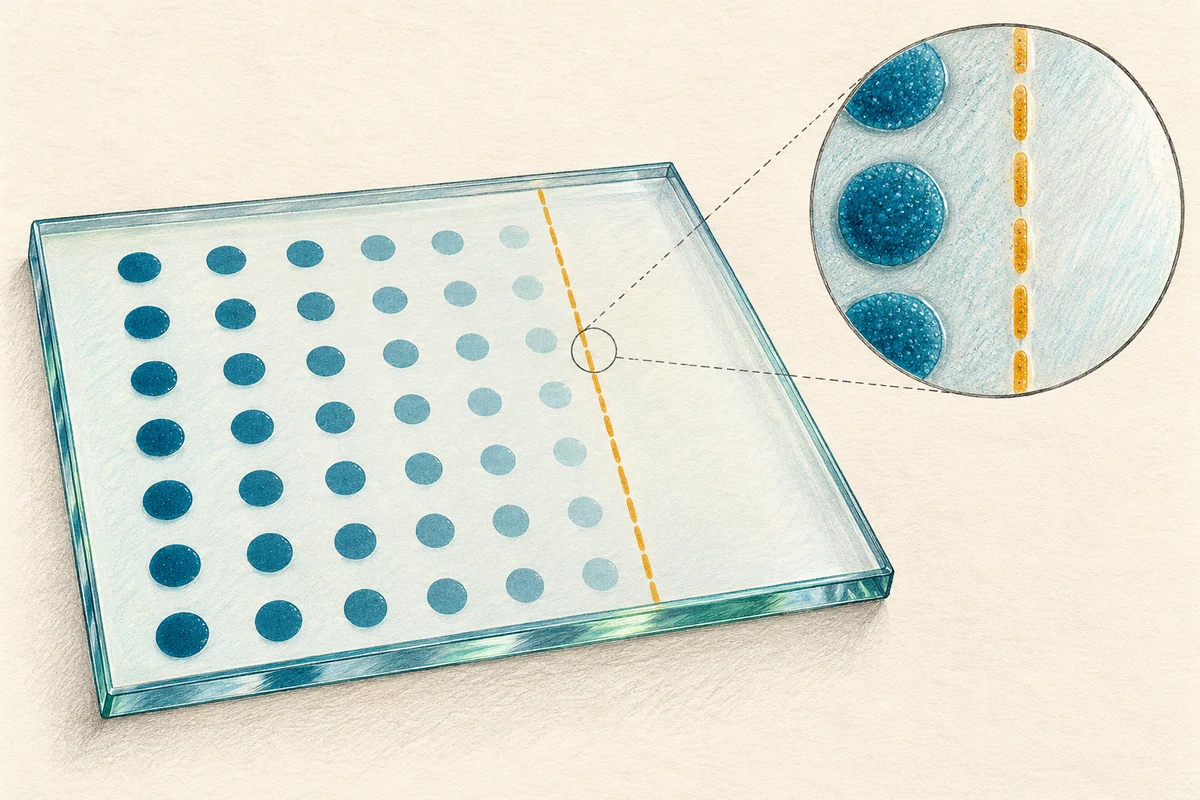
Ceramic frit (silk-screened/enamel) is a fired, glass-ceramic coating applied in controlled patterns (e.g., dots, lines, gradients, bands) for solar control, opacity, or aesthetics. Pattern boundaries (dot-matrix edges, band terminations, registration seams) are intentional design features, not worked-surface defects. Observation follows VIS inspection geometry;
Definition (Reference)
ReferenceCeramic frit (silk-screened/enamel) is a fired, glass-ceramic coating applied in controlled patterns (e.g., dots, lines, gradients, bands) for solar control, opacity, or aesthetics. Pattern boundaries (dot-matrix edges, band terminations, registration seams) are intentional design features, not worked-surface defects. Observation follows VIS inspection geometry; post-restoration acceptance for any worked area remains distinct from factory/product acceptance.
Typical Presentation (Informative)
Informative- Uniform, repeatable geometry (dot pitch, line spacing, edges) that stays consistent across the lite or series.
- Angle-dependent contrast: edges may read more strongly in oblique/raking views; a non-invasive reveal (clean & dry) does not change the boundary.
- On spandrel/frit bands, transitions may be feathered (dot gradient) or hard-edge by design.
Field Identification Cues (Normative)
NormativeSurface-catch class (MSRT):
- On the intended frit face, record the MSRT result without probing; run one light, non-marring pass only. Treat frit as product geometry/finish; on coated systems or IGUs default to visual morphology + location if any risk exists. (MSRT supports classification only.)
Visual signature:
- Pattern-true edge with no worked transition ring, no chip flanks/pits, and no directional swirl/web typical of mechanical/chemical damage.
- Boundary aligns with screen registration or design intent; adjacent glass face shows SC-0 and no perimeter.
Viewing/lighting:
- Inspect at 12 / 36 / 72 in, normal + oblique sweep (~60°-120°); use raking to document edge clarity/regularity; surfaces clean & dry (non-invasive reveal).
Location/access:
- Log pane ID and surface numbering (#1-#4; laminate-internal). Note if frit is inboard of IGU (#2/#3) or exposed. Acceptance in VIS pertains to the exposed surface being evaluated.
Classification Mapping (to VIS-DA) (Normative)
Normative- Design/processing feature - not surface damage. When the observation is a uniform, repeatable frit boundary with no worked-area perimeter and SC-0 on adjacent face, record “Design Feature - Not Surface Damage (outside CAT-1...CAT-4).”
- Escalate when:
- Frit over-spray / smear / offset appears outside the intended pattern (see Co.05.01 / Co.05.03) or a rub/scuff changes sheen (Co.02.02 / Co.01.01). → Classify under Coating Anomalies by morphology and assign CAT per VIS (appearance-only).
- Between-pane indication (fixed parallax at #2/#3 in an IGU) or otherwise inaccessible → CAT-5 by location/condition; refer per project protocol.
Indicative Relief (Informative)
Informative- Fired frit typically reads SC-0 at adjacent clear glass; the frit itself may present micro-texture/orange-peel inherent to the product but not a worked transition. Numeric depth is not required for classification; acceptance remains appearance-based in VIS.
Differentiation & False Positives (Informative)
Informative- vs. Paint overspray (R.02.01 / Co.05.03): Overspray leaves random, non-registered specks/film beyond design edges; may soften with reveal or show directional deposition. Frit boundaries are registered, uniform.
- vs. Coating rub/patchiness (Co.01/Co.02/Co.03): Rubs create sheen shifts or streaks that may have a worked perimeter; VIS disallows anomalies on the worked surface at acceptance. Frit edges do not present a worked ring.
- vs. Abrasion fields (M.02): Abrasion shows swirls/web/cross-hatch and can escalate to SC-1/SC-2; frit boundaries remain pattern-true and non-tactile at adjacent clear glass.
Evidence Package (Documentation Requirements) (Normative)
Normative- Photo set (VIS): 12 / 36 / 72 in, normal + oblique; include raking macros of the boundary and context frames proving pattern continuity (not a localized worked patch). Note lighting/time and reveal status.
- MSRT result: Record SC class at adjacent clear face (avoid probing into frit). One pass only; non-marring. On suspected coated surfaces, prefer polymer stylus or visual-only.
- Forms: Pane ID; surface numbering; worked surface Y/N; functional coating present on worked surface? (Y/N/Unknown); geometry checklist; photos attached.
- Acceptance split: VIS governs post-restoration appearance (no transition edge/directional patterning in any worked area); factory frit patterning remains a design/product attribute.
Mis-ID Pitfalls (Informative)
InformativeAttempting to “blend” a frit boundary to “soften” its appearance will create a worked region on the clear glass with a visible transition edge, which VIS disallows at acceptance (CAT-0...CAT-4). Do not alter design pattern geometry.
Reporting Language (Template)
Template- P.04.01 Ceramic Frit Pattern Boundary (Design Feature) - Uniform, registered frit boundary observed at VIS geometry; adjacent clear face MSRT = SC-0 (no relief). No transition edge, no chip-flank/pit morphology beyond the designed pattern. Logged as design/processing feature - not surface damage under VIS-DA. If over-spray/smear or coating rub is present beyond design edges, classify under Co family by CAT; if between-pane, record CAT-5 and refer per protocol.
Related glossary terms
- Ceramic fritGRK-234
- Paint oversprayGRK-063
- Coating rubGRK-115
- AbrasionGRK-035
- DepositGRK-045
Source and version
GlassRenu Damage Specification Sheets (DSS), DSS-P.04.01. Source revision and extraction date are recorded in the deployment manifest.
Open the complete published DSS with table of contents (PDF)
Normative and informative labels are preserved from the source. The downloadable one-sheet is a condensed classification aid; this web page retains the complete source-based specification content.