
On this page
- Diagnosis summary
- Safety and classification scope
- Classification & Scope (Normative)
- Typical Presentation (Informative)
- Field Identification Cues (Normative)
- Surface-catch class (MSRT)
- Visual signature
- Viewing / lighting
- Location / access
- Mechanism cue (context)
- Severity & CAT Mapping (Normative)
- Differentiation & Mis-ID Pitfalls (Informative)
- Evidence Package *(Documentation Requirements) (Normative)
- Reporting Language (Template)
- Related glossary terms
- Related DSS
- Source and version
DAMAGE SPECIFICATION STANDARD / METHOD-AGNOSTIC
DSS-U.01.03 — Halo without Central Feature (Unknown Chemistry)
Unknown mechanism - annular rings/ovals with no obvious central nucleus; evaporative/deposition rim remains while core is visually clear; typically SC-0 at core and SC-0-SC-1 on rim; reclassify to mineral/surfactant/sealant families if diagnostic cues present
Diagnosis summary
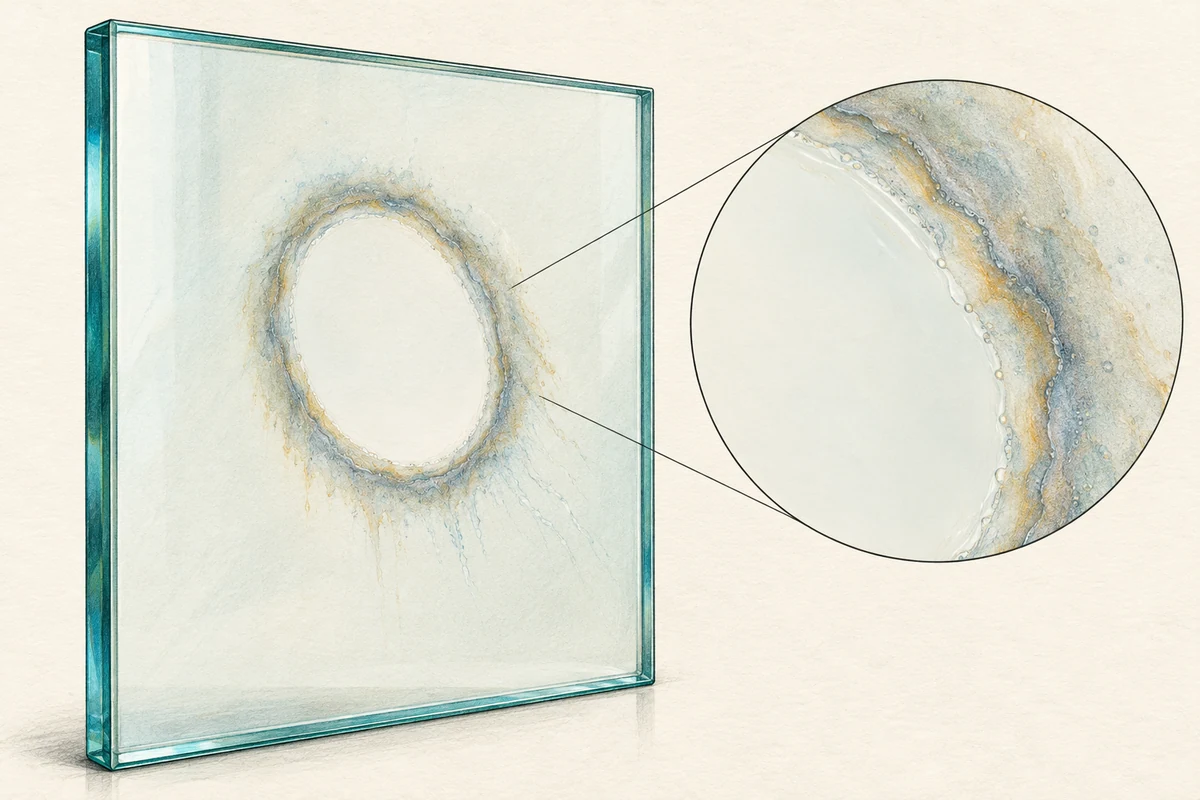
Halo without central feature is an appearance change presenting as a ring or oval band whose center is not visibly occupied by residue or defect. The annulus is presumed to result from edge-biased deposition during wetting/evaporation, surfactant Marangoni flow, or migration from adjacent materials, but the controlling chemistry is not yet identified. Classification is appearance-only per VIS (method-agnostic).
Classification & Scope (Normative)
NormativeHalo without central feature is an appearance change presenting as a ring or oval band whose center is not visibly occupied by residue or defect. The annulus is presumed to result from edge-biased deposition during wetting/evaporation, surfactant Marangoni flow, or migration from adjacent materials, but the controlling chemistry is not yet identified. Classification is appearance-only per VIS (method-agnostic). Inspect after Non-Invasive Reveal under VIS lighting/geometry; record surface numbering and worked-surface status.
Typical Presentation (Informative)
Informative- Discrete rings/ovals (single or clustered) ranging 10-150 mm+ diameter; ring width 1-10 mm.
- Variable contrast: faint sheen shift to light-toned rim; sometimes slight dark edge against reflections.
- No obvious seed or particulate at the center; multiple halos may partially overlap.
Field Identification Cues (Normative)
NormativeSurface-catch class (MSRT)
- Core: generally SC-0 (no relief).
- Rim: SC-0 if purely film; SC-1 where very shallow micro-texture or fine crystalloid is present; SC-2 implies misclassification-evaluate for mineral etch (Ch.03.03) or hot particle craters if present.
- Perform one light, non-marring pass across core → rim → outside on a small revealed test patch. Use polymer stylus if a functional coating is suspected. MSRT supports classification only.
Visual signature
- Annular band with cleaner center; no chip-flank sparkle (not scoring), no fused nodules (not hot particle).
- Under raking: rim shows sheen discontinuity or fine granularity; core is optically continuous with surrounding glass.
Viewing / lighting
- Evaluate clean & dry at 12 / 36 / 72 in, normal and oblique sweep (~60°-120°); use raking to locate rim density and to confirm feature absence at the center. Record distances/angles in-frame.
Location / access
- Record pane ID and surface numbering (#1-#4; laminate-internal). Often on outboard (#1) (dew/droplet drying), but may occur on inboard (#4) near sprays/aerosols. Between-pane appearance on #2/#3 via parallax → CAT-5 by location.
Mechanism cue (context)
- Mist/spray usage, detergent or additive residues, nearby silicone/EPDM, roof/metal runoff atomization, or condensation cycles. Lack of drip legs favors isolated droplet history over sheet flow.
Severity & CAT Mapping (Normative)
NormativeAssign CAT by visibility at acceptance geometry and MSRT after a reveal patch. Depth values are indicative-field measurement not required.
- CAT-1 (Benign / non-relief): Faint annular halo; SC-0 rim, SC-0 core; visible mainly in raking/angle; lifts on reveal patch. Indicative relief: 0-10 μm (film only).
- CAT-2 (Light): Persistent rim post-reveal with localized SC-1 (incipient micro-texture or very fine crystalloid); minimal standard-view impact. Indicative relief: ~10-40 μm at rim.
- CAT-3 (Moderate): Multiple rings/panels legible at standard distance; SC-1 consistent around rims; suggests recurrent cycles or additive-laden droplets. Indicative relief: ~40-120 μm at rim.
- Reclassify when (diagnostic cues present):
- White/grey crystalline rim, facet sparkle, or etched inner band → Ch.03 Mineral system (Deposits/Staining/Etching subtype).
- Iridescent, rainbow-thin rim tracking wipe geometry → R.04.01 Detergent/Surfactant film.
- Oily clear ring near PVC/EPDM contact → R.05.02 Plasticizer migration or R.05.01 EPDM rub if dark.
- Brown/black tonal rim below upstream materials → E.04.03 Curtain wall runoff staining.
- CAT-5 (by condition/location): Between-pane/inaccessible by parallax, integrity indicators, or confirmed functional-coating loss on the surface to be worked → CAT-5.
CAT is appearance-based; acceptance is separate under VIS-A at 12/36/72 in. Do not abrade to “force” a response during classification.
Differentiation & Mis-ID Pitfalls (Informative)
Informative- vs. Mineral spot/etch rings (Ch.03): Mineral rings often show crystalline texture and may leave true etch (SC-1→SC-2) after reveal; U.01.03 halos can be film-only (SC-0) with no inner etch.
- vs. Surfactant islands (R.04.01): Surfactant halos show thin-film colors and align with wipe paths; U.01.03 rings are isolated droplet-like without path context.
- vs. Silicone/siloxane halos (Ch.06.01 / R.01.01 proximity): Silicone halos often adjacent to sealant lines and resist wetting conspicuously; U.01.03 may occur mid-pane and show weaker wetting anomaly.
- vs. Coating anomalies (Co): Coating patchiness is planar on coated faces and not annular; verify face identity before attribution.
Evidence Package *(Documentation Requirements) (Normative)
Normative- Photo set (VIS): 12 / 36 / 72 in, normal + oblique; raking macros of rim segment and core; include mist/wetting test frame to show wetting response across rim vs. core where permitted. Record distance/angle in-frame.
- MSRT results: After a small reveal test patch, record SC-class at core (SC-0), rim (SC-0/SC-1), and outside control (SC-0).
- Forms: Pane ID; product family & surface numbering; worked surface Y/N; functional coating on worked surface? (Y/N/Unknown); reveal status; lighting/time; geometry checklist; photos attached.
- Acceptance split: Post-restoration acceptance per VIS-A §6; classification ≠ acceptance. Coated-face appearance rules apply per VIS §6.2.e when the worked surface is a factory functional coating.
Reporting Language (Template)
Template- U.01.03 Halo without Central Feature - Isolated annular ring with clear core on surface #___; post-reveal test patch shows [rim SC-0/SC-1] / core SC-0; visible at [12/36/72 in] under VIS geometry. Morphology: annular band, no chip-flank grooves, no fused nodules. Classification: CAT-[1/2/3] by visibility and SC-class; reclassify to Ch.03 (mineral), R.04.01 (surfactant), or R.05.02 (plasticizer) if diagnostic cues present; CAT-5 if between-pane or coating-side loss on the surface to be worked. Forms + photo set attached; acceptance per VIS-A §6.
Related glossary terms
- DepositGRK-045
- Test patchGRK-144
Source and version
GlassRenu Damage Specification Sheets (DSS), DSS-U.01.03. Source revision and extraction date are recorded in the deployment manifest.
Open the complete published DSS with table of contents (PDF)
Normative and informative labels are preserved from the source. The downloadable one-sheet is a condensed classification aid; this web page retains the complete source-based specification content.