
On this page
- Diagnosis summary
- Safety and classification scope
- Classification & Scope (Normative)
- Typical Presentation (Informative)
- Field Identification Cues (Normative)
- Surface-catch class (MSRT)
- Visual signature
- Viewing/lighting
- Severity & CAT Mapping (Normative)
- Differentiation & Mis-ID Pitfalls (Informative)
- Evidence Package (Documentation Requirements) (Normative)
- Reporting Language (Template)
- Related glossary terms
- Related DSS
- Source and version
DAMAGE SPECIFICATION STANDARD / METHOD-AGNOSTIC
DSS-M.03.02 — Edge Gross Chipping / “Clamshell”
Mechanical - edge & corner damage
Diagnosis summary
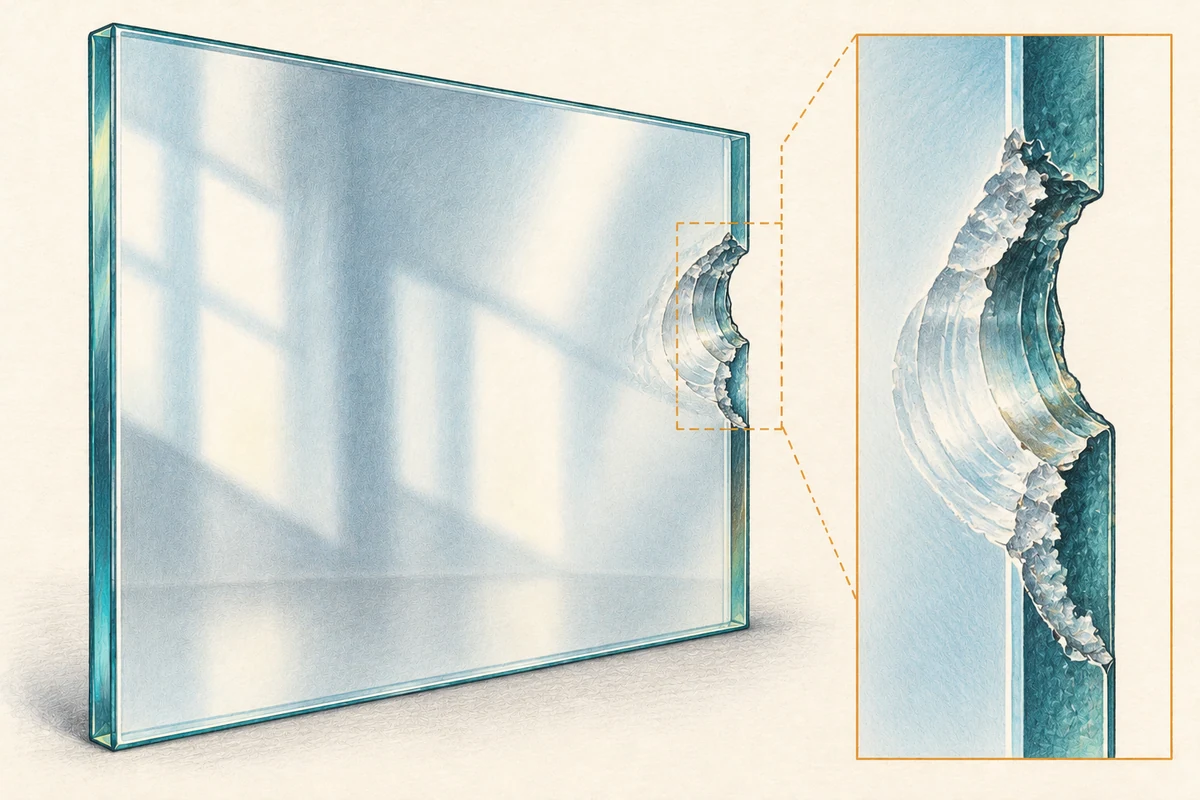
Gross edge chipping (“clamshells”) are discrete, larger shell-type fractures at or near the perimeter, typically from impact, improper handling, or stress at drilled/notched features. Classification is appearance-only per VIS; restoration methodology is out of scope. Inspect under VIS lighting/geometry and record surface numbering and worked-surface status on Forms:
Classification & Scope (Normative)
NormativeGross edge chipping (“clamshells”) are discrete, larger shell-type fractures at or near the perimeter, typically from impact, improper handling, or stress at drilled/notched features. Classification is appearance-only per VIS; restoration methodology is out of scope. Inspect under VIS lighting/geometry and record surface numbering and worked-surface status on Forms:
Typical Presentation (Informative)
Informative- Crescent or shell-shaped voids at the arris/edge; may expose bright, rough fracture facets.
- Can propagate from hardware holes/notches; sometimes accompanied by short radial micro-cracks.
- Highly visible in raking light; often apparent at standard view once size increases. (See VIS geometry & raking use.)
Field Identification Cues (Normative)
NormativeSurface-catch class (MSRT)
- Clear detect at chip perimeter; perform one light, non-marring pass only to sense relief (SC-2). On coated faces, prefer polymer stylus or rely on visual/location cues per VIS §5.5.
Visual signature
- Rough chip flanks with bright, irregular fracture edges; may include pits/craters adjacent to the edge land or hole perimeter. (Chip-flank/rough-edge morphology is determinative for escalation from minor edge nicks.)
Viewing/lighting
- Evaluate at 12 / 36 / 72 in using normal incidence + oblique sweep (~60°-120°) with raking light; surfaces clean/dry (VIS §5).
Location/access.
- Log pane ID and surface numbering (#1-#4; laminate-internal) on forms; acceptance pertains to the exposed surface being evaluated. If fixed parallax indicates a between-pane cue, classify CAT-5 and refer.
Severity & CAT Mapping (Normative)
NormativeAssign category by appearance cues + MSRT (not by intent to repair):
- CAT-2 → CAT-3 (lower bound): Larger, shallow shell with slight-clear catch and relatively clean flanks; visible primarily in raking light at close/standard view. Indicative depth: ~10-40 μm.
- CAT-3 (typical): Pronounced clamshell(s) with clear catch; rough, bright chip flanks; noticeable at standard view. Indicative depth: ~40-100 μm.
- CAT-4 (upper bound): Deep/extended shelling, multiple chips with secondary pits/craters or short cracks; strong catch; clearly visible at standard & wide-field views. Indicative depth: ~100-250 μm+.
- CAT-5 (by location/condition): Any case with through-thickness cracking, moving pane in frame, or between-pane/inaccessible location → out of in-place scope; document and refer.
Depth bands are indicative to anchor the spectrum for VIS-DA; assign CAT by visual/morphology + MSRT under VIS conditions.
Differentiation & Mis-ID Pitfalls (Informative)
Informative- vs. Edge micro-chipping (M.03.01): Minor edge nicks are small, isolated, and may lack bright rough flanks; gross clamshells show larger shell faces with pronounced, bright fracture edges and clear catch.
- vs. Factory edge finishes (P.03.01 / P.03.02): Seamed/arris bands and edge grind/polish patterns are uniform, edge-bound, and read SC-0 on the face; they do not present discrete chip flanks or pits.
- vs. Drill/slot exit lip (P.03.04): A continuous exit-side burr/lip is a manufacturing artifact at hole/slot perimeter; escalate only if discrete face-side chips propagate from the exit.
Evidence Package (Documentation Requirements) (Normative)
Normative- Photo set (VIS): 12 / 36 / 72 in, normal + oblique; include raking macros of chip flanks and at least one context frame showing the edge location (or hole/slot) and absence/presence of a worked perimeter.
- MSRT result: Record SC class (typically SC-2 “clear”); one pass only; non-marring; polymer stylus preferred on suspected coated faces.
- Forms: Pane ID; product family + surface numbering; worked surface Y/N; functional coating present on worked surface (Y/N/Unknown); reveal status; lighting/time; geometry checklist; photos attached.
- Acceptance split: VIS governs post-restoration appearance; transition edges and chip-flank morphology remain disqualifying at acceptance for CAT-1...CAT-4; structural/inaccessible → CAT-5 and refer.
Reporting Language (Template)
Template- M.03.02 Edge Gross Chipping / Clamshell - Discrete shell-type edge loss at [edge/arrises or hole/notch], MSRT = SC-2 (clear) with bright, rough chip flanks; visible at [12/36/72 in per VIS]. Classify CAT-[3/4] by morphology under VIS-DA. If fixed parallax indicates between-pane location or if through-thickness cracking is observed, record CAT-5 and refer per project protocol.
Related glossary terms
- ChipGRK-034
- Raking lightGRK-129
Source and version
GlassRenu Damage Specification Sheets (DSS), DSS-M.03.02. Source revision and extraction date are recorded in the deployment manifest.
Open the complete published DSS with table of contents (PDF)
Normative and informative labels are preserved from the source. The downloadable one-sheet is a condensed classification aid; this web page retains the complete source-based specification content.