
On this page
- Diagnosis summary
- Safety and classification scope
- Classification & Scope (Normative)
- Typical Presentation (Informative)
- Field Identification Cues (Normative)
- Surface-catch class (MSRT)
- Visual signature
- Viewing / lighting
- Location / access
- Mechanism cue (context)
- Severity & CAT Mapping (Normative)
- Differentiation & Mis-ID Pitfalls (Informative)
- Evidence Package *(Documentation Requirements) (Normative)
- Reporting Language (Template)
- ⭐ DSS-E
- Damage Specification Standards 2026
- DSS-E Environmental/Weathering/Biological
- Draft v1.0
- E.01 Marine/Coastal & Atmospheric
- E.02 Eolian Abrasion
- E.03 Biological & Organic Deposits
- E.04 Condensation/Runoff Patterns
- E.05 Photo‐Degradation of Films
- Related glossary terms
- Related DSS
- Source and version
DAMAGE SPECIFICATION STANDARD / METHOD-AGNOSTIC
DSS-R.06.02 — Steel / Ferrous Rub / Black Smear
Residue/transfer - contact with carbon steel or ferrous hardware/tools; dark grey-to-black smear, may oxidize brown; typically SC-0, localized SC-1 where abraded
Diagnosis summary
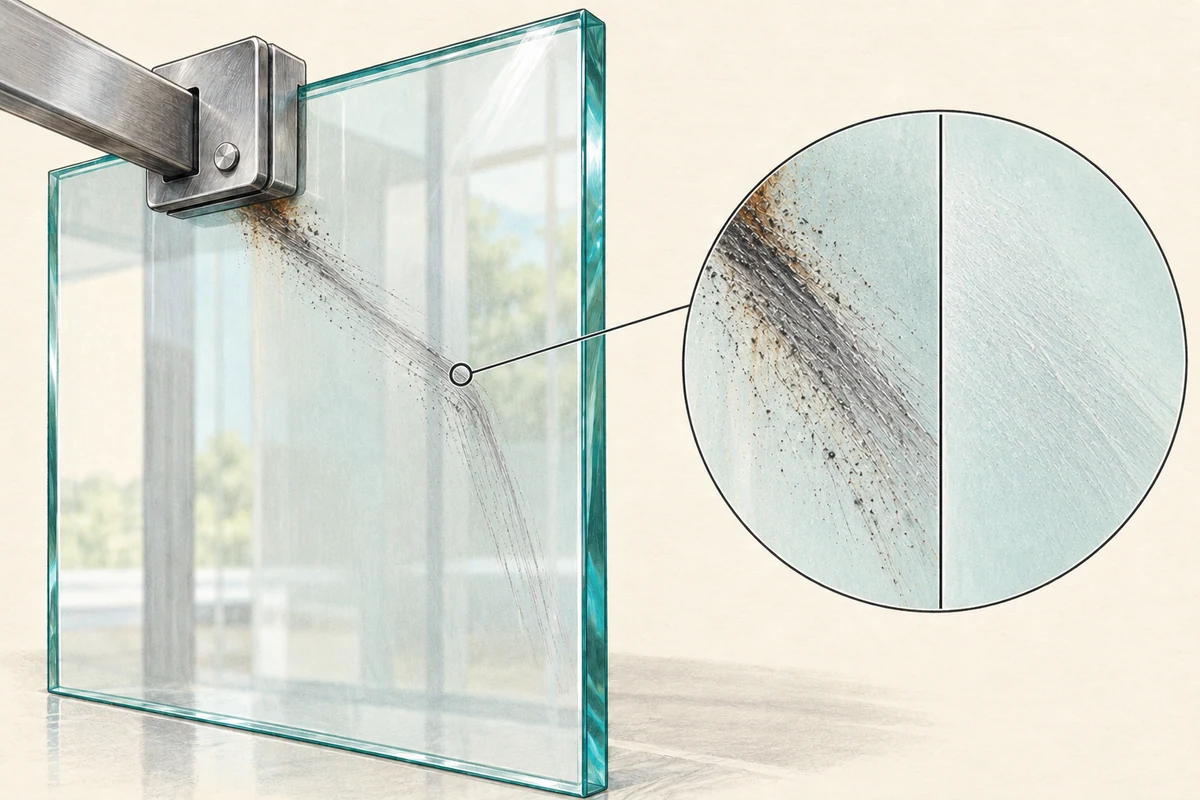
Steel / ferrous rub / black smear is an appearance change on glass caused by mechanical contact with carbon steel or ferrous components (fasteners, brackets, trowels, knives, ladders, window bars, site hardware) leaving a dark grey/black transfer. May slowly oxidize to brown at the edges if moisture is present. Classification is appearance-only per VIS (method-agnostic).
Classification & Scope (Normative)
NormativeSteel / ferrous rub / black smear is an appearance change on glass caused by mechanical contact with carbon steel or ferrous components (fasteners, brackets, trowels, knives, ladders, window bars, site hardware) leaving a dark grey/black transfer. May slowly oxidize to brown at the edges if moisture is present. Classification is appearance-only per VIS (method-agnostic). Inspect after Non-Invasive Reveal under VIS lighting/geometry; record surface numbering and worked-surface status.
Typical Presentation (Informative)
Informative- Dark linear smears along hardware contact paths (e.g., ladder foot, trowel edge) or localized arcs at knock points.
- Heavier density and soot-like transfer at pressure loci; can stain cloth dark on wipe.
- In some cases, brownish haloing from surface oxidation.
Field Identification Cues (Normative)
NormativeSurface-catch class (MSRT)
- Typically SC-0 (transfer film on surface).
- SC-1 appears where dry abrasive wiping or grit under contact created very shallow micro-texture; SC-2 suggests misclassification-check for M.01 linear scoring or Th.01.02 hot-particle embed.
- Perform one light, non-marring pass on a small revealed test patch (substrate). Use polymer stylus if a functional coating is suspected. MSRT supports classification only.
Visual signature
- Dark grey → black smear, sometimes with brown oxidation edge; directional drag evident; no discrete pits/nodules.
- No chip-flank sparkle (not incision) under raking.
Viewing / lighting
- Evaluate clean & dry at 12 / 36 / 72 in, normal incidence and oblique sweep (~60°-120°); raking macros to show drag, oxidation halo, edge feather. Record distances/angles in-frame.
Location / access
- Record pane ID and surface numbering (#1-#4; laminate-internal). If parallax places the smear between panes (#2/#3), classify CAT-5 by location and refer.
Mechanism cue (context)
- Steel tools/hardware used near glass, ladder rails/feet, masonry trowels, grinders (without sparks contacting) rubbing surfaces; iron fines visible on adjacent materials.
Severity & CAT Mapping (Normative)
NormativeAssign CAT by visibility at acceptance geometry and MSRT after a small reveal test. Depth values are indicative-field measurement not required.
- CAT-1 (Benign / non-relief): Light dark smear; SC-0; mainly angle/raking visible. Indicative relief: 0-10 μm (optical film).
- CAT-2 (Light): Persistent black smear with localized SC-1 from prior dry wiping/soil; limited standard-view impact. Indicative relief: ~10-40 μm.
- CAT-3 (Moderate): Broad/high-contrast smears legible at standard distance, with scattered SC-1 and possible brown oxidation; indicates extended dwell or repeated contact. Indicative relief: ~40-120 μm.
- Reclassify when: After true residue lift, any incised lines with chip-flank sparkle or SC-2 persist → evaluate under M.01 (linear scoring). If pits/fused nodules present, evaluate Th.01.02 grinder spark embed.
- CAT-5 (by condition/location): Between-pane/inaccessible by parallax, integrity indicators, or confirmed functional-coating loss on the surface to be worked → CAT-5.
CAT is appearance-based; acceptance is separate under VIS-A at 12/36/72 in. Do not abrade to “force” removal during classification.
Differentiation & Mis-ID Pitfalls (Informative)
Informative- vs. Aluminum rub (R.06.01): Aluminum is cool/light grey; ferrous rub is dark grey/black, can finger-stain, and may oxidize brown.
- vs. EPDM gasket rub (R.05.01): EPDM is black but follows gasket geometry; ferrous rub follows tool/hardware paths and may show oxidation halo.
- vs. Hot-particle embed (Th.01.02): Hot particle shows pit/nodule field, sometimes with rusting dots; ferrous rub is smear-film without pits.
- vs. Soot/particulate pollution (E.01.03): Soot is broad/dirty grey and dry; ferrous rub is localized, directional, and often coincident with hardware contact.
Evidence Package *(Documentation Requirements) (Normative)
Normative- Photo set (VIS): 12 / 36 / 72 in, normal + oblique; raking macros of drag, oxidation halo, edge feather; context frames showing steel tools/hardware proximity. Record distance/angle in-frame.
- MSRT result (substrate): After a small reveal patch, perform one light, non-marring pass; record SC-class (SC-0/SC-1/SC-2).
- Forms: Pane ID; product family & surface numbering; worked surface Y/N; functional coating present on worked surface? (Y/N/Unknown); reveal status; lighting/time; geometry checklist; photos attached.
- Acceptance split: Post-restoration acceptance per VIS-A §6; classification ≠ acceptance. Coated-face appearance rules apply per VIS §6.2.e when the worked surface is a factory functional coating.
Reporting Language (Template)
Template- R.06.02 Steel / Ferrous Rub / Black Smear - Dark grey-black directional smear along hardware/tool contact on surface #___; post-reveal test patch shows [SC-0/SC-1]; visible at [12/36/72 in] under VIS geometry. Morphology: drag path, possible brown oxidation halo, no chip-flank sparkle, no pits. Classification: CAT-[1/2/3] by visibility and SC-class; reclassify to M.01 if incisions persist, or to Th.01.02 if pits/nodules are present; CAT-5 if between-pane or coating-side loss on the surface to be worked. Forms + photo set attached; acceptance per VIS-A §6.
⭐ DSS-E
Damage Specification Standards 2026
DSS-E Environmental/Weathering/Biological
Draft v1.0
E.01 Marine/Coastal & Atmospheric
- E.01.01 Salt‐spray crystals / shoreline frosting
- E.01.02 Atmospheric corrosion matte (SOx/NOx/acid rain)
- E.01.03 Soot/particulate pollution film
E.02 Eolian Abrasion
- E.02.01 Wind‐borne sand abrasion (matte/frost)
- E.02.02 Dust storm micro‐pitting
E.03 Biological & Organic Deposits
- E.03.01 Algae/biofouling film
- E.03.02 Lichens/moss (rough adhesion)
- E.03.03 Tree sap/organic exudate shadow
- E.03.04 Avian residue acid shadow
E.04 Condensation/Runoff Patterns
- E.04.01 Recurring drip/run staining pattern
- E.04.02 Thermal bridging condensation patterning
- E.04.03 Curtain wall runoff staining (adjacent materials)
E.05 Photo‐Degradation of Films
- E.05.01 UV‐induced browning/yellowing of residues
- E.05.02 Oxidation darkening of films
Related glossary terms
- Test patchGRK-144
- AbrasionGRK-035
- AbrasiveGRK-168
- DepositGRK-045
- PittingGRK-078
Source and version
GlassRenu Damage Specification Sheets (DSS), DSS-R.06.02. Source revision and extraction date are recorded in the deployment manifest.
Open the complete published DSS with table of contents (PDF)
Normative and informative labels are preserved from the source. The downloadable one-sheet is a condensed classification aid; this web page retains the complete source-based specification content.