
On this page
- Diagnosis summary
- Safety and classification scope
- Classification & Scope (Normative)
- Typical Presentation (Informative)
- Field Identification Cues (Normative)
- Surface-catch class (MSRT)
- Visual signature
- Viewing / lighting
- Location / access
- Mechanism cue (context)
- Severity & CAT Mapping (Normative)
- Differentiation & Mis-ID Pitfalls (Informative)
- Evidence Package *(Documentation Requirements) (Normative)
- Reporting Language (Template)
- Related glossary terms
- Related DSS
- Source and version
DAMAGE SPECIFICATION STANDARD / METHOD-AGNOSTIC
DSS-U.01.02 — Modeled Micro-Texture with Embedded Particulates (Uncertain Chemistry)
Mixed/unknown mechanism - low-contrast matte with fine embedded or partially embedded specks; may result from chemical softening plus particulate impingement/setting; SC-1 broadly in field, isolated SC-2 at raised particulates or micro-divots
Diagnosis summary
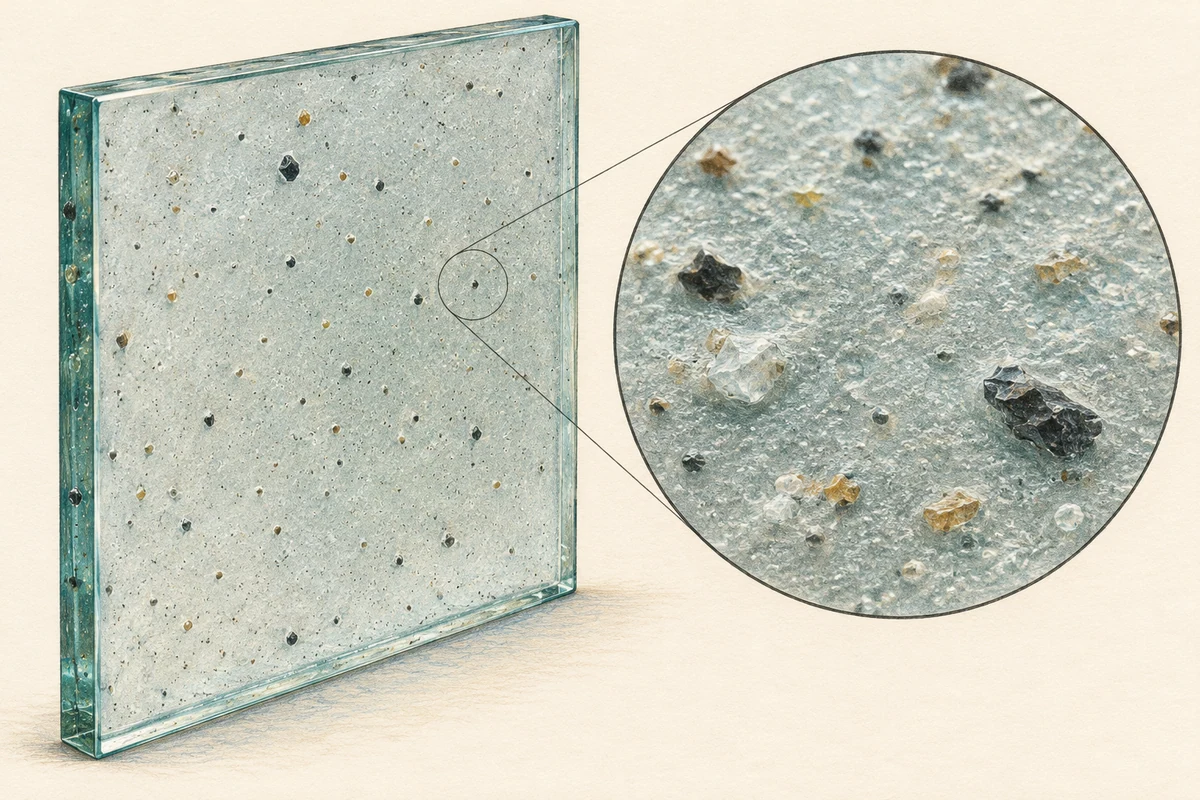
Modeled micro-texture with embedded particulates is an appearance change in which a subtle, non-directional matte field is accompanied by discrete specks that appear embedded or partially seated in the surface. The presentation suggests chemical softening/attack (acidic, alkaline, or mineral) combined with particle deposition/impingement, but the exact chemistry is uncertain.
Classification & Scope (Normative)
NormativeModeled micro-texture with embedded particulates is an appearance change in which a subtle, non-directional matte field is accompanied by discrete specks that appear embedded or partially seated in the surface. The presentation suggests chemical softening/attack (acidic, alkaline, or mineral) combined with particle deposition/impingement, but the exact chemistry is uncertain. Classification is appearance-only per VIS (method-agnostic). Inspect after Non-Invasive Reveal under VIS lighting/geometry; record surface numbering and worked-surface status.
Typical Presentation (Informative)
Informative- Low-contrast “milky” modeling over a patch or panel with peppered fine dots (dark or light) scattered within the field.
- Specks range from <0.5 mm to ~2 mm apparent diameter; some show tiny shadows or micro-divots at center under raking.
- Often no gravity-driven runs or wipe paths; field edges can be soft/irregular.
Field Identification Cues (Normative)
NormativeSurface-catch class (MSRT)
- SC-1 across the modeled field (incipient micro-texture).
- SC-2 (pin-point) at individual raised particulates or micro-divots where a stylus crosses a protrusion or craterlet.
- Perform one light, non-marring pass on a small revealed test patch, sampling (a) clean glass control, (b) field matrix, and (c) several specks. Use a polymer stylus if a functional coating is suspected. MSRT supports classification only.
Visual signature
- Non-directional matte (no swirl/line patterning) with random speck distribution; specks may be dark (entrained fines) or light (etched pin-craters).
- No chip-flank linear grooves (not scoring); no fused hemispherical nodules typical of hot particle if true fusion is absent-verify carefully under raking.
- Under raking, some specks show tiny radial micro-chipping or a minute depression.
Viewing / lighting
- Evaluate clean & dry at 12 / 36 / 72 in, normal and oblique sweep (~60°-120°); use low-angle raking and specular reflection to separate matte field from speck relief. Record distances/angles in-frame.
Location / access
- Record pane ID and surface numbering (#1-#4; laminate-internal). Common on outboard (#1) in construction/industrial exposures; between-pane mapping by parallax on #2/#3 → CAT-5 by location.
Mechanism cue (context)
- Nearby cement/mortar work, industrial fallout, spray booths, road/rail dust, or cool night dew cycles that could set fines into a chemically softened surface. Lack of welding/grinding activity argues against hot particle as the dominant cause.
Severity & CAT Mapping (Normative)
NormativeAssign CAT by visibility at acceptance geometry and MSRT. Depth values are indicative-field measurement not required.
- CAT-2 (Light): Small patch; SC-1 matrix with sparse specks (few per 100 cm2); limited standard-view impact. Indicative relief: field ~10-40 μm, speck high/low points ~20-60 μm.
- CAT-3 (Moderate): Pane-noticeable patch/panel; SC-1 matrix with numerous specks (tens per 100 cm2) legible at standard distance. Indicative relief: field ~40-120 μm, specks ~60-150 μm.
- CAT-4 (Severe): Wide-area field with dense peppering visible at standard and wide-field views; frequent SC-2 pin-points; occasional micro-divots. Indicative relief: field ~120-200 μm, local speck maxima ~150-300+ μm.
- Reclassify when (component rules):
- Discrete fused hemispherical beads with metallic tint → Th.01.02 grinder spark embed.
- Crystalline ring halos / drip geometry → Ch.03 mineral system (Deposits/Staining/Etching).
- Uniform granular frost within mask edges → V.01.01 abrasive blast.
- Linear grooves with chip-flank sparkle → M.01 scoring / M.02 abrasion fields.
- CAT-5 (by condition/location): Between-pane/inaccessible by parallax, integrity indicators, or confirmed functional-coating loss on the surface to be worked → CAT-5.
CAT is appearance-based; acceptance is separate under VIS-A at 12/36/72 in. Do not abrade to “force” a response during classification.
Differentiation & Mis-ID Pitfalls (Informative)
Informative- vs. Hot particle peppering (Th.01.02): Hot particle shows fused, often metallic-colored nodules and distinct craters; this condition often has non-fused fines or very shallow micro-divots without metallic cues.
- vs. Dust-storm micro-pitting (E.02.02): Eolian pitting is directionally biased (wind-ward) and frequently gradient-based; U.01.02 lacks strong directionality and pairs with modeled matte.
- vs. Mineral etch (Ch.03.03): Mineral etch displays ring/flow halos; U.01.02 specks are random, with no consistent drip/run geometry.
- vs. Coating anomalies (Co): Coating issues are planar/patchy, face-specific, and do not present embedded specks; confirm coated face before attribution.
Evidence Package *(Documentation Requirements) (Normative)
Normative- Photo set (VIS): 12 / 36 / 72 in, normal + oblique; raking macros isolating field matte and multiple specks (include one with apparent micro-divot); overview frames showing extent and uniformity. Record distance/angle in-frame.
- MSRT results: After a small reveal test patch, record SC-class for control (SC-0), field matrix (SC-1), and specks (SC-2 where present).
- Forms: Pane ID; product family & surface numbering; worked surface Y/N; functional coating on worked surface? (Y/N/Unknown); reveal status; lighting/time; geometry checklist; photos attached.
- Acceptance split: Post-restoration acceptance per VIS-A §6; classification ≠ acceptance. Coated-face appearance rules apply per VIS §6.2.e when the worked surface is a factory functional coating.
Reporting Language (Template)
Template- U.01.02 Modeled Micro-Texture with Embedded Particulates - Low-contrast matte field with scattered embedded/partially embedded specks on surface #___; post-reveal test patch shows SC-1 matrix and SC-2 at select specks; visible at [12/36/72 in] under VIS geometry. Morphology: non-directional modeling, random peppering, no fused metallic nodules, no linear chip-flank grooves. Classification: CAT-[2/3/4] by visibility and SC-class; reclassify per notes if hot-particle, mineral, blast, or abrasion signatures dominate; CAT-5 if between-pane or coating-side loss on the surface to be worked. Forms + photo set attached; acceptance per VIS-A §6.
Related glossary terms
Source and version
GlassRenu Damage Specification Sheets (DSS), DSS-U.01.02. Source revision and extraction date are recorded in the deployment manifest.
Open the complete published DSS with table of contents (PDF)
Normative and informative labels are preserved from the source. The downloadable one-sheet is a condensed classification aid; this web page retains the complete source-based specification content.