
On this page
- Diagnosis summary
- Safety and classification scope
- Classification & Scope (Normative)
- Typical Presentation (Informative)
- Field Identification Cues (Normative)
- Surface-catch class (MSRT)
- Visual signature
- Viewing / lighting
- Location / access
- Mechanism cue (context)
- Severity & CAT Mapping (Normative)
- Differentiation & Mis-ID Pitfalls (Informative)
- Evidence Package *(Documentation Requirements) (Normative)
- Reporting Language (Template)
- Related glossary terms
- Related DSS
- Source and version
DAMAGE SPECIFICATION STANDARD / METHOD-AGNOSTIC
DSS-U.01.05 — Non-Directional Milky Field, Low Contrast (Undetermined)
Unknown mechanism - broad low-contrast haze without obvious directionality, rings, runs, or discrete particulates; may reflect weathering, aged films, or incipient micro-texture; typically SC-0 to SC-1 across the field
Diagnosis summary
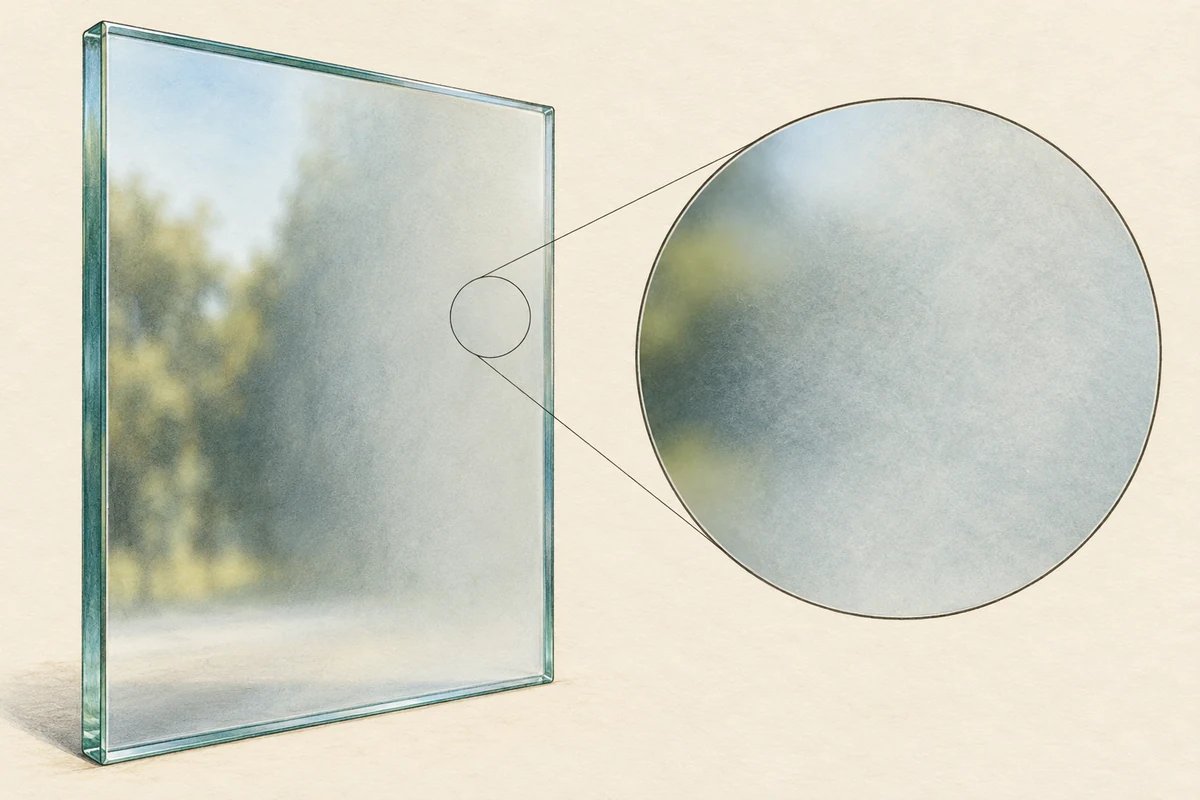
Non-directional milky field (low contrast) is an appearance change characterized by a broad, subtle, “milky” veil over part or all of a lite without clear directional patterning, annular halos, runs/drips, or discrete peppering/pits. Possible contributors include aged organic films, very early environmental weathering, soft chemical exposure short of distinct etch, or legacy maintenance residues.
Classification & Scope (Normative)
NormativeNon-directional milky field (low contrast) is an appearance change characterized by a broad, subtle, “milky” veil over part or all of a lite without clear directional patterning, annular halos, runs/drips, or discrete peppering/pits. Possible contributors include aged organic films, very early environmental weathering, soft chemical exposure short of distinct etch, or legacy maintenance residues. Because the controlling mechanism is undetermined, this item is classified appearance-only per VIS (method-agnostic). Inspect after Non-Invasive Reveal under VIS lighting/geometry; record surface numbering and worked-surface status.
Typical Presentation (Informative)
Informative- Low-contrast “milkiness” that reduces specular snap but lacks lines/swirl, ring/halo geometry, or distinct specks.
- Field edges are often soft or ill-defined (gradual fade into clear glass).
- More visible at oblique angles and under raking light than at normal incidence.
Field Identification Cues (Normative)
NormativeSurface-catch class (MSRT)
- Frequently SC-0 (film-on-top or purely optical veil).
- SC-1 where incipient micro-texture is present (very shallow relief detectable only by careful pass).
- Perform one light, non-marring pass on a small revealed test patch within the field and on adjacent clear control. Use a polymer stylus if a functional coating is suspected. MSRT supports classification only.
Visual signature
- Uniform or gently graded haze; no chip-flank sparkle, no discrete pits, no meniscus rims/runs.
- Wetting behavior may show subtle contrast (patches that bead/sheet differently).
Viewing / lighting
- Evaluate clean & dry at 12 / 36 / 72 in under normal and oblique sweep (~60°-120°); employ low-angle raking to confirm absence of lines/rings. Record distances/angles in-frame.
Location / access
- Record pane ID and surface numbering (#1-#4; laminate-internal). Observed on outboard (#1) (weathering exposure) and inboard (#4) (maintenance films). Between-pane by parallax on #2/#3 → CAT-5 by location.
Mechanism cue (context)
- History of intermittent cleaning, detergent/additive use, nearby HVAC/kitchen aerosols, or marine/industrial atmospheres without discrete incident reports.
Severity & CAT Mapping (Normative)
NormativeAssign CAT by visibility at acceptance geometry and MSRT after a reveal patch. Depth values are indicative-field measurement not required.
- CAT-1 (Benign / non-relief): Subtle veil visible mainly at oblique/raking; SC-0; clears on reveal patch or reduces markedly. Indicative relief: 0-10 μm (optical/film only).
- CAT-2 (Light): Persistent low-contrast milkiness post-reveal with localized SC-1; limited impact at standard distance. Indicative relief: ~10-40 μm.
- CAT-3 (Moderate): Pane-noticeable haze at standard distance, SC-1 consistent across field; indicates dwell/aging or incipient micro-texture. Indicative relief: ~40-120 μm.
- Reclassify when (diagnostic cues emerge):
- Ringed halos/edge crystals → Ch.03 Mineral system (Deposits/Staining/Etching).
- Directional swirls/lanes → M.02 Abrasion fields.
- Embedded peppering/pitlets → U.01.02 or Th.01.02 (if fused metallic).
- Planar patchiness on a coated face → Co family after confirming coated surface.
- CAT-5 (by condition/location): Between-pane/inaccessible by parallax, integrity indicators, or confirmed functional-coating loss on the surface to be worked → CAT-5.
CAT is appearance-based; acceptance is separate under VIS-A at 12/36/72 in. Do not abrade to “force” a response during classification.
Differentiation & Mis-ID Pitfalls (Informative)
Informative- vs. Surfactant/detergent film (R.04.01): Surfactant films often show iridescent colors and wipe path geometry; U.01.05 lacks pathing and may respond weakly to reveal.
- vs. Atmospheric matte (E.01.02): Atmospheric matte may bias to edges/rivulets; U.01.05 often appears mid-field with soft boundaries.
- vs. Coating anomalies (Co): Coating issues are face-specific and planar; confirm face identity and look for lot-wide repetition.
- vs. Mineral etch (Ch.03.03): Mineral etch exhibits rings/runs and crystalline cues; U.01.05 lacks those geometries.
Evidence Package *(Documentation Requirements) (Normative)
Normative- Photo set (VIS): 12 / 36 / 72 in, normal + oblique; raking macros to demonstrate absence of lines/rings/pits; a wetting response frame (where permitted) to show sheet/bead contrast. Record distance/angle in-frame.
- MSRT results: After a small reveal test patch, record SC-class for field (SC-0/SC-1) and adjacent control (SC-0).
- Forms: Pane ID; product family & surface numbering; worked surface Y/N; functional coating on worked surface? (Y/N/Unknown); reveal status; lighting/time; geometry checklist; photos attached.
- Acceptance split: Post-restoration acceptance per VIS-A §6; classification ≠ acceptance. Coated-face appearance rules apply per VIS §6.2.e when the worked surface is a factory functional coating.
Reporting Language (Template)
Template- U.01.05 Non-Directional Milky Field (Undetermined) - Broad low-contrast haze without lines/rings/pits on surface #___; post-reveal test patch shows [SC-0/SC-1] with adjacent control SC-0; visible at [12/36/72 in] under VIS geometry. Morphology: uniform/graded milkiness, no chip-flank sparkle, no discrete peppering, no meniscus geometry. Classification: CAT-[1/2/3] by visibility and SC-class; reclassify per notes if mineral, abrasion, embedded particulate, or coating signatures are later confirmed; CAT-5 if between-pane or coating-side loss on the surface to be worked. Forms + photo set attached; acceptance per VIS-A §6.
Related glossary terms
- Raking lightGRK-129
- Test patchGRK-144
- AbrasionGRK-035
- DepositGRK-045
Source and version
GlassRenu Damage Specification Sheets (DSS), DSS-U.01.05. Source revision and extraction date are recorded in the deployment manifest.
Open the complete published DSS with table of contents (PDF)
Normative and informative labels are preserved from the source. The downloadable one-sheet is a condensed classification aid; this web page retains the complete source-based specification content.