
On this page
- Diagnosis summary
- Safety and classification scope
- Classification & Scope (Normative)
- Typical Presentation (Informative)
- Field Identification Cues (Normative)
- Surface-catch class (MSRT)
- Visual signature
- Viewing / lighting
- Location / access
- Mechanism cue (context)
- Severity & CAT Mapping (Normative)
- Differentiation & Mis-ID Pitfalls (Informative)
- Evidence Package *(Documentation Requirements) (Normative)
- Reporting Language (Template)
- ⭐ DSS-Ch
- Damage Specification Standards 2026
- DSS-Ch Chemical Attack/Etch/Reaction
- Draft v1.0
- Ch.01 Acid Attack
- Ch.02 Alkaline Attack
- Ch.03 Hard‐Water / Mineral System (three distinct)
- Ch.04 Solvent/Chemical Burns
- Ch.05 Oxidizers/Reducers
- Ch.06 Sealers/Repellents/Coating Interactions
- Related glossary terms
- Related DSS
- Source and version
DAMAGE SPECIFICATION STANDARD / METHOD-AGNOSTIC
DSS-Th.04.01 — Localized Thermal “Hot Spot” Imprint (Solar Concentration / Reflective Interactions)
Thermal - envelope interaction; localized radiant focus from adjacent surfaces
Diagnosis summary
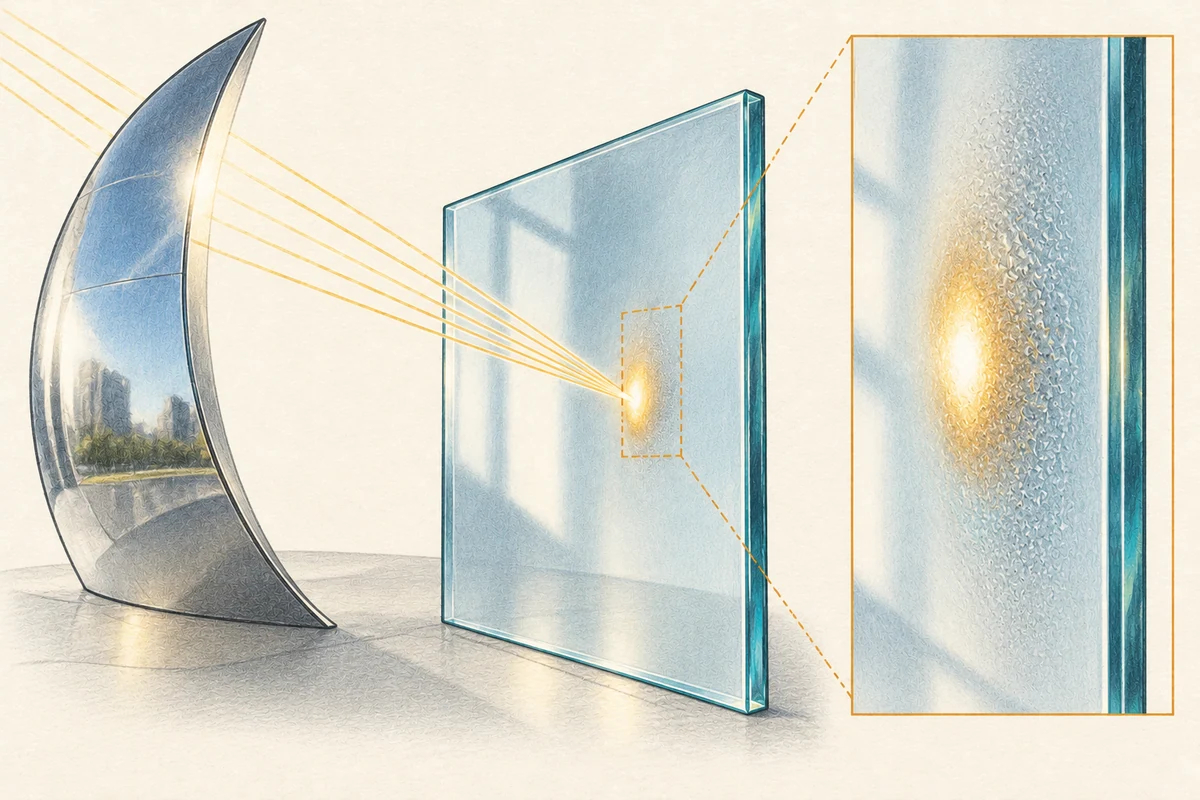
A localized thermal “hot spot” imprint is a compact patch or band of appearance change (and, at higher severities, stress damage) produced when reflected or concentrated solar radiation from adjacent surfaces (e.g., concave façades, mirrored fins, metal panels, light shelves, vehicles) focuses on the glass. The result is a tone/shine shift ± modeled micro-texture within the focal footprint;
Classification & Scope (Normative)
NormativeA localized thermal “hot spot” imprint is a compact patch or band of appearance change (and, at higher severities, stress damage) produced when reflected or concentrated solar radiation from adjacent surfaces (e.g., concave façades, mirrored fins, metal panels, light shelves, vehicles) focuses on the glass. The result is a tone/shine shift ± modeled micro-texture within the focal footprint; severe events can initiate cracking. Classification is appearance-only per VIS (method-agnostic). Any confirmed crack is an integrity condition and out of in-place scope (CAT-5). Inspect after Non-Invasive Reveal under VIS lighting/geometry; record surface numbering and worked-surface status on Forms:
Typical Presentation (Informative)
Informative- Compact elliptic/teardrop patch or narrow wandering band on the sun-exposed elevation, often time-of-day dependent (appears/disappears as the sun moves).
- Sheen/contrast shift in specular view; modeled micro-texture may be present in raking light at the focus.
- Context clues: high-gloss metal, mirrored façades, curved glass, parked vehicles or sunshades positioned to throw a specular reflection onto the lite.
- Severe cases: crack nucleus near the focal hotspot, propagating toward edges/corners/penetrations.
Field Identification Cues (Normative)
NormativeSurface-catch class (MSRT)
- SC-0 for optical-only impressions (gloss/tone shift without relief).
- SC-1 where very shallow modeled micro-texture exists; SC-2 is uncommon but possible in pronounced softening.
- Perform one light, non-marring pass; use a polymer stylus if a coating is suspected. Do not pass across any suspected crack. MSRT supports classification, not acceptance.
Visual signature
- Local, soft-edged patch/band-no worked transition ring; lacks discrete pepper (separates from hot-particle damage) and lacks chip-flank sparkle (separates from scoring).
- Often coincident with specular reflection path from a known exterior reflector; may “move” diurnally.
Viewing / lighting
- Evaluate clean & dry at 12 / 36 / 72 in, with normal incidence and oblique sweep (~60°-120°); include raking light to detect modeled micro-texture. If feasible, document at the expected time of peak reflection.
Location / access
- Record pane ID and surface numbering (#1-#4; laminate-internal). If parallax indicates a between-pane presentation, classify CAT-5 by location and refer per protocol.
Mechanism cue (context)
- Identify candidate reflectors/concentrators and geometry (curved/mirrored surfaces, polished metals, cars). Note sun azimuth/elevation and time during observation.
Severity & CAT Mapping (Normative)
NormativeAssign CAT by appearance + MSRT + morphology (three-part cueing). Depth/relief values below are indicative-measurement is not required.
- CAT-1 (Benign / non-relief): Sheen/tone shift only; SC-0; visible mainly in raking at close/standard view. Indicative relief: ~0-10 μm (optical only).
- CAT-2 (Light): Subtle modeled micro-texture within the hotspot; SC-1; limited impact at standard view; no chip flanks. Indicative relief: ~10-40 μm.
- CAT-3 (Moderate): SC-2 (clear) modeled micro-texture visible at standard view, boundaries soft; no discrete pits. Indicative relief: ~40-120 μm.
- CAT-4 (Severe): Pronounced matte/frosted hotspot or narrow focused band; distinct at standard & wide-field views; still no peppering. Indicative relief: ~120-300 μm+.
- CAT-5 (by condition/location): Any confirmed crack, pane instability, or between-pane/inaccessible by parallax → CAT-5 (non-repairable/out of in-place scope).
CAT is appearance-based; acceptance is separate under VIS-A at 12/36/72 in. Do not “probe” with MSRT.
Differentiation & Mis-ID Pitfalls (Informative)
Informative- vs. Torch proximity streak (Th.02.01): Torch produces tool-path bands and may leave soot; solar hotspot ties to external reflector geometry and time of day.
- vs. Overheated grinder/belt burn (Th.02.02): Burn lines track abrasive travel and often show compound/rubber smear; solar hotspots are stationary footprints that migrate with the sun.
- vs. Hot-particle damage (Th.01.xx): Slag/spark fields show discrete nodules/pits with bright rims; solar hotspots are continuous patches without pepper.
- vs. Residue films (R-family): Films remove at reveal (SC-0). Persisting core patch with SC-1/SC-2 indicates thermal effect.
- vs. Coating anomalies (Co-family): Coating rub/patchiness may mimic sheen change; on a worked coated surface any anomaly is not permitted at acceptance (VIS §6.2.e). Confirm coating presence and use coated-face rules.
Evidence Package *(Documentation Requirements) (Normative)
Normative- Photo set (VIS): 12 / 36 / 72 in, normal + oblique, include raking macros of the hotspot; add context frames showing suspected reflector and the specular path. Record distance/angle/time in-frame; note sun conditions (clear/overcast).
- MSRT result: Record SC class (SC-0/1/2) with one light, non-marring pass (polymer stylus on suspected coated faces). Do not pass across any crack.
- Forms: Pane ID; product family & surface numbering; worked surface Y/N; functional coating present on worked surface? (Y/N/Unknown); reveal status; lighting/time; geometry checklist; photos attached.
- Acceptance split: Post-restoration acceptance per VIS-A §6; classification ≠ acceptance. Coating-side anomalies on the worked surface remain disqualifying.
Reporting Language (Template)
Template- Th.04.01 Localized Thermal “Hot Spot” Imprint (Solar/Reflective) - Soft-edged hotspot/track on surface #___ with [SC-0/SC-1/SC-2]; no pits/craters or chip flanks; visible at [12/36/72 in] under VIS geometry after Non-Invasive Reveal. Context shows [concave façade/mirrored fin/metal panel/vehicle] reflecting to locus; time noted [HH:MM]. Classification: CAT-[1/2/3/4] by cues; CAT-5 if crack present, pane instability, or between-pane by parallax. Forms + photo set attached; acceptance per VIS-A §6.
⭐ DSS-Ch
Damage Specification Standards 2026
DSS-Ch Chemical Attack/Etch/Reaction
Draft v1.0
Ch.01 Acid Attack
- Ch.01.01 Acid‐etch graffiti (HF/BOE)
- Ch.01.02 Muriatic/brick wash fallout (HCl)
- Ch.01.03 Organic acid residues (avian/biogenic high acidity)
Ch.02 Alkaline Attack
- Ch.02.01 Cement/mortar slurry etch (high pH)
- Ch.02.02 Concrete splash/run‐off etch pattern
- Ch.02.03 Efflorescence‐associated surface attack
Ch.03 Hard‐Water / Mineral System (three distinct)
- Ch.03.01 Mineral deposits (removable)
- Ch.03.02 Mineral staining (persistent film/discoloration, non‐etch)
- Ch.03.03 Mineral etching (subsurface micro‐texture)
Ch.04 Solvent/Chemical Burns
- Ch.04.01 Paint remover/solvent bloom (matting)
- Ch.04.02 Adhesive remover staining pattern
- Ch.04.03 Degreaser/alkaline cleaner “burn”
Ch.05 Oxidizers/Reducers
- Ch.05.01 Bleach/peroxide shadowing
- Ch.05.02 Reducing agent discoloration
Ch.06 Sealers/Repellents/Coating Interactions
- Ch.06.01 Silane/siloxane migration halo
- Ch.06.02 Hydrophobic coating mismatch halo
- Ch.06.03 Anti‐graffiti coating ghost (chemically altered)
Related glossary terms
- Alkaline attackGRK-075
- Raking lightGRK-129
- Acid attackGRK-074
- Coating rubGRK-115
- AbrasiveGRK-168
- DepositGRK-045
Source and version
GlassRenu Damage Specification Sheets (DSS), DSS-Th.04.01. Source revision and extraction date are recorded in the deployment manifest.
Open the complete published DSS with table of contents (PDF)
Normative and informative labels are preserved from the source. The downloadable one-sheet is a condensed classification aid; this web page retains the complete source-based specification content.