
On this page
- Diagnosis summary
- Safety and classification scope
- Classification & Scope (Normative)
- Typical Presentation (Informative)
- Field Identification Cues (Normative)
- Surface-catch class (MSRT)
- Visual signature
- Viewing / lighting
- Location / access
- Mechanism cue (context)
- Severity & CAT Mapping (Normative)
- Differentiation & Mis-ID Pitfalls (Informative)
- Evidence Package *(Documentation Requirements) (Normative)
- Reporting Language (Template)
- ⭐ DSS-U
- Damage Specification Standards 2026
- DSS-U Unknown/Mixed Mechanisms
- Draft v1.0
- U.01 Mixed & Undetermined
- Related glossary terms
- Related DSS
- Source and version
DAMAGE SPECIFICATION STANDARD / METHOD-AGNOSTIC
DSS-V.03.02 — Sticker / Poster Adhesive Campaigns (Mass Adhesive Residue)
Intentional applied materials - large-area paper/vinyl labels, posters, and campaign stickers; residual adhesive films, paper fiber ghosts, grid liner prints; typically SC-0 for intact film-on-top, localized SC-1 where prior scraping introduced very shallow micro-texture; reclassify if substrate alteration persists after true residue lift
Diagnosis summary
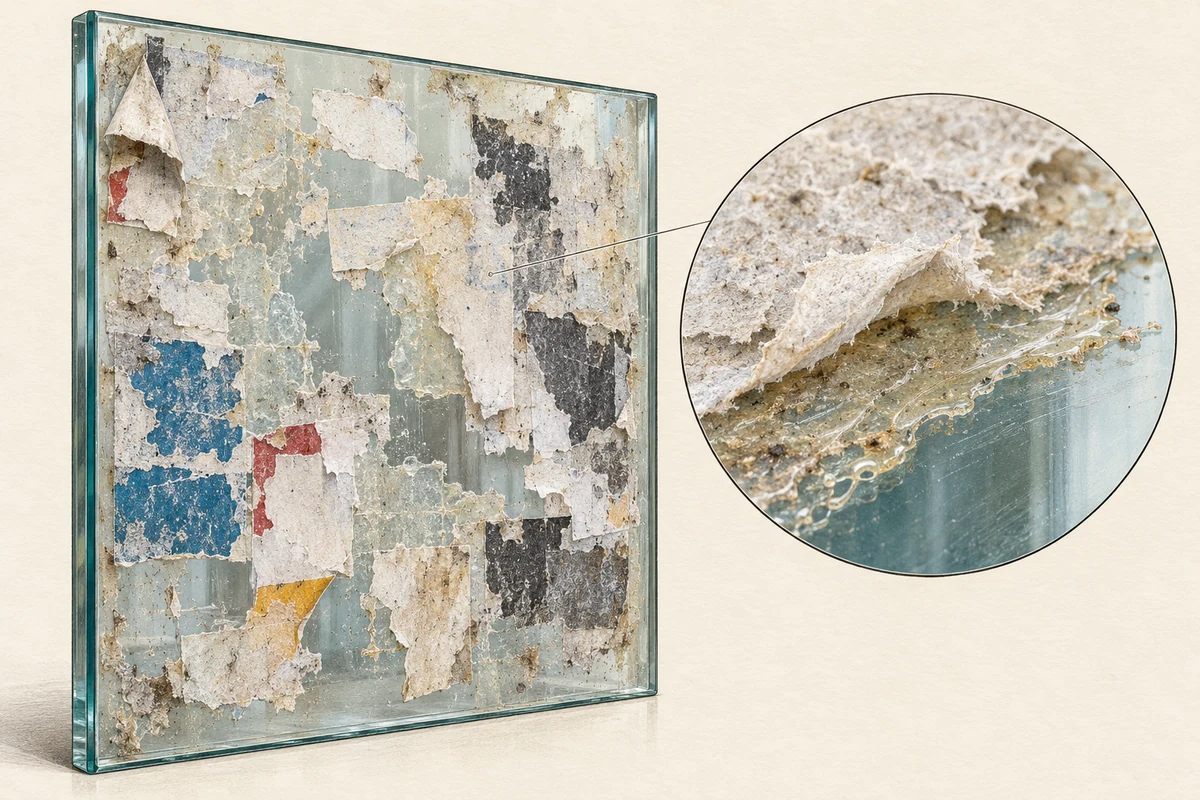
Sticker/poster adhesive campaigns are appearance changes from affixed labels, posters, and vinyls applied to glass, leaving adhesive films, paper fiber ghosts, and outline “shadows.” Multi-layer campaigns may build heterogeneous films with edge dirt rims. The materials are exogenous; absent abrasive attempts, the substrate remains unaltered. Classification is appearance-only per VIS (method-agnostic).
Classification & Scope (Normative)
NormativeSticker/poster adhesive campaigns are appearance changes from affixed labels, posters, and vinyls applied to glass, leaving adhesive films, paper fiber ghosts, and outline “shadows.” Multi-layer campaigns may build heterogeneous films with edge dirt rims. The materials are exogenous; absent abrasive attempts, the substrate remains unaltered. Classification is appearance-only per VIS (method-agnostic). Inspect after Non-Invasive Reveal under VIS lighting/geometry; record surface numbering and worked-surface status.
Typical Presentation (Informative)
Informative- Rectangular/silhouette outlines matching posters/decals; paper fiber remnants and adhesive smear within boundaries.
- Grid-print ghosts from release-liner pattern; number/letter halos from die-cut vinyl.
- Edge dirt rims and finger pull tabs at corners; layered campaigns produce patchwork density.
Field Identification Cues (Normative)
NormativeSurface-catch class (MSRT)
- SC-0 for film-on-top adhesive and paper fibers.
- SC-1 localized only where prior scraping or entrained grit produced very shallow micro-texture; SC-2 indicates misclassification-consider M.01.01 scraper scoring or M.02 abrasion fields if grooves/swirl remain.
- Perform one light, non-marring pass on a small revealed test patch (substrate). Use polymer stylus if a functional coating is suspected. MSRT supports classification only.
Visual signature
- Translucent/tacky film with lint/paper fibers; matte haze in adhesive-rich zones; clean glass islands where stickers didn’t cover.
- No chip-flank sparkle, no granular frost, no fused pits.
Viewing / lighting
- Evaluate clean & dry at 12 / 36 / 72 in, normal and oblique sweep (~60°-120°); raking shows adhesive smear flow, fiber orientation, edge rims. Record distances/angles in-frame.
Location / access
- Record pane ID and surface numbering (#1-#4; laminate-internal). Common on public-facing exposed faces (#1/#4), transit/storefront zones. Between-pane by parallax on #2/#3 (rare historic trapping) → CAT-5 by location.
Mechanism cue (context)
- Campaign layering (multiple outlines), retail/venue postings, permit decals, event stickers; co-evidence: torn paper, tape residues, plasticizer bleed from vinyl.
Severity & CAT Mapping (Normative)
NormativeAssign CAT by visibility at acceptance geometry and MSRT after a true residue-lift test on a contained patch (without abrading substrate). Depth values are indicative-field measurement not required.
- CAT-1 (Benign / non-relief): Thin adhesive film/fiber ghosts legible mainly at angle/raking; SC-0; lifts clean on test patch leaving no shadow. Indicative relief: 0-10 μm (optical film only).
- CAT-2 (Light): Heavier, aged adhesive with paper fiber loading and edge dirt rims; SC-0 with localized SC-1 where prior scraping/grit affected substrate; limited standard-view impact. Indicative relief: ~10-40 μm (film stack).
- CAT-3 (Moderate): Large multi-layer campaign fields readily visible at standard distance as matte veils/patchwork; substrate generally SC-0 after proper lift; note SC-1 localized if prior abrasive attempts present. Indicative relief: ~40-120 μm (film stack).
- Reclassify when: After true residue lift, if linear grooves with chip-flank sparkle remain → M.01.01 scraper scoring; if modeled matte/swirl remains → M.02 abrasion fields; if oily transparent film without fibers dominates → R.04.03 HVAC oil / R.04.04 kitchen grease; if plasticizer haze with wetting halo dominates near PVC → R.05.02 plasticizer smear.
- CAT-5 (by condition/location): Between-pane/inaccessible by parallax, integrity indicators, or confirmed functional-coating loss on the surface to be worked → CAT-5.
CAT is appearance-based; acceptance is separate under VIS-A at 12/36/72 in. Do not abrade to “force” a response during classification.
Differentiation & Mis-ID Pitfalls (Informative)
Informative- vs. Paint/marker coatings (V.03.01): Paint shows color opacity, overspray, drips; sticker campaigns show clear/whitish adhesive film, paper fibers, silhouette outlines.
- vs. Acid/cream etch (V.02): Etch presents whitened substrate micro-texture (SC-2) with swirls/runs; adhesive residue is film-on-top (SC-0) and lifts with proper reveal.
- vs. Surfactant/detergent film (R.04.01): Surfactant films show iridescent wipe trails; adhesive shows tacky, fiber-loaded mats, silhouette edges.
- vs. Plasticizer migration (R.05.02): Plasticizer films are oily/clear, align with PVC contact zones; sticker campaigns produce rectilinear poster shapes, paper fiber ghosts.
Evidence Package *(Documentation Requirements) (Normative)
Normative- Photo set (VIS): 12 / 36 / 72 in, normal + oblique; raking macros of fiber-laden zones, edge dirt rims, silhouette corners, liner grid ghosts; overviews showing extent and multi-layer history. Record distance/angle in-frame.
- MSRT result (substrate): After a small true residue-lift test patch (no abrasion), perform one light, non-marring pass on substrate and adjacent control; record SC-class (SC-0 substrate, SC-0 control; SC-1 localized only if prior abrasion evident).
- Forms: Pane ID; product family & surface numbering; worked surface Y/N; functional coating present on worked surface? (Y/N/Unknown); reveal status; lighting/time; geometry checklist; photos attached.
- Acceptance split: Post-restoration acceptance per VIS-A §6; classification ≠ acceptance. Coated-face appearance rules apply per VIS §6.2.e when the worked surface is a factory functional coating.
Reporting Language (Template)
Template- V.03.02 Sticker / Poster Adhesive Campaigns - Rectilinear silhouettes with adhesive film and paper fiber ghosts on surface #___; true residue-lift test patch confirms SC-0 substrate (SC-1 localized only where prior scraping evident); visible at [12/36/72 in] under VIS geometry. Morphology: tacky translucent film, fiber matting, edge dirt rims, liner grid ghosts, no chip-flank sparkle, no granular frost. Classification: CAT-[1/2/3] by visibility and film mass; reclassify per notes if substrate etch/abrasion signatures persist; CAT-5 if between-pane or coating-side loss on the surface to be worked. Forms + photo set attached; acceptance per VIS-A §6.
⭐ DSS-U
Damage Specification Standards 2026
DSS-U Unknown/Mixed Mechanisms
Draft v1.0
U.01 Mixed & Undetermined
- U.01.01 Mixed chemical-mechanical field (etch + track)
- U.01.02 Modeled micro‐texture with embedded particulates (uncertain chemistry)
- U.01.03 Halo without central feature (unknown chemistry)
- U.01.04 Directional patterning with intermittent chip flanks (uncertain tool)
- U.01.05 Non‐directional milky field, low contrast (undetermined)
Related glossary terms
- Adhesive residueGRK-061
- AbrasiveGRK-168
- Test patchGRK-144
- AbrasionGRK-035
Source and version
GlassRenu Damage Specification Sheets (DSS), DSS-V.03.02. Source revision and extraction date are recorded in the deployment manifest.
Open the complete published DSS with table of contents (PDF)
Normative and informative labels are preserved from the source. The downloadable one-sheet is a condensed classification aid; this web page retains the complete source-based specification content.